Paper 3 - Limitations and workable improvements
Learn to identify the measurement that most limits an investigation, explain its physical cause and propose a modification that would actually help. You will turn vague claims about “human error” into specific, testable improvements.
The measurement that limits the result
Why can repeating an experiment many times leave its result just as wrong? Repeats can reduce the effect of random scatter, but a ruler held at the wrong reference point or a temperature that drifts throughout the run can bias every repeat in the same direction.
A limitation is a feature of the apparatus or procedure that restricts the reliability, accuracy or scope of a conclusion. Describe the quantity affected and the physical reason. “Human error” names a person, rather than explaining a measurement. “The lower edge of the oscillating mass is hard to locate against the ruler because it moves during the reading” identifies something you can improve.
Distinguish a random effect from a systematic one. Variable judgement of an edge can cause scatter. Measuring a length to the bottom of a spherical bob when the model requires its centre introduces a consistent offset. Recording more values does not remove the offset. Check the measurement's definition before blaming the instrument.
The most visually noticeable problem is not always the most important one. Compare fractional contributions to the final result. A large absolute uncertainty in a long timing interval may matter less than a small uncertainty in a tiny extension.
Worked example 1: finding the dominant contribution
Question. An experiment uses the supplied relation . It measures and . Use simple percentage-uncertainty addition to identify which measurement most limits .
Plan. Compare the percentage contributions, remembering the square on time.
Answer. The extension contributes 5.0%, compared with 1.0% from time, so extension is the dominant measurement limitation. The simple total estimate is 6.0%.
Check. Improving the stopwatch alone cannot remove the larger extension contribution. The coefficients in the relation, not just the raw uncertainties, decide what matters.
A narrow range is another limitation: the change in the response can be comparable to its reading uncertainty. Two readings can suggest a proportionality but cannot reveal curvature convincingly. Repeating exactly the same two settings and collecting more independent settings address different weaknesses.
Watch out
“Use a more accurate instrument” is incomplete. Name the quantity, explain what makes its present reading uncertain, and say which feature of the replacement reduces that uncertainty.
Look for a limitation you can tie to the apparatus.
Improvements that address a cause
An improvement is a change to the apparatus or procedure that attacks an identified limitation. Explain the mechanism: what becomes easier to locate, more stable, larger or less dependent on judgement?
For a spring read against a ruler, clamp the ruler close to and parallel with the motion, and attach a thin horizontal pointer to the moving end. Read the pointer square-on. This defines the endpoint and reduces parallax. It does not merely ask the observer to “be more careful”. If a bob's centre is needed, measure to its top and bottom and average, or measure its diameter with calipers and add the radius to a length ending at its top.
[DIAGRAM: asset_name: Removing parallax; asset_slug: p3-parallax-improvement; caption: A nearby scale and a square-on sight line reduce ambiguity in locating a pointer; description: A side view places a pointer above a horizontal ruler. A vertical sight line through the pointer meets the true ruler position. An oblique sight line through the same pointer meets a different ruler position. Labels identify the square-on view, oblique view, pointer and apparent reading; a note recommends bringing the ruler close to the pointer.]
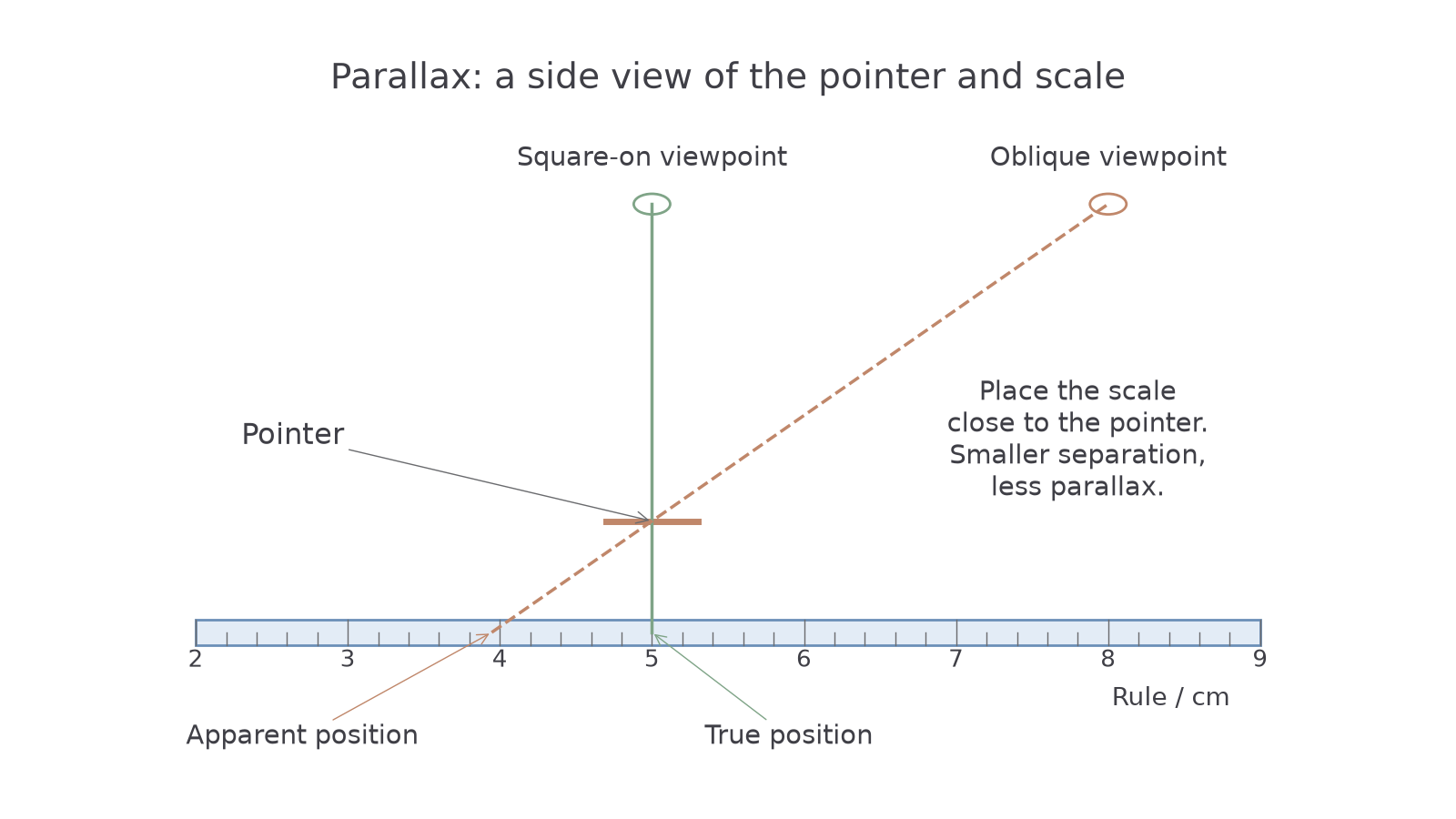
For an oscillation timed by eye, time more complete oscillations and repeat the measurement. A fixed reference marker makes the start and end positions repeatable. If manual timing remains limiting, an appropriate light gate, sensor or video method can reduce reaction-time dependence, provided its triggering point and timing method are explained. “Use a computer” is not a measurement method.
For a wire diameter, take micrometer readings at several positions and orientations, checking zero first. Variation along or around the wire is information about the wire, rather than simply a reason to average without thought. For a warming resistance wire, reduce the current and switch off between readings if the investigation requires constant temperature. For a cooling liquid, use insulation or a lid when reducing unwanted energy transfer is relevant to the measured quantity, and stir to reduce temperature gradients.
| Limitation | Specific modification | Why it helps |
|---|---|---|
| Stand moves under load | Secure its base or clamp it to the bench | Keeps the reference geometry stable. |
| Large period judgement variation | Time many cycles past a fixed marker | Reduces the relative influence of start/stop judgement. |
| Temperature changes during electrical readings | Lower current and switch off between readings | Reduces heating that changes the component's properties. |
| Only two settings test a relationship | Use several additional, well-spaced settings and plot the appropriate graph | Reveals the trend, scatter and possible curvature. |
Paper 3 evaluation distinguishes a modification from simply carrying out the existing instructions properly. If the task already instructs you to repeat and average, “repeat and average” is not an additional improvement. A suggestion must also remain feasible in a school laboratory and preserve the investigation rather than replace it with an unrelated experiment.
Workable methods and safe extensions
A proposed modification earns its place only if someone could carry it out and use its results. Name the apparatus, describe where it goes, state what is measured and explain how the measurements answer the investigation's question. A clear labelled diagram is useful when words leave the geometry uncertain.
Check that the instrument measures the intended quantity with a suitable range and resolution. A light gate detects an interruption of its beam; to measure speed using an interrupting card, its width and transit time must be known. A video method needs a visible length scale in the same plane as the motion and known frame times. A camera alone does not supply metres or seconds.
The same skills transfer to an unfamiliar apparatus when the relationship is supplied. Identify the independent variable, dependent variable and controls. Choose a useful range, repeat where variation matters, then analyse the appropriate graph or constant. You do not need to pretend you already know the theory of every device.
Practical: a safe extension to a spring investigation
An initial investigation tests how extension varies with load at room temperature. To investigate whether temperature changes the relationship, repeat the load-extension measurements at several controlled temperatures, allowing the spring to reach a stable temperature each time. Use the same spring, reference length definition and permitted load range. Measure temperature near the spring rather than assuming the room setting is its temperature.
Keep loads within the spring's safe working range; secure the support and keep the area below the hanger clear. If warming is used, choose controlled low-temperature equipment and avoid touching hot metal. Compare the graph gradients at the different temperatures rather than comparing one extension at a different load.
The extension is a new question built on the original method. It needs a new control strategy; it is not established merely by repeating the original room-temperature measurements.
State a hazard and a matched precaution. “Be careful” tells the experimenter nothing about what might happen. “Keep feet out from under the mass hanger and use a tray to catch falling masses” identifies a risk and reduces its consequence. In electrical work, use suitably rated low-voltage apparatus and avoid exposed connections becoming hot. In thermal work, contain hot water securely and protect against burns and spills.
The opening problem is now practical: repeats can shrink scatter while leaving a bias untouched. A useful improvement changes the cause of that bias, rather than multiplying the number of biased readings.
Quick Recap
- Identify the quantity that is uncertain and the physical cause; avoid vague “human error”.
- Compare fractional contributions to find the measurement that most limits the result.
- Match an apparatus or procedure change to the cause, explaining why it helps.
- Keep modifications workable, preserve the investigation and match safety precautions to actual hazards.
Repeating an experiment can leave it wrong because a systematic bias persists; a useful improvement changes the measurement's cause of error, not just its repetition count.