1.4 - Adding and subtracting vectors
Distinguish scalar quantities from vectors and combine coplanar vectors using diagrams and triangle geometry. Find a resultant's magnitude and direction, and interpret subtraction as the change from one vector to another.
Scalars, vectors and direction
Can you walk and finish with zero displacement? Walk once around a closed track and you have done exactly that. The distance records the journey's length; the displacement records the change in position.
A scalar has magnitude without an associated direction. Distance, speed, mass, time, energy and power are scalar quantities. A vector has both magnitude and direction. Displacement, velocity, acceleration, force and momentum are vectors. You will study each in its physical setting as the course develops.
Scalar and vector quantities
A scalar quantity has magnitude only. A vector quantity has magnitude and direction and combines according to vector addition.
Giving a speed of says how fast something moves. Giving a velocity of due north also says which way. Two objects can have equal speeds and different velocities. Direction is part of the physical information, rather than an optional label.
Represent a vector by an arrow. Its length, on a chosen scale, represents magnitude; its arrowhead represents direction. In equations, bold symbols such as distinguish a vector from its magnitude . Equal vectors have equal magnitudes and directions. For the addition of displacement vectors, you may move the arrows on the page without changing their lengths or directions.
A negative sign reverses a vector: has the same magnitude as but the opposite direction. It does not make the magnitude negative. Scalars can also have signed values in some contexts; a negative Celsius temperature does not turn temperature into a vector.
Watch out
A direction of motion does not automatically tell you the direction of acceleration or force. Those are separate vectors. Later, a turning object will show you how a constant speed can accompany a changing velocity.
The distinction matters before any calculation.
Adding coplanar vectors
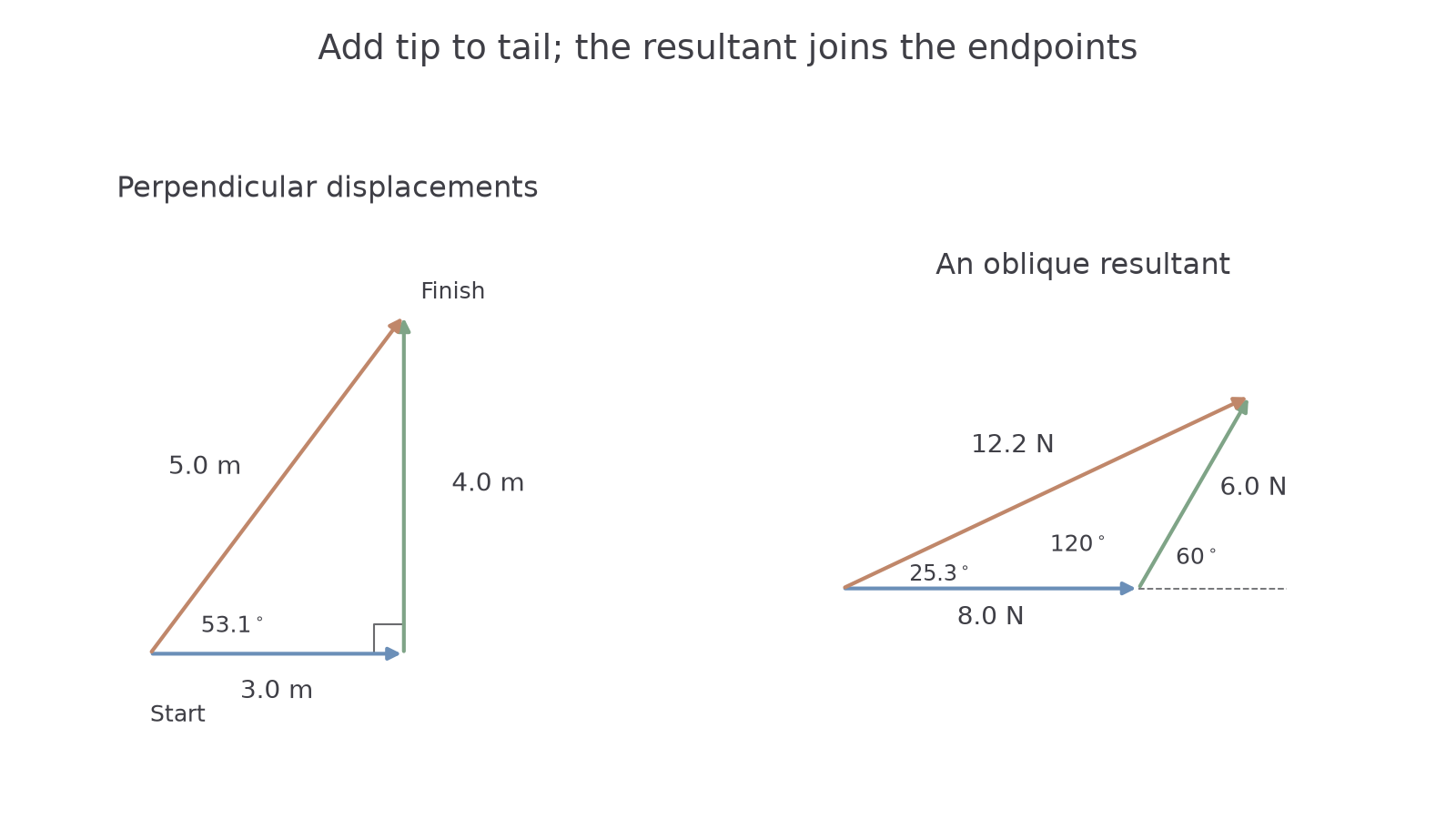
A resultant is the single vector with the same combined effect as the vectors being added. For two successive displacements, it points directly from the initial position to the final position, regardless of the route between them.
To add and , put the tail of at the head of . Draw the resultant from the first tail to the final head. This is the tip-to-tail method. The vectors must represent the same kind of quantity: adding a force to a velocity has no meaning.
Worked example 1: perpendicular displacements
Question. You move east, then north. Determine the resultant displacement.
Plan. Draw the two displacements tip to tail. Use Pythagoras for the magnitude and trigonometry for direction.
Answer. at north of east.
Check. The displacement is less than the distance travelled. Its angle is closer to north than east because the northward displacement is larger.
For a scale drawing, choose a scale such as 1 cm for 1 m, preserve the angles and measure the resultant. Accurate calculation is preferable when sufficient numerical information is supplied. The parallelogram method gives the same result: put both tails together and draw their resultant along the diagonal from that common tail. In the force examples here, the forces act on the same object and we calculate their combined translational effect. Turning effects need the points where the forces act as well; you will study those separately.
[DIAGRAM: asset_name: Tip-to-tail addition; asset_slug: coplanar-vector-addition; caption: The resultant joins the starting point to the final tip; description: Two coordinate diagrams show a blue vector followed by a sage vector, with a clay resultant from first tail to final head. The left uses 3 metres east then 4 metres north, giving 5 metres at 53 degrees north of east. The right uses 8 newtons east then 6 newtons at 60 degrees north of east, showing the 120-degree interior triangle angle and a resultant of 12.2 newtons at 25.3 degrees north of east.]
When the vectors are not perpendicular, Pythagoras alone is insufficient. Use the cosine and sine rules for a general triangle.
Triangle rules for vector addition
For a triangle with sides opposite angles ,
Side lengths use the same unit; angles may be in degrees or radians with the calculator in the matching mode. The angles of a triangle add to . If two vectors have magnitudes and angle between their directions when their tails coincide, their resultant magnitude satisfies
The plus sign occurs because the interior tip-to-tail angle is , whose cosine is .
Not on the data sheet: learn it.
A drawing prevents you confusing the angle between directions with the interior angle.
Exam-style example: an oblique resultant
Question. Two forces have magnitudes and . The first acts east and the second at north of east. Determine their resultant.
Plan. The directions differ by , so the tip-to-tail triangle has interior angle . Use the cosine rule for the resultant, then the sine rule for its angle north of east.
Answer. Approximately at north of east.
Check. The magnitude lies between and their scalar sum ; the direction lies between the two forces. The triangle sketch selects the small angle here, rather than the supplementary angle that has the same sine.
For parallel vectors in the same direction, add magnitudes. For opposite directions, subtract magnitudes and keep the direction of the larger vector. These are limiting cases of the same vector rule. As the angle between vectors changes from to , the resultant changes from to .
Subtracting vectors and finding a change
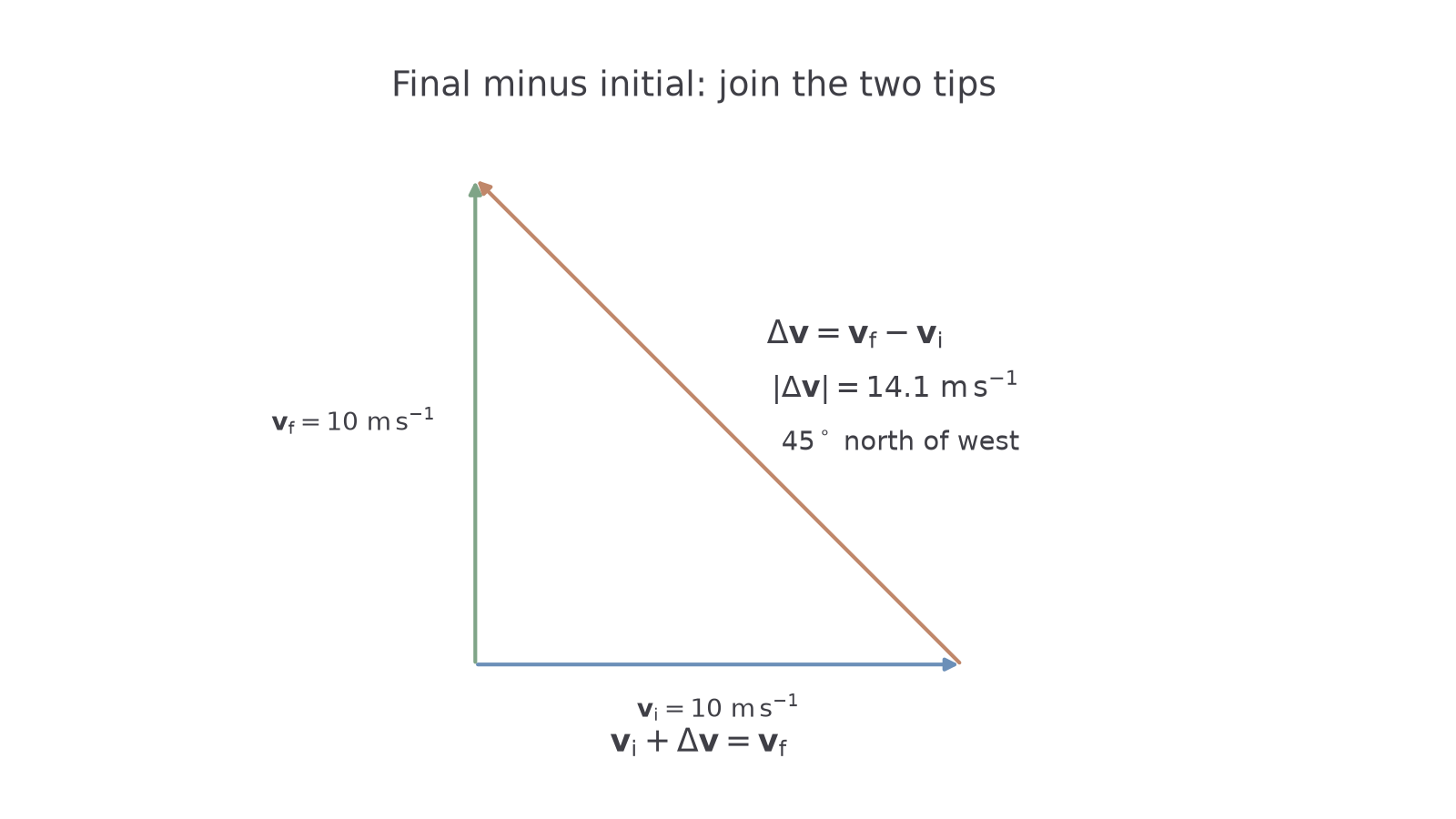
A vector change compares a final vector with an initial vector. To subtract the initial vector, reverse it and add it: . Here the two velocities and their difference all have unit . This vector-change rule is not on the data sheet: learn it.
If both original vectors start at the same point on a diagram, their difference runs from the tip of the initial vector to the tip of the final vector. That arrow tells you what must be added to the initial vector to obtain the final one.
Worked example 2: slowing along one line
Question. A cart's velocity changes from east to east. Find the change in velocity.
Plan. Choose east as positive, then subtract initial from final.
Answer. west.
Check. Adding this westward change to the initial eastward velocity leaves the smaller eastward final velocity. The cart need not be travelling west for its velocity change to point west.
The most revealing case is a turn at unchanged speed.
Worked example 3: equal speed, different velocity
Question. A cyclist turns from east to north. Determine the change in velocity.
Plan. Add the final northward velocity to the negative of the initial velocity, which points west.
Answer. About at north of west.
Check. The speed change is zero, but the velocity change is not. The direction changed, so the two vectors are unequal.
[DIAGRAM: asset_name: The arrow for a velocity change; asset_slug: velocity-vector-subtraction; caption: Final minus initial points from the initial tip to the final tip; description: Initial velocity is a blue eastward arrow of 10 metres per second and final velocity a sage northward arrow of the same length, both with a common tail. A clay arrow joins the initial tip to the final tip, pointing north-west and labelled change in velocity, magnitude 14.1 metres per second. A small equation states initial velocity plus change equals final velocity.]
This way of thinking will be essential for acceleration and circular motion. A scalar difference of speeds cannot replace a vector difference of velocities.
Watch out
For , reverse , not . Reversing both the order and the arrow changes the sign of the answer. Always check that .
Use a fresh turn to test the direction.
Quick Recap
- Scalars have magnitude; vectors also carry direction and follow vector addition.
- Add coplanar vectors tip to tail and draw the resultant from the first tail to the final head.
- Use suitable triangle geometry, including sine and cosine rules, to determine magnitude and direction.
- Subtract a vector by reversing it; final minus initial points from the initial tip to the final tip.
You can walk with zero displacement because a closed route ends at its starting position, even though the distance travelled is not zero.