11.2 - Quarks, hadrons and leptons
Use the six quark flavours and their charges to describe protons, neutrons, baryons and mesons. Distinguish hadrons from fundamental leptons, and explain beta decay as a change in quark flavour with the appropriate emitted lepton and antilepton.
Six quark flavours and their antiquarks
A neutron has zero electric charge: does that mean it contains no charged constituents? Surprisingly, its quarks are charged. Their fractional charges add to zero, so neutrality of the whole object does not imply neutrality of every constituent.
A quark is a fundamental particle: in this model it is not made from smaller constituent particles. Quarks come in six types, called flavours. You need their names and charges, rather than their masses or other properties.
| Quark flavour | Symbol | Charge in units of |
|---|---|---|
| up | ||
| down | ||
| strange | ||
| charm | ||
| top | ||
| bottom |
Remember two charge groups: up, charm and top have charge ; down, strange and bottom have charge . The positive elementary charge is , supplied on the data sheet. The fractional charge assignments themselves must be learnt.
Each quark has a corresponding antiquark with the same mass and opposite charge. A bar over the symbol identifies it: is an anti-up quark, and an anti-strange quark. Thus has charge , while has charge . “Anti” changes the charge sign, rather than changing a two-thirds magnitude into one third.
Worked example 1: an antiquark charge in coulombs
Question. Determine the charge of an anti-charm quark in coulombs, using .
Plan. Charm has charge , so reverse its sign before converting.
Check. The magnitude is smaller than , and the sign is opposite to a charm quark's positive charge.
An anti-strange quark has charge . This makes a useful check that “antiquark” does not always mean a negatively charged particle: its sign depends on the corresponding quark.
Watch out
The italic symbol for an up quark and the upright unit for atomic mass are different things. Likewise, a bar is an antiparticle label, rather than a negative sign on the particle's name or mass.
Identify the antiquark's charge from the correct flavour group.
Baryons and mesons have quark constituents
A proton or neutron is not fundamental: it has quark constituents. Particles containing quark constituents are called hadrons. The two hadron families studied here are baryons and mesons.
Baryon and meson
A baryon consists of three quarks. A meson consists of one quark and one antiquark.
A proton consists of two up quarks and one down quark, . A neutron consists of one up quark and two down quarks, . Both are baryons. Their charges follow by addition:
The neutron's zero charge is therefore a cancellation of charged constituents. It is not three neutral quarks, nor an electron hidden inside a proton.
[DIAGRAM: asset_name: Quark composition and total charge; asset_slug: quark-composition-charges; caption: Adding constituent charges distinguishes protons, neutrons and example mesons; description: Four labelled composition panels show a proton with up up down and charge plus e, a neutron with up down down and charge zero, a meson with up and anti-down and charge plus e, and a meson with down and anti-strange and charge zero. The symbols are count markers, not measured particle positions or shapes.]
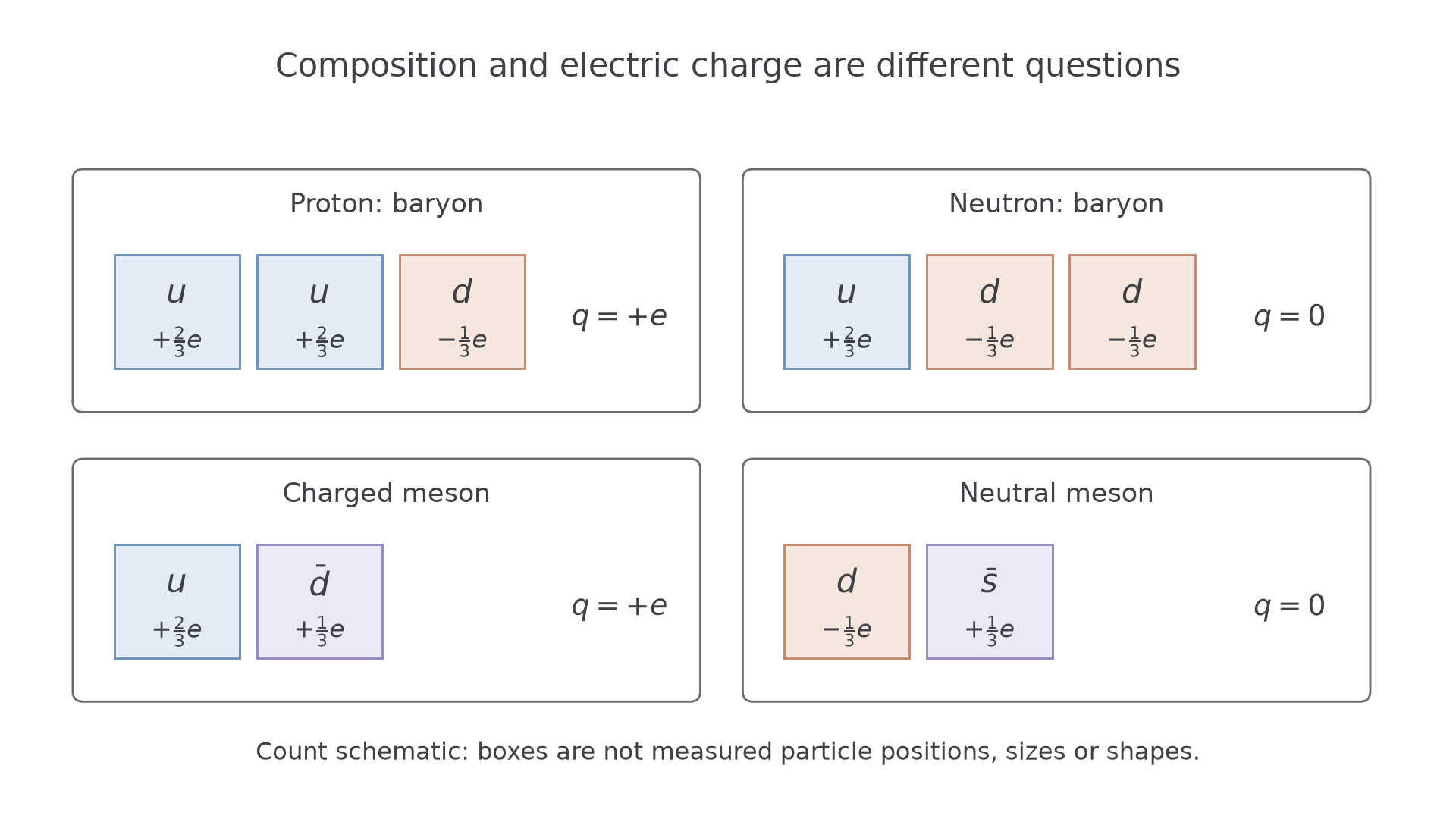
For a meson, the quark and antiquark need not have the same flavour. A combination has charge
A combination has charge , even though down and anti-strange are not each other's antiparticles. A neutral meson is therefore not automatically a same-flavour quark–antiquark pair.
Exam-style example: using composition rather than charge alone
Question. Particle P has composition . Particle Q has composition . State the hadron family and charge of each.
P contains three quarks, so it is a baryon; its charge is . Q contains one quark and one antiquark, so it is a meson; its charge is .
Answer. P is a positively charged baryon. Q is a positively charged meson.
Check. Equal total charge does not imply the same particle or family. Count the constituents first, then add their charges.
Continue this lesson.
You’re previewing NovaLearn without an account. Create a free account to read the rest.
Create free account