4.3 - Density and pressure in fluids
Calculate density from mass and geometry, relate pressure to the normal force on an area, and derive the pressure difference between two depths in a fluid. Use the vertical depth and distinguish extra pressure due to a liquid from the total pressure.
Mass per unit volume
Would a narrow tube of water give less pressure at its bottom than a wide tank of water at the same depth? The tank contains much more water, but that alone does not settle the question. First distinguish how much material there is from how closely its mass is packed.
Density compares mass with volume. Two objects made of the same homogeneous material at the same temperature have the same density even when their masses and volumes differ.
Density
Density is mass per unit volume.
If of a material has mass , each cubic metre would have mass for the same homogeneous material. That is the meaning of the density, rather than a claim that the particular sample contains a cubic metre.
Density
Here is density in , is mass in , and is volume in . Use the volume of the material whose density you want. A whole object's average density can include its internal empty space; its material density does not.
Not on the data sheet: learn it.
Geometry gives the volume
Convert lengths before squaring or cubing. Use the radius, half the diameter, in circle, cylinder and sphere formulae. For the following shapes, all lengths are in ; area and surface area are in , perimeter or circumference in , and volume in .
| Plane shape | Area | Perimeter or circumference |
|---|---|---|
| Rectangle, sides | ||
| Circle, radius | ||
| Right-angled triangle, perpendicular sides , hypotenuse | , with | |
| Isosceles triangle, base , height , equal sides | , with |
A triangular cross-section of area extended uniformly through length has volume , just as a cylinder has its circular cross-section multiplied by length.
| Solid | Volume | Total surface area |
|---|---|---|
| Cuboid, sides | ||
| Closed cylinder, radius , length | ||
| Sphere, radius |
These geometry relations are not on the data sheet: learn them. The cylinder's total surface area includes both circular ends; an open tube needs the appropriate surfaces instead. A hollow shape's material volume is the outer volume minus the empty inner volume.
Worked example 1: density of a rectangular sample
Question. A solid sample has mass and dimensions , and . Calculate its density.
Answer. .
Check. The volume is , not . The mass of one cubic metre is much larger than that of this small sample.
A sphere illustrates why surface area and volume must not be confused: doubling its radius multiplies its surface area by four but its volume, and hence its mass at fixed density, by eight. This is a consequence of the powers of radius in the geometry, not a change in the material.
Exam-style example: density from a diameter
Question. A solid sphere of diameter has mass . Calculate its density.
Plan. Halve the diameter, calculate the sphere's volume, then use mass per unit volume.
Check. Using diameter as radius would make the volume eight times too large and the density eight times too small.
For an irregular solid that does not dissolve or absorb water, immerse it fully and measure the increase in water volume in a measuring cylinder. Avoid trapped bubbles. Determine its mass separately with a balance. A small volume change has a large fractional uncertainty, so a suitably sized cylinder helps more than writing extra decimal places.
Normal force per unit area
The same force can have a very different effect when concentrated onto a small area. That is why a sharp point can penetrate a surface with a modest force, while spreading the force across a broad contact area reduces the pressure.
Pressure
Pressure is the normal force acting per unit area.
“Normal” means perpendicular to the surface. For a force perpendicular to a flat surface, pressure compares that force with the area over which it acts.
Pressure
Here is pressure in pascals, , is the normal force in , and is the area in . One pascal is one newton per square metre. For varying pressure this relation gives the average pressure over the stated area.
Not on the data sheet: learn it.
A fluid at rest exerts pressure normal to any surface in contact with it. Pressure at a point is a scalar; the associated force has a direction set by the surface. Fluid pressure is not a downward force simply because the fluid has weight.
Worked example 2: spreading a load
Question. A normal force of acts uniformly over an area of . Calculate the pressure.
Answer. About .
Check. Doubling the contact area with the same force would halve this pressure.
An area in square centimetres needs a squared conversion: . Confusing a length conversion with an area conversion is a common source of powers-of-ten errors here.
Exam-style example: force on a circular piston
Question. Fluid exerts a uniform pressure of on one circular face of diameter . Calculate the force on that face.
Answer. .
Check. This is the force from the fluid on that face, rather than necessarily the resultant on the whole piston. Pressure on its other face may exert an opposing force.
Use the actual loaded area, rather than the surface area of the whole object.
Pressure increases with vertical depth
A horizontal layer of fluid at rest must support the weight of the fluid above it. That creates a pressure increase with depth. Compare two levels within a fluid of uniform density, separated by a vertical distance .
Imagine a vertical cylinder of this fluid with cross-sectional area . Let its top and bottom pressures be and . The fluid around it exerts an upward force on its bottom and a downward force on its top. Its weight is , so equilibrium gives
The area cancels. This is why a narrow water tube and a wide water tank can have the same pressure at equal depth, even though their total water weights are very different.
[DIAGRAM: asset_name: Pressure difference in a stationary fluid; asset_slug: hydrostatic-cylinder; caption: The pressure force from below supports both the force from above and the cylinder's weight; description: A vertical imaginary cylinder inside a body of liquid has area A and height delta h. Downward top force p1 A and weight rho A delta h g act on it, while a larger upward bottom force p2 A balances their sum. Top and bottom levels are labelled p1 and p2.]
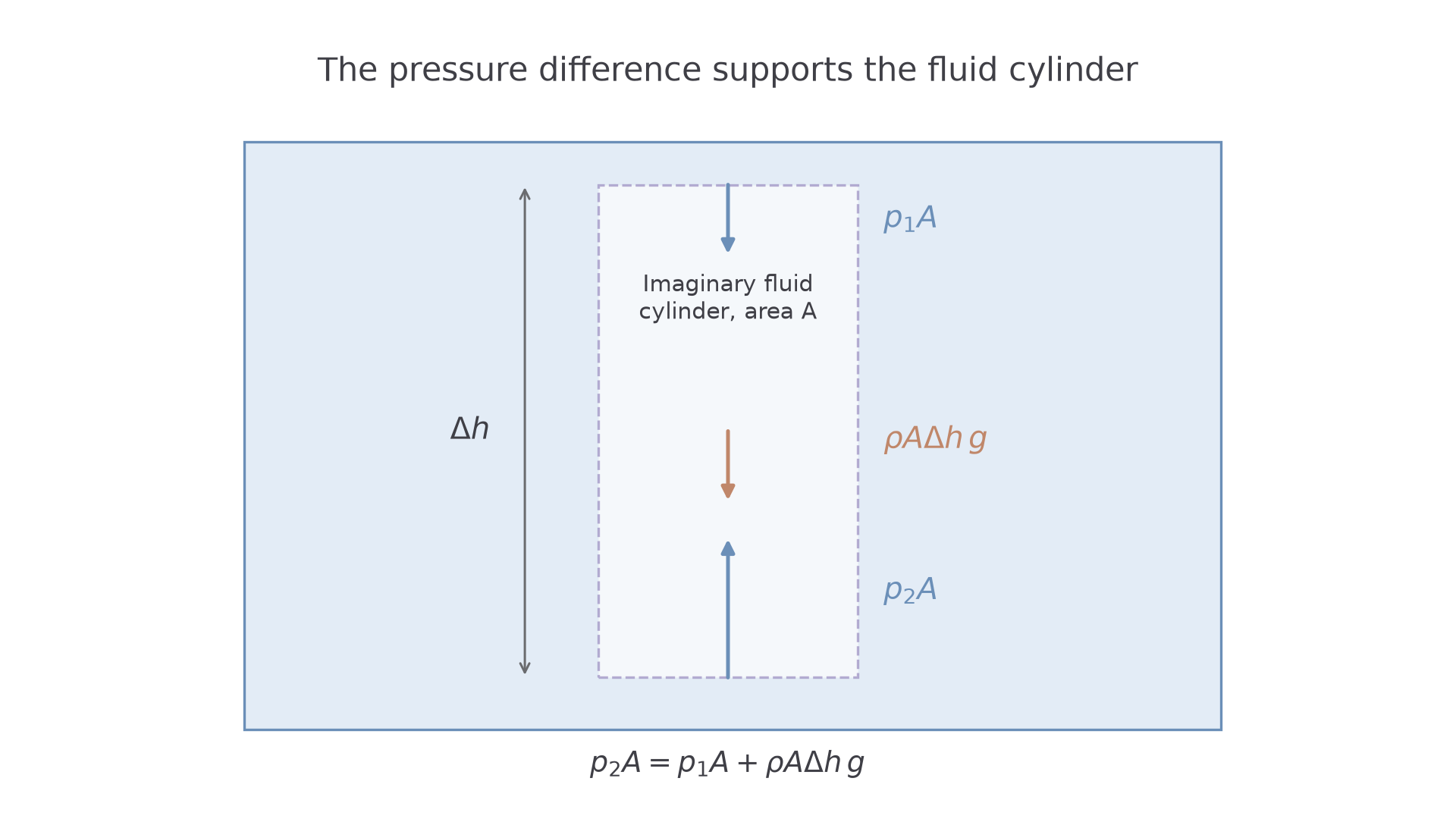
Hydrostatic pressure difference
Here is the pressure increase in on going down through vertical depth in , is the fluid density in , and is gravitational field strength in . The fluid is at rest, with approximately uniform density and . The simple form needs modification if density changes appreciably over the depth.
On the data sheet.
Pressure at a point below an open liquid surface is the pressure at the surface plus the extra hydrostatic pressure. With surface pressure , the total is , where is the vertical depth. This is the supplied pressure-difference relation applied between the surface and the point.
Worked example 3: extra pressure and total pressure
Question. A point is below a water surface. The density is , , and surface pressure is . Calculate the extra pressure due to the water and the total pressure.
Check. The extra pressure is only about ; it is not the whole atmospheric-plus-water pressure.
A pressure-depth graph for a uniform liquid is a straight line with gradient . If its vertical axis shows total pressure, its intercept at the surface is ; if it shows extra pressure above the surface value, its intercept is zero. For example, a pressure increase of through gives . The slope, rather than the total pressure at one point, identifies density.
Watch out
Use the fluid's density and the vertical depth difference. The length of a sloping tube, the container's width and the density of an immersed object are not substitutes for those quantities.
Test the pressure difference without adding an unnecessary surface pressure.
Quick Recap
- Density is mass per unit volume; use the correct geometric volume and convert lengths before taking powers.
- Pressure is normal force per unit area, with one pascal equal to one newton per square metre.
- A stationary uniform fluid has pressure difference equal to density times gravitational field strength times vertical depth difference.
- Add the surface pressure when total pressure is required; pressure differences do not need that addition.
A narrow tube and a wide tank of the same stationary liquid have equal pressure at the same depth below surfaces at the same pressure: container width cancels from the force balance.