13.1–13.3 - Gravitational forces and fields
Use the gravitational field model to describe forces on test masses, apply Newton's inverse-square law, and derive field strength outside a spherical mass. Read field directions and graphs, and explain why a small region near a planet's surface can be treated as approximately uniform.
A field maps force per unit mass
Does a planet's gravitational field disappear when no satellite happens to be there? No. The field describes what force a small test mass would experience at each position; the test mass helps define or measure it, rather than switching it on.
A mass is the source of a gravitational field. The field is a model mapping the gravitational force per unit mass through space. It is not material emitted by the source. At a particular point, a larger test mass experiences a proportionally larger force, while the force per unit mass is unchanged.
Gravitational field strength
Gravitational field strength at a point is the gravitational force per unit mass on a small test mass placed at that point.
The field is a vector: its direction is the direction of force on a test mass. Gravitational forces are attractive, so the field around an isolated spherical planet points towards its centre.
Force per unit mass
Here is field-strength magnitude in , is gravitational force in , and is test mass in . The force and field vectors have the same direction. The test mass is small enough not to significantly alter the source arrangement.
Not on the data sheet: learn it.
The unit is equivalent to , since a newton is . Thus field strength is also the acceleration of a freely falling test mass when gravity is its only force. A supported object can experience a gravitational force without accelerating because another force balances it.
[DIAGRAM: asset_name: Gravitational field lines are a map; asset_slug: gravitational-field-map; caption: Inward radial lines map the exterior field; a small surface region can be approximated by parallel lines; description: The left panel shows a spherical mass with twelve non-crossing radial lines outside it and arrows pointing inward. The right panel enlarges a small near-surface patch and shows approximately parallel evenly spaced downward arrows. Labels state that lines represent field direction and relative strength, not emitted material.]
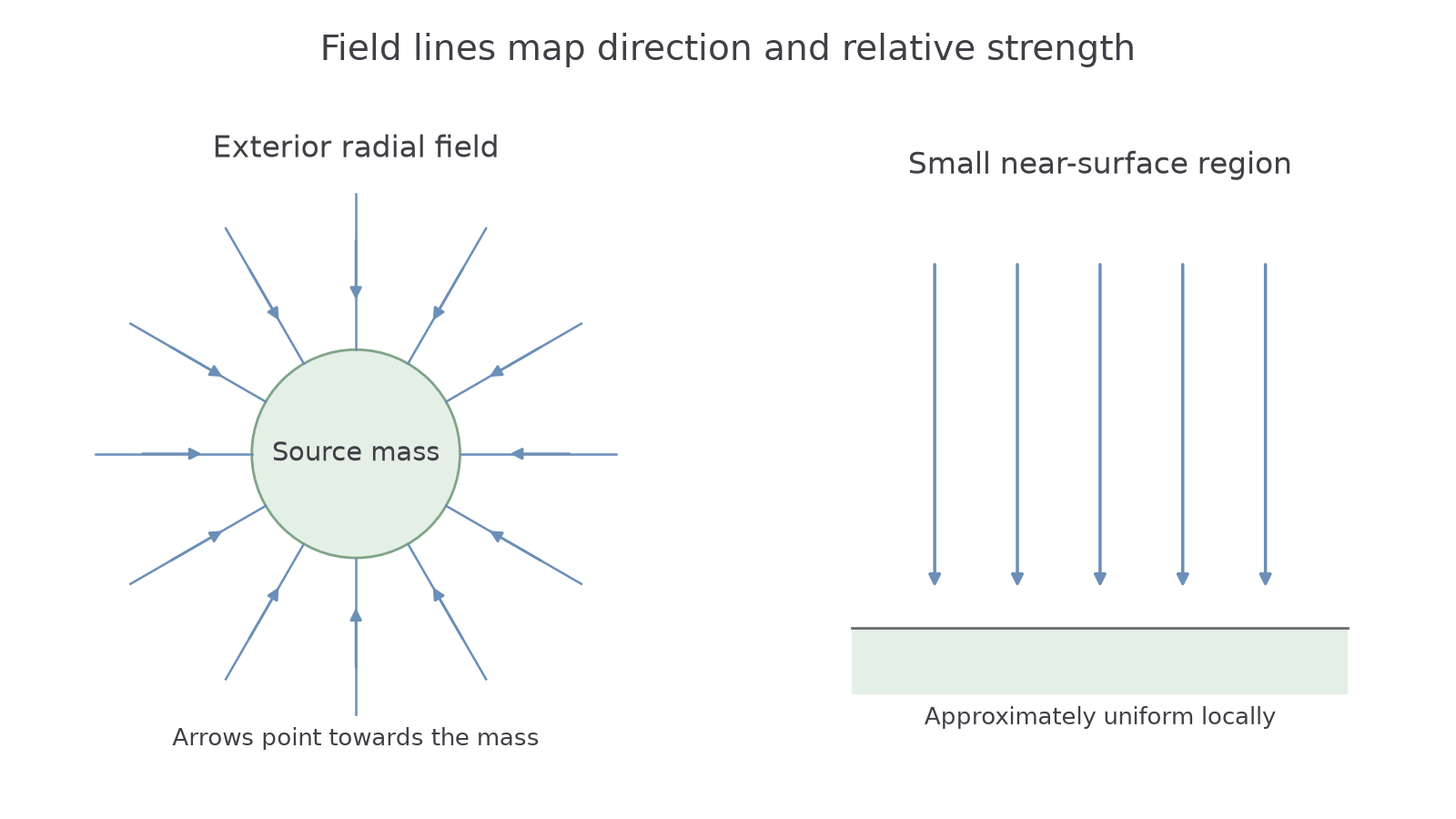
Field-line arrows show direction. Closer line spacing represents greater strength in the chosen drawing; lines do not cross because the field at one point has one resultant direction. The number of lines an artist chooses is not a count of physical objects. A small surface patch is often drawn with parallel lines as a local approximation, not as a claim that the whole planet's field is parallel.
Watch out
Mass is not field strength. Doubling a test mass doubles its gravitational force, but does not double the field strength at that position. Distinguish the source, the field and the test mass.
Newton's law and spherical masses
Every pair of masses attracts gravitationally. Increasing either mass increases the force; increasing their separation weakens it. Newton's law gives the quantitative relation for point masses.
Newton's law of gravitation
Here is force magnitude in , masses are in , and is their separation in . The forces act along the line joining the masses, towards one another. The gravitational constant is using the examination value.
The value of is on the data sheet. The force equation is not on the data sheet: learn it.
The inverse square is decisive: doubling separation reduces the force to one quarter. Doubling one mass doubles the force; doubling both masses multiplies it by four. The force on each body has the same magnitude, even when their masses are very different, by Newton's third law. Their accelerations can differ because acceleration is force divided by the body's own mass.
Worked example 1: the attraction of laboratory masses
Question. Two small masses of and have centres apart. Treat them as point masses and calculate their gravitational attraction using .
Plan. Use the centre separation and both masses.
Answer. Approximately on each mass, in opposite directions towards one another.
Check. Ordinary laboratory masses have extremely small mutual gravitational forces. Do not confuse this force with either mass's much larger weight in Earth's field.
For a point outside a uniform sphere, its gravitational effect is the same as if the sphere's mass were concentrated at its centre. This justifies using a centre-to-centre distance for spherical planets. A height above the surface is not that distance: , where is planet radius and altitude.
Exam-style example: a force outside a model planet
Question. A spherical planet has mass . A spacecraft is from its centre. Calculate the gravitational force, using .
Plan. Treat the exterior spherical planet as a point mass at its centre.
Answer. Approximately , towards the planet's centre.
Check. The separation is squared as a whole, including its power of ten. The point-mass representation applies outside the sphere, not automatically inside it.
Continue this lesson.
You’re previewing NovaLearn without an account. Create a free account to read the rest.
Create free account