10.2 - Kirchhoff's laws and circuit equations
Learn to use charge conservation at a junction and energy conservation around a closed loop. Translate connected circuits into signed equations, then solve simultaneous equations to find currents without assuming that current is used up or shared equally.
Charge conservation at junctions
Can a junction keep taking in more current than it sends out while a circuit stays steady? It would have to keep accumulating charge. In a steady d.c. circuit that does not happen, so the rates of charge entering and leaving must balance.
Kirchhoff's first law
The sum of the currents entering a junction equals the sum of the currents leaving that junction.
This is conservation of charge. Current is charge per unit time, so the current balance is a charge balance expressed as a rate. It does not say that each outgoing branch carries the same current. Different branches can have different resistances and currents.
Write a positive magnitude for an arrow entering and place it on the incoming side; do the same for arrows leaving. For example, if enters and leaves one branch, the other outgoing current is . Both branches together carry all the incoming charge per second.
In algebra, may describe one incoming current and two outgoing currents. Each current is measured in amperes. This relationship is not printed on the data sheet: learn the law and apply it to the actual arrow directions, rather than memorising one particular subscript arrangement.
Watch out
A current arrow is a chosen direction for a signed unknown. If a solved current is negative, the actual conventional current flows opposite to that arrow. The negative sign is useful information, not automatically a failed solution.
A junction dot identifies which conductors connect. Follow the actual node, including any ideal wires attached to it, before deciding which currents enter or leave. Crossing lines without a connection mark are not an extra junction.
Energy conservation around loops
A charge returning to the same point in a steady circuit cannot have gained a net amount of electrical energy on each lap. Energy supplied by sources must equal energy transferred elsewhere along that closed route.
Kirchhoff's second law
The algebraic sum of e.m.f.s and potential differences around any closed loop is zero; equivalently, the sum of e.m.f.s supplying energy equals the sum of potential drops in that loop.
The law follows from conservation of energy. Divide the energy account for a charge by that charge to obtain an account in volts. This is not the first law repeated: the first accounts for charge at a junction; the second accounts for energy per charge around a loop.
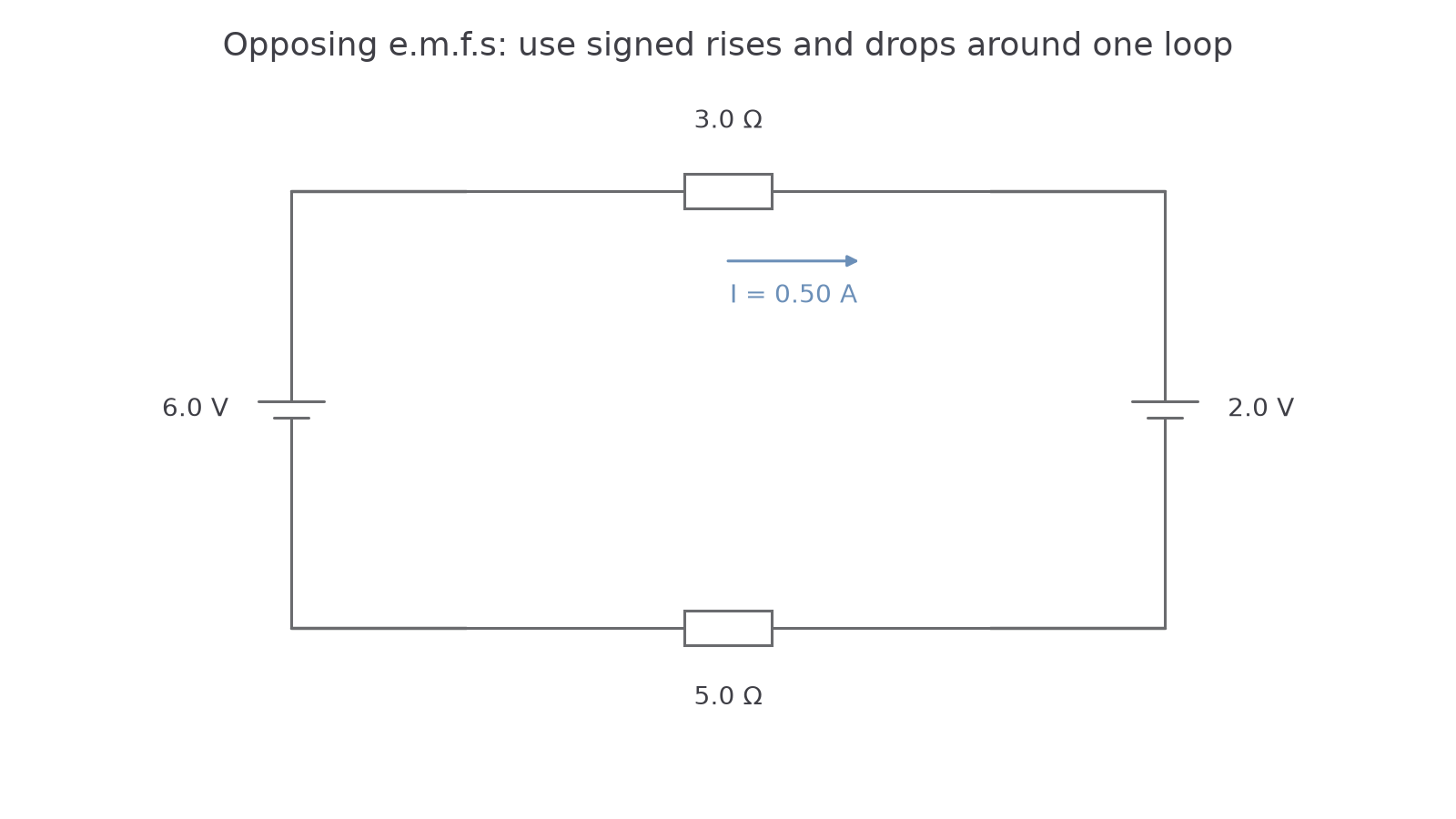
Choose a loop direction. Crossing a source from its negative to positive terminal is a rise ; crossing the other way is . Crossing a resistor in the direction of its assumed conventional current gives a drop ; crossing against that current gives . Here and are in volts, in amperes and in ohms. Neither Kirchhoff's loop law nor is printed as a general equation on the data sheet: learn them.
[DIAGRAM: asset_name: Opposing e.m.f.s in one complete loop; asset_slug: circuits-opposing-sources; caption: The two ideal sources oppose, so their e.m.f.s subtract in the chosen direction; description: A complete series circuit contains ideal sources of 6.0 and 2.0 volts oriented to oppose each other, and resistors of 3.0 and 5.0 ohms. A clockwise conventional-current arrow is shown. The larger source is crossed negative to positive clockwise and the smaller positive to negative.]
Worked example 1: sources that oppose
Question. Two ideal sources of and oppose each other in one series loop with and resistors. Calculate the current, taking the direction driven by the larger source as positive.
Numerical equation coefficients use volts and ohms consistently. The resistor drops are and : . The smaller ideal source receives energy in this arrangement; the loop law accounts for the direction of energy transfer rather than forcing every source to supply energy.
Continue this lesson.
You’re previewing NovaLearn without an account. Create a free account to read the rest.
Create free account