4.1, 4.2 - Moments, couples and centres of gravity
Represent an object's weight at its centre of gravity, calculate the turning effect of a force, and use the principle of moments. Distinguish a couple, which has a turning effect despite zero resultant force, from two forces that simply cancel.
Weight acts through the centre of gravity
Can an object's centre of gravity be somewhere with no material at all? A uniform circular hoop gives a neat answer: its centre of gravity is at the empty centre, because its weight is distributed symmetrically around the ring.
Gravity acts on every small piece of an extended object. In a uniform gravitational field, we can replace all those small forces by one resultant weight acting through a particular point. That point is the centre of gravity. This is a way to represent the overall effect of distributed weight; gravity has not stopped acting on the rest of the material.
Centre of gravity
The centre of gravity is the point through which the resultant weight of an object may be considered to act.
For a uniform rod, it is at the midpoint. For a uniform rectangular sheet, it is at the intersection of its diagonals. Symmetry locates it only when the mass distribution is also suitably symmetric. A rod with a heavy attachment near one end need not have its centre of gravity at the geometric midpoint.
You can locate the centre of gravity of an irregular lamina experimentally. Suspend it freely from one point and let it come to rest. A plumb line hung from the same suspension point shows the vertical line below that point. Mark this line on the lamina. Repeat from a different suspension point: the intersection locates the centre of gravity. Keep the lamina free to turn, and read the line without parallax.
Why does the method work? If the weight's line of action missed the suspension point, it would turn the lamina. At rest, the centre of gravity must lie vertically below the suspension point. The second line fixes the point rather than only one possible vertical line.
Model limit
A single weight at the centre of gravity represents the distributed weight in a nearly uniform gravitational field. “Uniform rod” means uniform mass per unit length; it is that condition, rather than the word “rod”, that places its centre of gravity at the midpoint.
You will use the centre of gravity whenever an object's own weight contributes to its turning effect.
The moment of a force
A door is easier to turn when you push near its handle than near its hinge. The force can be the same, but its moment, or turning effect about the hinge, is different. The relevant distance is measured perpendicular to the force's line of action.
Moment of a force
The moment of a force about a point is the force multiplied by the perpendicular distance from that point to the force's line of action.
The line of action is the straight line along which the force acts. You may extend that line to find the shortest distance to the pivot.
Moment about a point
Here is the moment in , is the force in , and is the perpendicular distance in from the chosen point to the line of action. State clockwise or anticlockwise as appropriate. If the line of action passes through the point, and the moment is zero.
Not on the data sheet: learn it.
Worked example 1: an angled push on a spanner
Question. A force of acts at the end of a spanner, at to the spanner. Calculate the magnitude of the moment about the nut.
Plan. Use the perpendicular component of the force. Multiplying the full force by the full spanner length would ignore the angle.
Answer. .
Check. A perpendicular push would give , so the angled push must give less. A push directly along the spanner would give no moment about the nut.
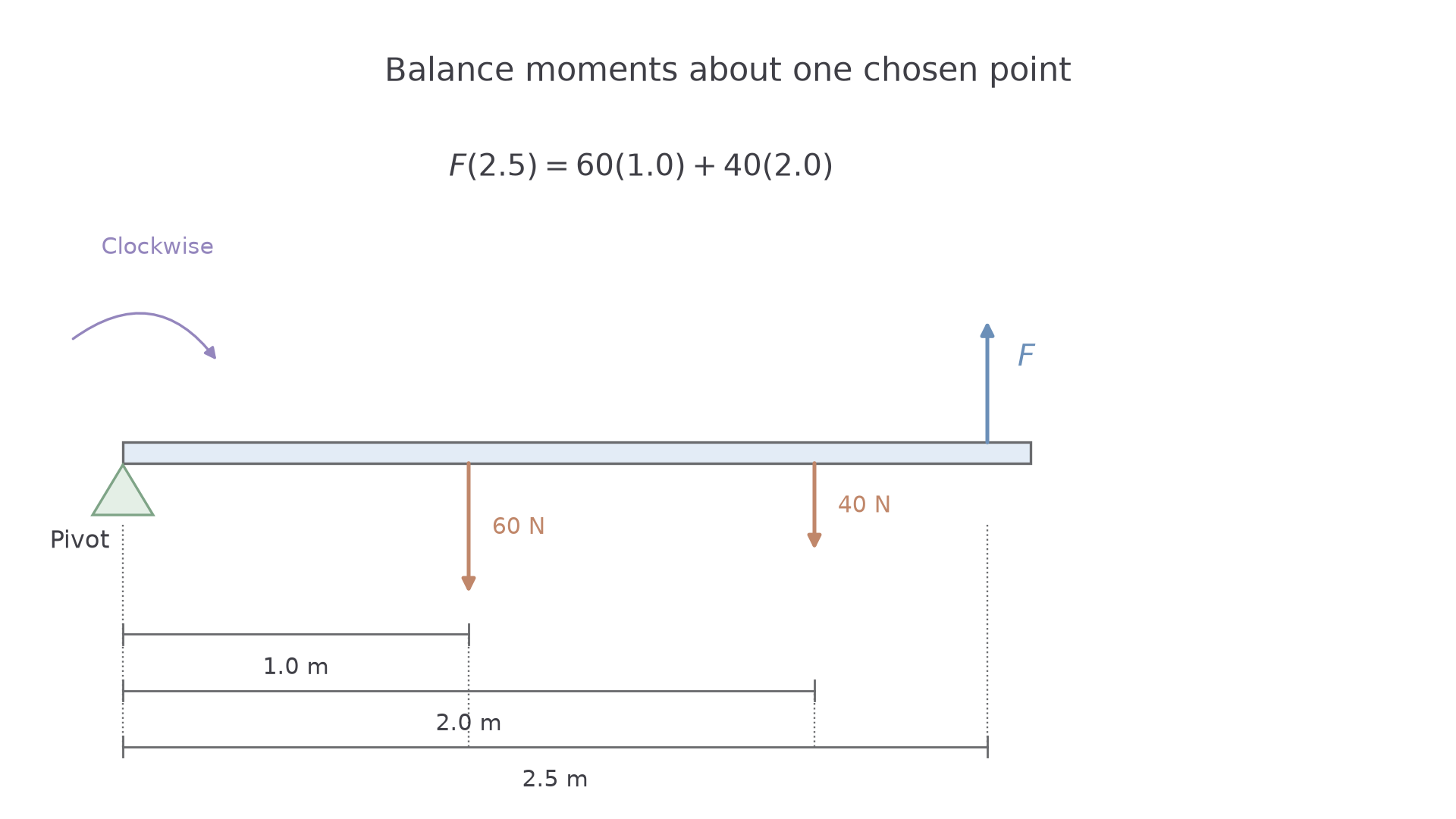
Several forces can turn an object in opposing senses. For equilibrium, the total clockwise moment must equal the total anticlockwise moment about the same point. This is the principle of moments. Do not add moments taken about different pivots in the same balance equation.
[DIAGRAM: asset_name: A beam with balanced moments; asset_slug: beam-moments; caption: The upward force balances the clockwise moments of the two downward forces about the left pivot; description: A horizontal beam has a left pivot, a 60 newton downward weight one metre from the pivot, a 40 newton downward force two metres from it, and an upward force at two point five metres. Distances are shown from the same pivot, with a separate curved arrow indicating clockwise sense.]
Exam-style example: balancing a beam
Question. A horizontal beam is pivoted at its left end. Its weight acts from the pivot. A downward load of acts from it. An upward force acts from the pivot. Determine for rotational equilibrium.
Plan. Take moments about the pivot, so any force at the pivot has zero moment.
Answer. upwards.
Check. Its moment is , equal to the total clockwise moment. The forces need a separate balance for full equilibrium; you will use that in the next lesson.
Watch out
The distance along a beam is not automatically the perpendicular distance. Either find the perpendicular distance to the force's line of action or resolve the force perpendicular to the beam. Do not apply both corrections a second time.
Check the moment balance with fresh positions.
A couple has zero resultant force but non-zero torque
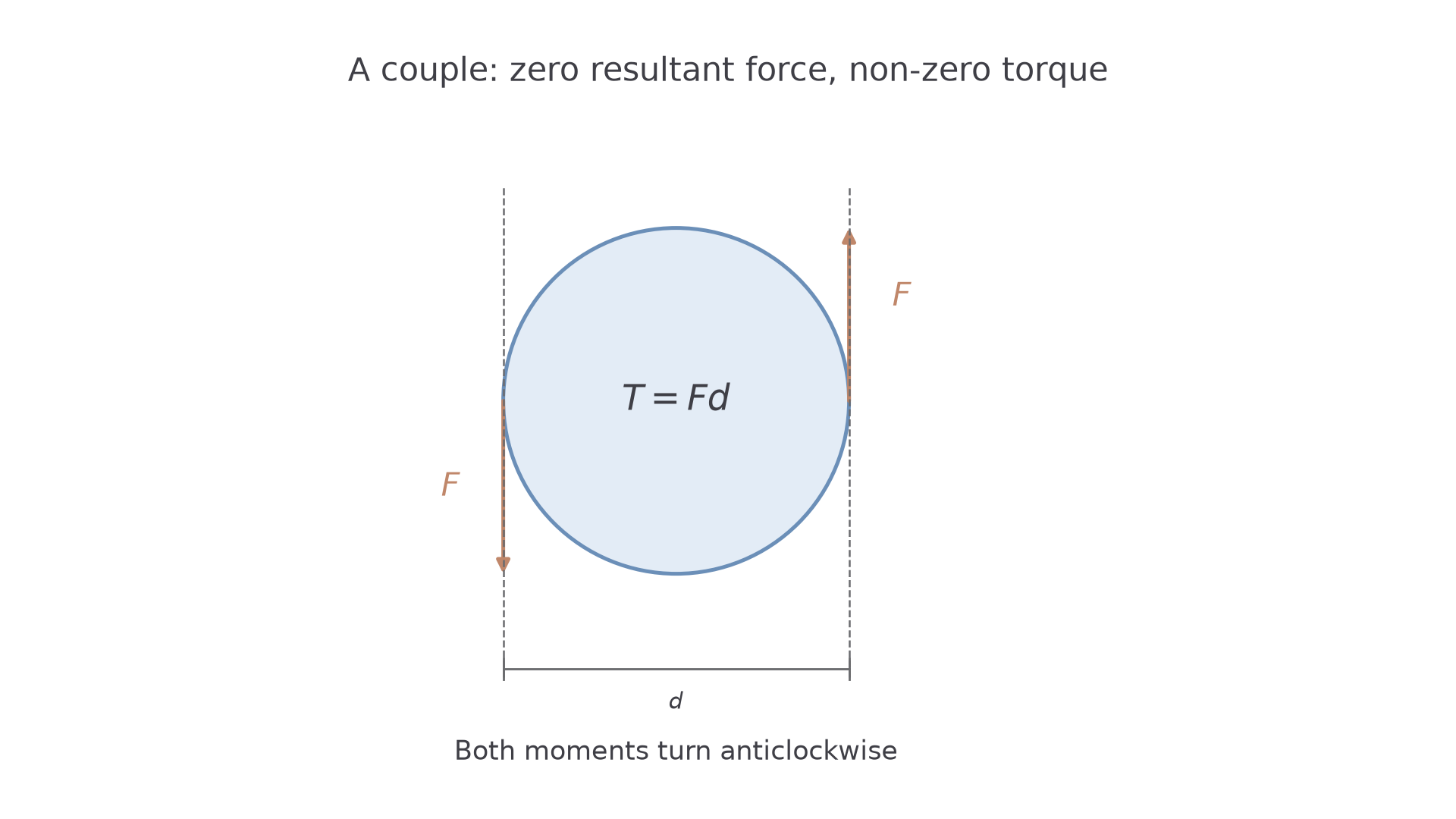
Two forces can cancel as vectors and still turn an object. Imagine pushing upwards on the right side of a wheel and downwards on its left side with equal forces. Their resultant force is zero, but both moments turn the wheel anticlockwise.
A couple is a pair of equal, opposite, parallel forces acting along different lines. It has a turning effect without a resultant force. If the lines of action coincided, the forces would cancel without this turning effect, so that would not be a couple.
Torque of a couple
Here is the torque in , is the magnitude of one force in , and is the perpendicular separation of the two lines of action in .
Not on the data sheet: learn it.
Why only one force in the formula? Take moments about a point midway between the lines. Each force has moment in the same sense, giving altogether. About a point on one line, that force has zero moment and the other has moment . The couple's torque is independent of the point about which it is calculated.
[DIAGRAM: asset_name: A couple on a wheel; asset_slug: couple-torque; caption: Equal opposite forces have zero resultant but their moments act in the same sense; description: A circular wheel has a downward force at its left edge and an equal upward force at its right edge. The perpendicular distance between the vertical lines of action is labelled d. Each arrow begins at the wheel's edge and the sense is anticlockwise.]
Worked example 2: turning a wheel
Question. Two tangential forces, each , act on opposite sides of a wheel of diameter . They form a couple. Calculate its torque.
Answer. .
Check. Each force has a lever arm of about the centre, so adding the two moments also gives .
A couple is a useful warning against deciding equilibrium from resultant force alone. Zero resultant force prevents acceleration of the centre of mass, but a non-zero resultant moment can still change the object's rotation.
Exam tip
Moment and torque have unit . Although this has the same base units as a joule, write for a turning effect, not . The quantities have different physical meanings.
Find the double-counting error in a couple calculation.
Quick Recap
- The centre of gravity is where an object's resultant weight may be considered to act; it can be outside the material.
- A moment is force multiplied by perpendicular distance to its line of action.
- In rotational equilibrium, clockwise and anticlockwise moments about the same point are equal.
- A couple has equal opposite parallel forces on different lines, zero resultant force, and torque equal to one force times their perpendicular separation.
A hoop's centre of gravity can lie in empty space because it represents the combined turning effect of the weight distributed around the hoop.