5.1 - Power and efficiency
Distinguish how much energy is transferred from how quickly it is transferred, derive the force–speed relationship for power, and use efficiency to follow useful and unwanted energy transfers.
The rate of energy transfer
Two people of the same mass climb the same staircase, one walking and one running: who gains more gravitational potential energy? They gain the same amount if the vertical rise is the same. The runner transfers that energy in less time, so the average useful power is greater.
Power measures the rate of doing work or transferring energy. A powerful motor need not transfer more energy on a particular job; it can complete the same energy transfer more quickly.
Power
Power is work done per unit time, or energy transferred per unit time.
The unit is the watt. One watt is one joule per second, so a device transferring each second has power .
Average power
is average power in watts (W), is work done or energy transferred in joules (J), and is elapsed time in seconds (s). For an energy change, write . This gives the average over the stated interval; the instantaneous power may vary during it.
Not on the data sheet: learn it.
Worked example 1: climbing a staircase
Question. A person of mass climbs a vertical height of in . Calculate the average power used to increase gravitational potential energy. Use .
Plan. Find the useful energy increase, then divide by the time.
Answer. (2 s.f.).
Check. Taking twice as long would give half the power but the same energy gain. This is useful mechanical power, rather than the person's total metabolic power.
On an energy-transferred against time graph, the gradient is power. A steeper gradient means a faster energy transfer; a horizontal line means no further energy is being transferred. If the graph curves, its gradient at one instant is obtained from a tangent, while gives an average between two points.
Watch out
A watt is a rate, not an amount of energy. Multiplying watts by seconds gives joules. A joule per second per second would describe a change in power, not power itself.
Check both the energy account and the time interval.
Power, force and speed
A moving vehicle needs energy supplied continuously when it works against resistance. At a greater speed it travels further each second, so the same driving force does more work each second.
For a constant force parallel to the displacement, combine the work and power relations:
Here is the speed for the interval. Over a very short interval this gives the instantaneous power delivered by a force parallel to the instantaneous velocity. If a force makes angle to the motion, only its parallel component contributes, so .
Mechanical power
is power in W, is force in N and is speed in . This form applies when force and velocity are in the same direction. Use the relevant force: driving-force power is not automatically the same as the rate of increase of kinetic energy.
Not on the data sheet: learn it.
At constant speed on a level road, the driving force equals the total resistance. The driving power is then transferred against resistance, rather than increasing kinetic energy. If the vehicle accelerates, some power increases kinetic energy as well.
Worked example 2: a steady-speed vehicle
Question. A vehicle travels at on a level road against a total resistance of . Calculate the mechanical power delivered by the driving force.
Plan. Constant velocity means zero resultant force, so the driving force is .
Answer. .
Check. Each second the vehicle moves 20 metres and the drive does of work. Zero acceleration does not mean zero driving power.
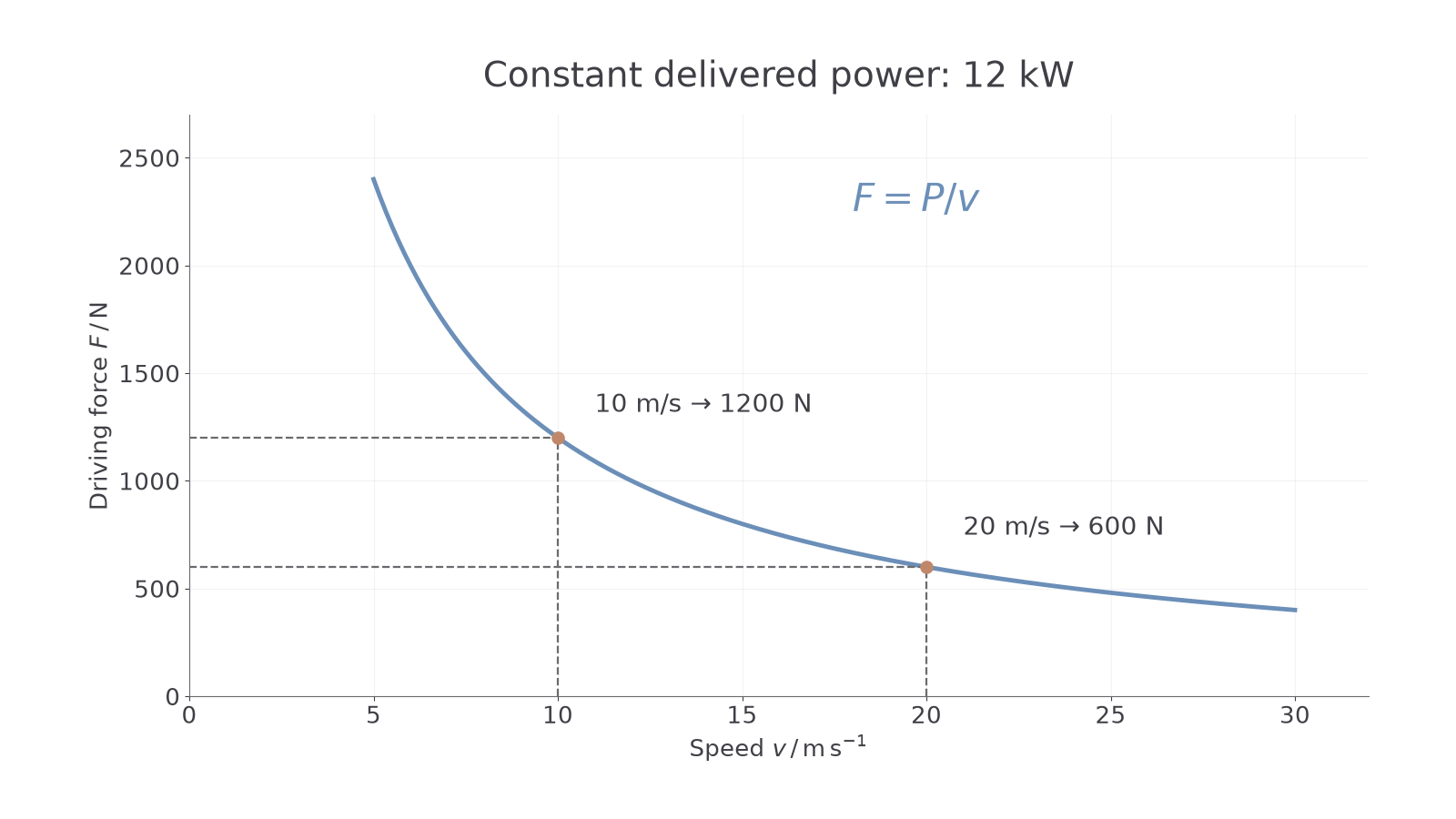
Another useful prediction follows from : if the delivered power stays constant, doubling the speed halves the available driving force. The graph shows that relationship. It does not predict an infinite starting force at zero speed: a real motor and transmission have limits, so constant power is not a valid model all the way to rest.
[DIAGRAM: asset_name: Driving force at constant power; asset_slug: energy-constant-power; caption: At a fixed delivered power, driving force decreases as speed increases; description: A force against speed graph shows F equals 12000 divided by v from 5 to 30 metres per second. Points at 10 metres per second and 1200 newtons and at 20 metres per second and 600 newtons demonstrate that doubling speed halves force. The zero-speed region is not included.]
Use the appropriate force before substituting.
Useful output and efficiency
A motor often transfers energy to its surroundings as well as to its intended load. Friction warms its moving parts, and electrical resistance warms its coils. Those transfers still obey energy conservation, but they do not all serve the chosen purpose.
Efficiency
The efficiency of a system is the ratio of useful energy output to total energy input.
You must decide what the useful output is. For a lifting motor it may be an increase in gravitational potential energy; for an electric heater, heating the room may be the useful output. Energy transferred by heating is not automatically unwanted in every device.
Efficiency
is dimensionless. Both energies must use the same unit; the power ratio applies to the corresponding transfers over the same interval. Multiply the ratio by 100 to express efficiency as a percentage. Useful output is part of the total input, so the ratio cannot exceed 1 for this energy-conversion account.
Not on the data sheet: learn it.
Exam-style example: finding a lifting time
Question. A motor takes an input power of and has efficiency 0.70 while lifting a load through . Calculate the lifting time. Assume constant useful power and negligible changes in kinetic energy. Use .
Plan. First find the useful power, then use the useful energy increase.
Answer. (2 s.f.).
Check. Using the whole input power as useful power would give , an unrealistically short time for this motor. In 7.01 seconds the input supplies about , of which reaches the load.
The staircase puzzle also needs this distinction. The runner's useful mechanical power is larger, but those observations alone do not give the efficiency of either person's body: their total chemical energy inputs have not been measured.
Exam tip
Write efficiencies as fractions in calculations: 65% means 0.65. Check that useful output is smaller than total input, and state which transfer you counted as useful.
Use energy conservation to interpret the unwanted output.
Quick Recap
- Average power is work done or energy transferred divided by time; one watt is one joule per second.
- Deriving connects energy transfer to the force parallel to motion.
- At constant speed, driving power can be transferred entirely against resistance.
- Efficiency compares useful output with total input; unwanted transfers still conserve energy.
The walker and runner gain the same gravitational potential energy for the same mass and rise, but the runner has greater average useful power because the transfer takes less time.