14.1, 14.2 - Thermal equilibrium and temperature scales
Learn what temperature tells you about energy transfer, how a thermometer turns a changing physical property into a reading, and why the kelvin scale has a substance-independent meaning. You will convert between Celsius and kelvin without confusing a temperature with a temperature change.
Temperature and thermal equilibrium
Can a metal spoon and a wooden spoon feel different while they are at the same temperature? Yes: leave both in the same room long enough and they can reach the same temperature, yet the metal can feel colder because it transfers energy away from your warmer hand more rapidly.
Touch is responding to energy transfer as well as temperature. Temperature determines the direction of spontaneous transfer by heating: energy is transferred from a region of higher temperature to one of lower temperature. It does not flow in the direction of “more total energy” or “greater mass”. A small hot object can warm a much larger cooler one.
Thermal equilibrium
Regions at the same temperature are in thermal equilibrium. When placed in thermal contact, there is no net transfer of energy by heating between them.
If two isolated objects at different temperatures are brought into thermal contact, energy leaves the hotter and enters the cooler until they reach a common temperature. That final temperature need not be their simple arithmetic mean: their masses and responses to heating matter, as the next lesson will show.
A thermometer works by coming into thermal equilibrium with what it measures. Allow time for its sensing element to reach the object's temperature; a newly inserted probe may still be responding. Stir a liquid when appropriate so the probe is not measuring a small warmer or cooler region instead of the bulk liquid. A thermometer with a large thermal capacity can itself noticeably alter a small sample's temperature.
[DIAGRAM: asset_name: The direction of thermal transfer; asset_slug: thermal-equilibrium-transfer; caption: A temperature difference determines transfer direction, and equal temperature gives no net transfer by heating; description: Two panels compare a hot object at 70 degrees Celsius in contact with a cooler one at 20 degrees Celsius, with an energy-transfer arrow from hot to cool, and the same isolated pair after reaching a common temperature of 45 degrees Celsius for the illustrated equal-response case. The second panel has no net-transfer arrow and states that equal temperatures do not mean equal masses or equal internal energies.]
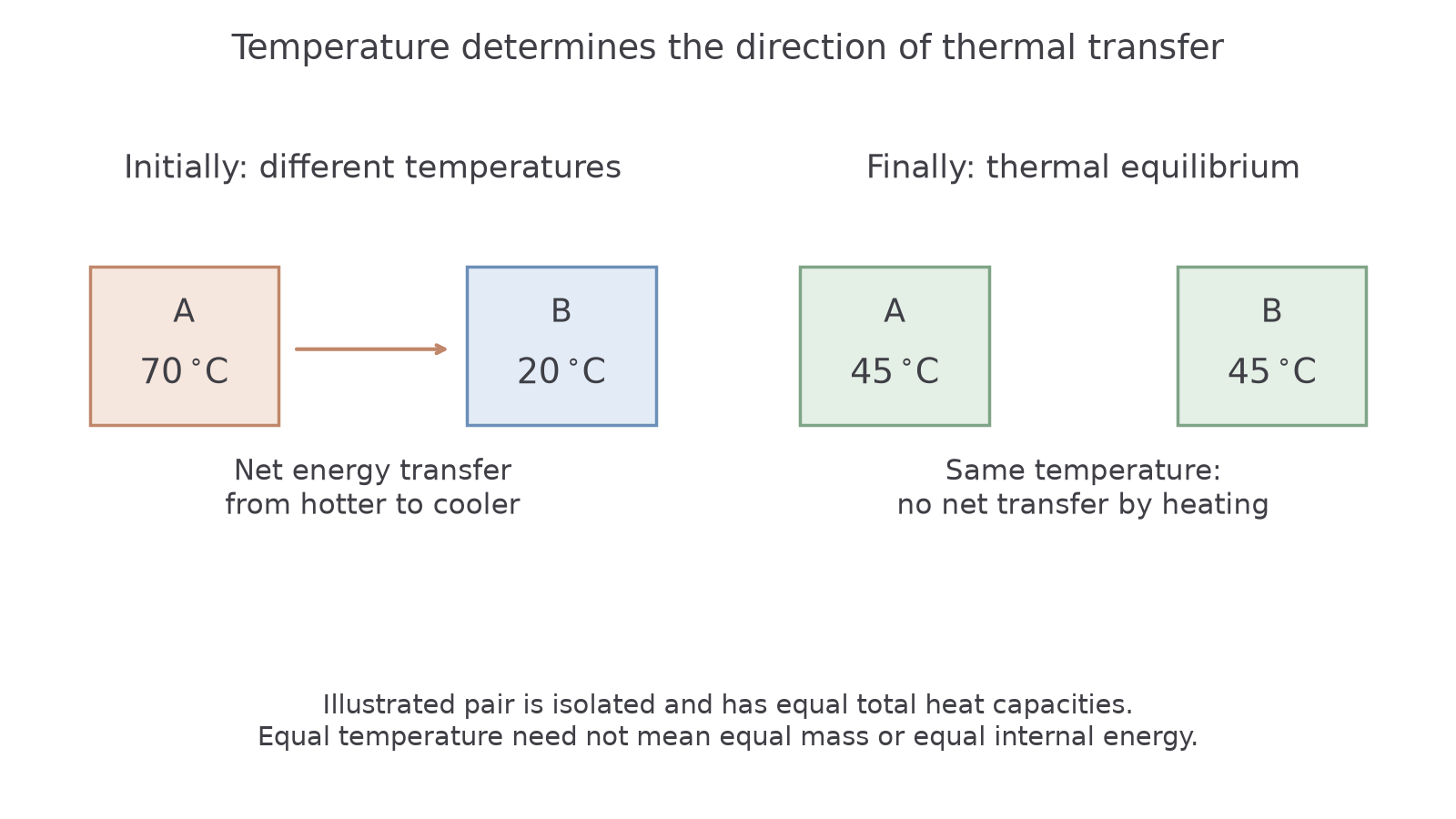
Temperature is a property of a system; heating is a process of energy transfer caused by a temperature difference. Energy within the material is part of its internal energy, not a substance called heat stored inside it. Equal temperatures do not require equal internal energies: a large amount of material and a small amount can share a temperature.
Watch out
“Cold flows into the spoon” reverses the physical account. Energy leaves your warmer hand and enters the cooler spoon. The rate can differ between materials even when the spoons began at equal temperatures.
Use temperature, rather than the size of the objects, to predict a transfer.
Physical properties used as thermometers
A thermometer needs a measurable thermometric property that changes reproducibly with temperature. The reading of that property is not yet a temperature: calibration tells you how the two correspond.
| Changing property | How it can be used | Important condition |
|---|---|---|
| Density of a liquid | For a fixed mass, a density change changes its volume; expansion of a suitable liquid moves its level along a narrow capillary. | Choose a liquid with a useful, calibrated response over the temperature range. Do not assume every liquid expands uniformly at all temperatures. |
| Gas volume | Measure how the volume of a fixed amount of gas changes with temperature, for example under a freely moving piston carrying a constant load. | Keep pressure constant and allow the gas to reach the measured temperature. |
| Resistance of a metal | Measure resistance and use its calibrated temperature dependence. | Use a small sensing current to avoid appreciable self-heating. |
| E.m.f. of a thermocouple | Join two different metals to make junctions; the measured e.m.f. depends on their temperatures. | Keep the reference junction at a known temperature, or compensate for its temperature. |
A thermocouple's sensing junction can be small and respond quickly. Its e.m.f. does not report one junction's temperature independently of the reference. A resistance thermometer and a liquid thermometer can also respond nonlinearly; matching two calibration points does not prove that all intermediate readings agree.
To establish a simple empirical scale, measure the property at two known reference temperatures and assume a linear change only over a range where that approximation is justified. A fraction of the property interval then corresponds to the same fraction of the temperature interval.
Continue this lesson.
You’re previewing NovaLearn without an account. Create a free account to read the rest.
Create free account