4.3 - Upthrust and floating
Explain upthrust using the pressure difference between the top and bottom of an immersed object. Calculate the force from displaced fluid volume, distinguish upthrust from apparent weight, and use equilibrium to explain floating and submerged fractions.
Pressure differences give an upward resultant
How can a steel boat float when a solid piece of steel sinks? The water responds to the submerged volume and shape of the object as a whole. It does not decide whether to push upwards by checking the name of the material.
An immersed object experiences pressure forces on every surface touching the fluid. Each force acts normally into that surface. In a stationary liquid, pressure increases with depth, so a horizontal bottom face experiences a larger upward pressure force than the downward pressure force on an equal-area top face.
For a cuboid, equal sideways pressure forces on opposite vertical faces cancel. The remaining fluid-force resultant is upward. This is upthrust. It acts even on an object whose weight is too large for it to float.
Upthrust
Upthrust is the upward resultant force exerted by a fluid on an immersed object, arising from the variation of pressure with depth.
Consider a fully submerged cuboid of horizontal cross-sectional area and height . If its top and bottom pressures are and , then
The pressure-difference relation was , and is the cuboid's volume. Here is the fluid density. Pressure is a force per area; multiplying its difference by area gives a force.
[DIAGRAM: asset_name: Pressure forces and upthrust; asset_slug: upthrust-pressure-forces; caption: Greater pressure on the lower face gives an upward fluid-force resultant; description: A cuboid is fully submerged in water, with equal small horizontal pressure arrows at matching depths on opposite sides. A downward pressure arrow at its top is shorter than an upward pressure arrow at its bottom. A separate free-body diagram shows upward upthrust and downward weight, without counting individual pressure forces again.]
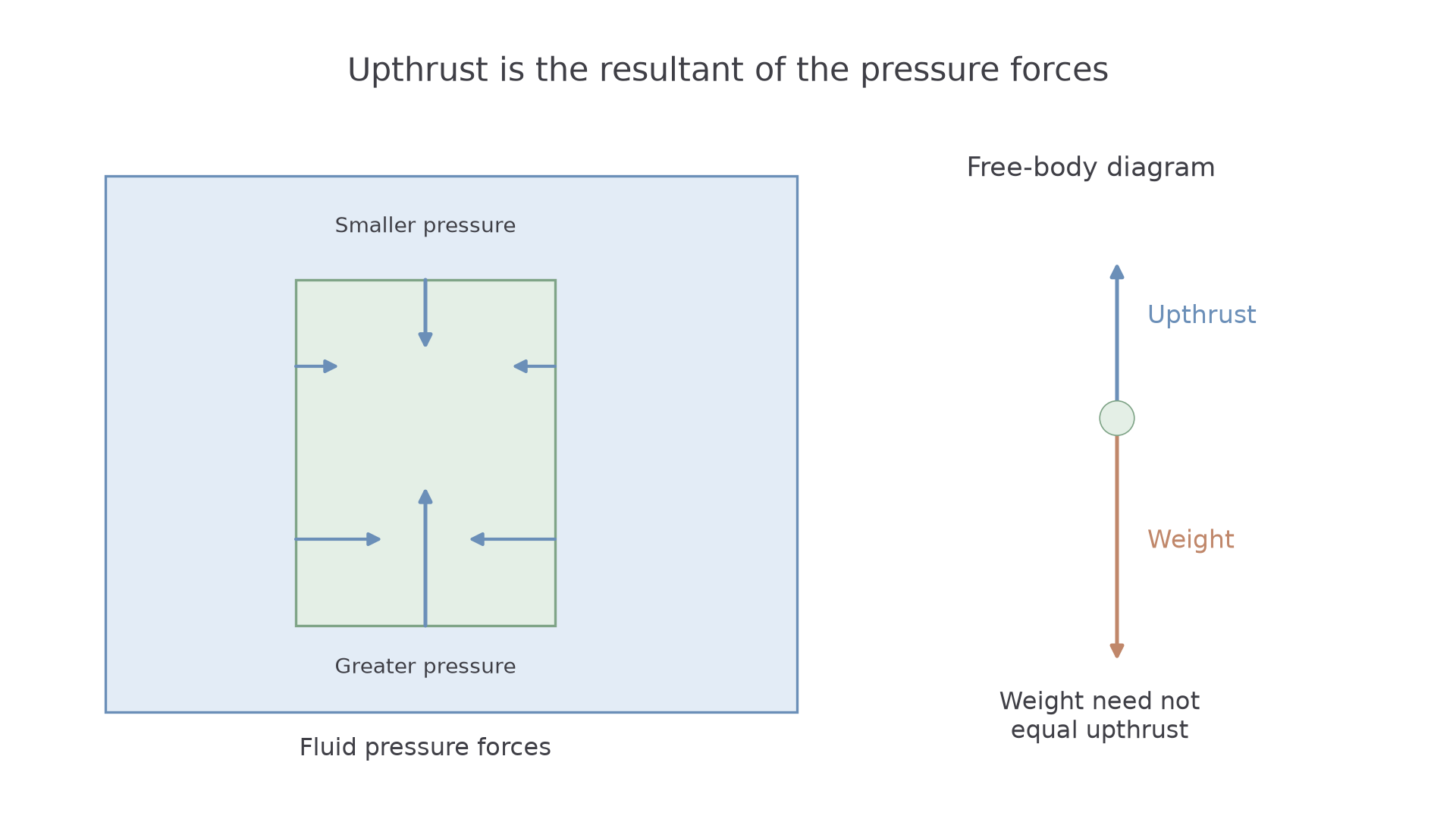
Uniform pressure added everywhere contributes equal and opposite force effects over a closed immersed object; it does not change the upthrust. The pressure difference with depth is what matters. The same principle applies to gases, although changes of gas density with height can sometimes prevent use of one constant density over a large height.
Watch out
Do not draw both upthrust and all its component pressure forces on the same free-body diagram as separate contributions. Upthrust is their resultant. Counting both would count the fluid force twice.
Check the mechanism rather than assuming that every upward force is drag.
The weight of displaced fluid
A fully immersed object occupies space that would otherwise contain fluid. Imagine replacing the object with the same volume of the surrounding fluid. That fluid would be at rest, with its weight balanced by the surrounding pressure forces. The surrounding fluid exerts the same pressure forces on the object's surface, so its upthrust equals the weight of the fluid displaced.
This reasoning extends the cuboid result to other shapes. It is Archimedes' principle. For a partly immersed object, use only the volume below the fluid surface, rather than the object's total volume.
Upthrust from displaced fluid
Here is upthrust in , is the surrounding fluid density in , is gravitational field strength in , and is the volume of fluid displaced in . It applies to immersion in a stationary fluid, using approximately uniform density over the displaced volume. A fully submerged object's exterior immersed volume is displaced, including sealed internal space.
On the data sheet.
At fixed fluid density, doubling displaced volume doubles upthrust. Once a rigid object is fully submerged in an incompressible liquid, moving it deeper does not increase its displaced volume. Its upthrust stays approximately constant, although the absolute pressure on every surface rises. This often feels surprising until you compare the top-to-bottom pressure difference.
Worked example 1: the upthrust on an immersed object
Question. An object displaces of water of density . Calculate the upthrust, using .
Answer. upwards.
Check. The displaced water has mass , whose weight is indeed about .
An immersed object can also be held by a force meter. If it is stationary and denser than the fluid, the upward tension and upthrust balance its weight:
Here , upthrust , and weight are all forces in . The meter reads , often called the apparent weight. The actual gravitational weight remains ; the fluid shares the support.
Exam-style example: a reduced force-meter reading
Question. The object in Worked example 1 has mass and is held stationary by a vertical force meter while fully submerged. Calculate the meter reading, neglecting air upthrust before immersion.
Answer. .
Check. Weight exceeds upthrust, so a positive upward tension is needed. If upthrust exceeded weight, a string pulling up could not hold the object submerged; a downward restraint would be needed instead.
In a liquid, a sinking object at terminal velocity may have three forces: downward weight, upward upthrust, and upward drag. The terminal balance is , not necessarily weight equals drag alone.
Floating adjusts the displaced volume
A freely floating object at rest has upthrust equal to its weight. If you place a light block on water, it sinks far enough to displace its own weight of water, then stops moving vertically once equilibrium is reached. It does not have to become fully immersed.
For a homogeneous object of total volume , material density , and submerged volume , neglecting air upthrust and other vertical forces,
The left side is the submerged fraction; it is dimensionless, as is the density ratio on the right. This is derived from the supplied upthrust relation and weight, rather than an extra formula printed on the data sheet. If the object is denser than the fluid, the fraction required would exceed one: immersion alone cannot provide enough upthrust for floating equilibrium.
Worked example 2: how much of a block is below water?
Question. A uniform block has density and floats in water of density . Find its submerged volume fraction. If it floats with vertical sides and total height , find the depth below the surface.
Answer. of its volume, with a submerged depth of .
Check. The height fraction equals the volume fraction here because the block's horizontal cross-section is constant. It would not generally hold for a sphere or a hull with sloping sides.
A steel hull can enclose a large volume of air while containing a relatively small volume of steel. Its external submerged shape can displace enough water to support the hull and its contents. Its average density, including the enclosed space, can be below the water density even though steel's material density is higher. A solid steel piece of the same mass has much less available displaced volume.
For example, a floating vessel with total mass must displace of fresh water of density , because equilibrium gives . Adding cargo makes it settle lower and displace more water. There is a limit: the hull must retain enough enclosed volume and a suitable waterline rather than simply filling with water.
Key idea
Use the density of the fluid to calculate upthrust. Use the mass, or average density and whole volume, of the object to calculate its weight. These are different sides of the equilibrium equation.
Bring the pressure picture and the volume calculation together.
Quick Recap
- Upthrust is the upward resultant of the fluid's pressure forces, rather than a reduction in weight.
- Its magnitude is the weight of displaced fluid; use fluid density and submerged volume.
- A force meter can read weight minus upthrust while the actual gravitational weight stays the same.
- Floating equilibrium requires upthrust to equal weight, which determines the submerged fraction or displaced volume.
A steel boat floats because its hollow shape can displace its own weight of water before it is fully submerged; a solid steel piece cannot displace enough water to balance its weight.