13.2 - Circular and geostationary orbits
Use gravity as the inward resultant for a circular orbit, relate orbital speed and period to centre distance, and identify every condition for a geostationary orbit. Explain orbital free fall without confusing weightlessness with an absence of gravity.
Gravity continuously turns an orbit
If gravity pulls a satellite towards a planet, why does it not fall straight down? The satellite already has tangential velocity. Gravity changes its velocity direction continuously, so an appropriate speed gives a circular path rather than a straight radial fall.
Gravity is the inward resultant. Do not draw an equal outward force balancing it: a zero resultant would give constant straight-line velocity, not an orbit. In an ideal circular orbit, gravity is perpendicular to velocity and changes direction without changing speed or kinetic energy.
[DIAGRAM: asset_name: An orbit has an inward resultant; asset_slug: circular-orbit-gravity; caption: Gravity supplies the centripetal resultant rather than being balanced by an outward force; description: A circular satellite orbit around a spherical planet has a marked satellite at the right side. Its blue velocity arrow starts at the satellite and is tangent upward. Its clay gravitational-force arrow starts there and points left towards the centre. Radius is labelled from planet centre to satellite; altitude is marked separately from the surface. No extra outward or centripetal force arrow is drawn.]
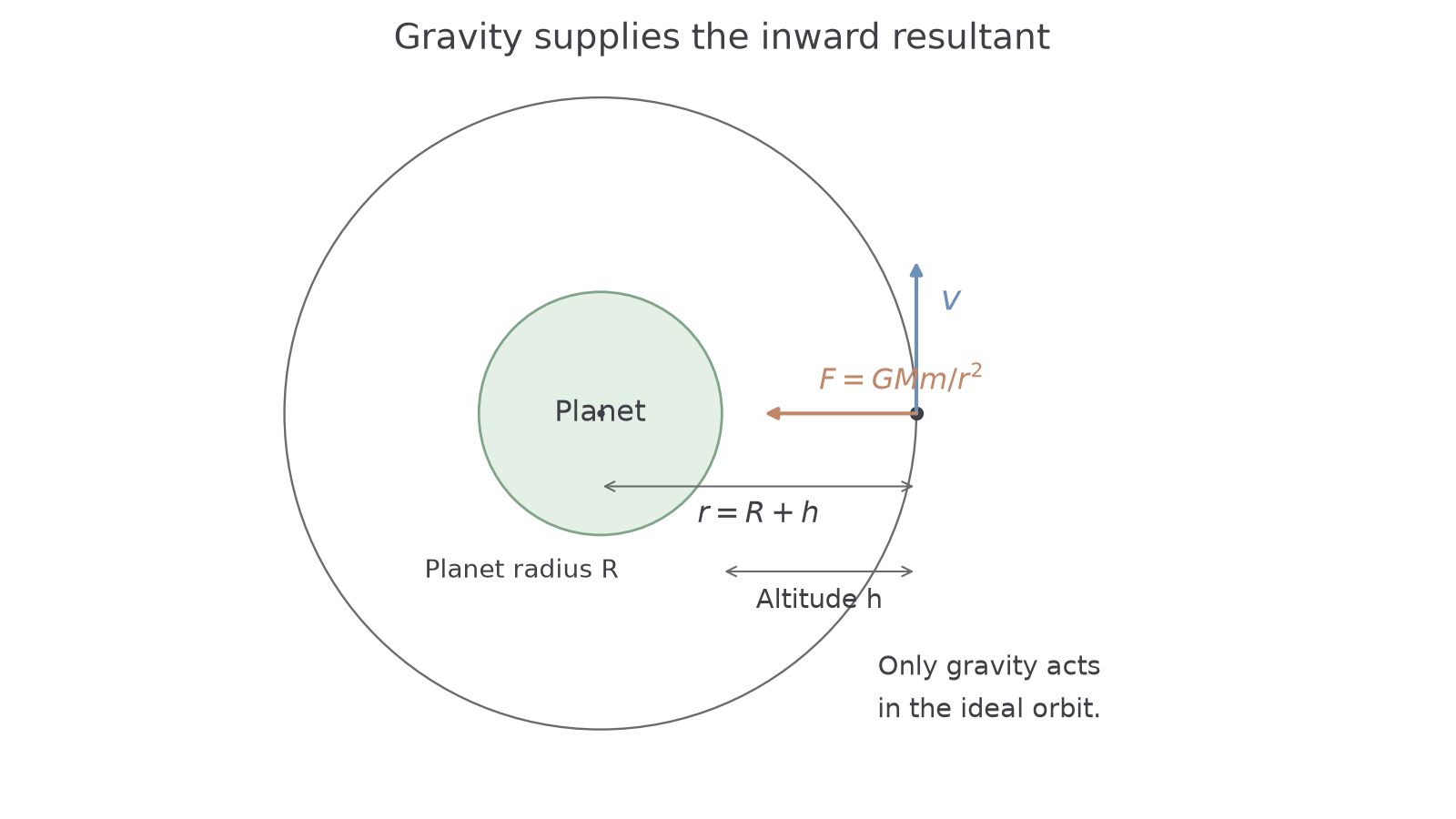
Set gravitational force equal to the required centripetal resultant:
The satellite mass cancels because both gravitational force and required centripetal force are proportional to it. Satellites of different small masses can have the same circular speed at the same radius around the same planet.
Circular orbital speed
Here is orbital speed in , is central mass in , and is centre-to-centre orbital radius in . Use a circular orbit outside a spherical central body and a satellite whose mass is negligible compared with that body. Ignore drag, propulsion and other gravitational sources in this model.
Not on the data sheet: learn it, including the force reasoning that gives it.
Worked example 1: speed around a model planet
Question. A small satellite has a circular orbit of radius around a spherical planet of mass . Determine its orbital speed. Use .
Plan. Equate gravity to the centripetal requirement, then use the centre distance.
Answer. Approximately .
Check. A speed in kilometres per second is plausible for a large-planet orbit. The radius was supplied, so no planet radius should be subtracted from it.
An orbiting astronaut feels weightless because astronaut and spacecraft are both freely falling with nearly the same acceleration. There is little or no support force from the floor. Gravity itself remains substantial; the gravitational force is exactly what curves the orbit. “Weightless” describes this lack of apparent supporting weight, not zero gravitational field.
Orbital radius, speed and period
A higher circular orbit has a weaker gravitational field and a lower required speed. It also has a longer circumference to cover, so its period increases substantially.
Use in :
Period of a circular orbit
Here is in seconds, is centre distance in metres, and is central mass in kilograms. Equivalently, . These relations use the same circular, gravity-only approximation as the orbital-speed expression.
Not on the data sheet: learn the derivation.
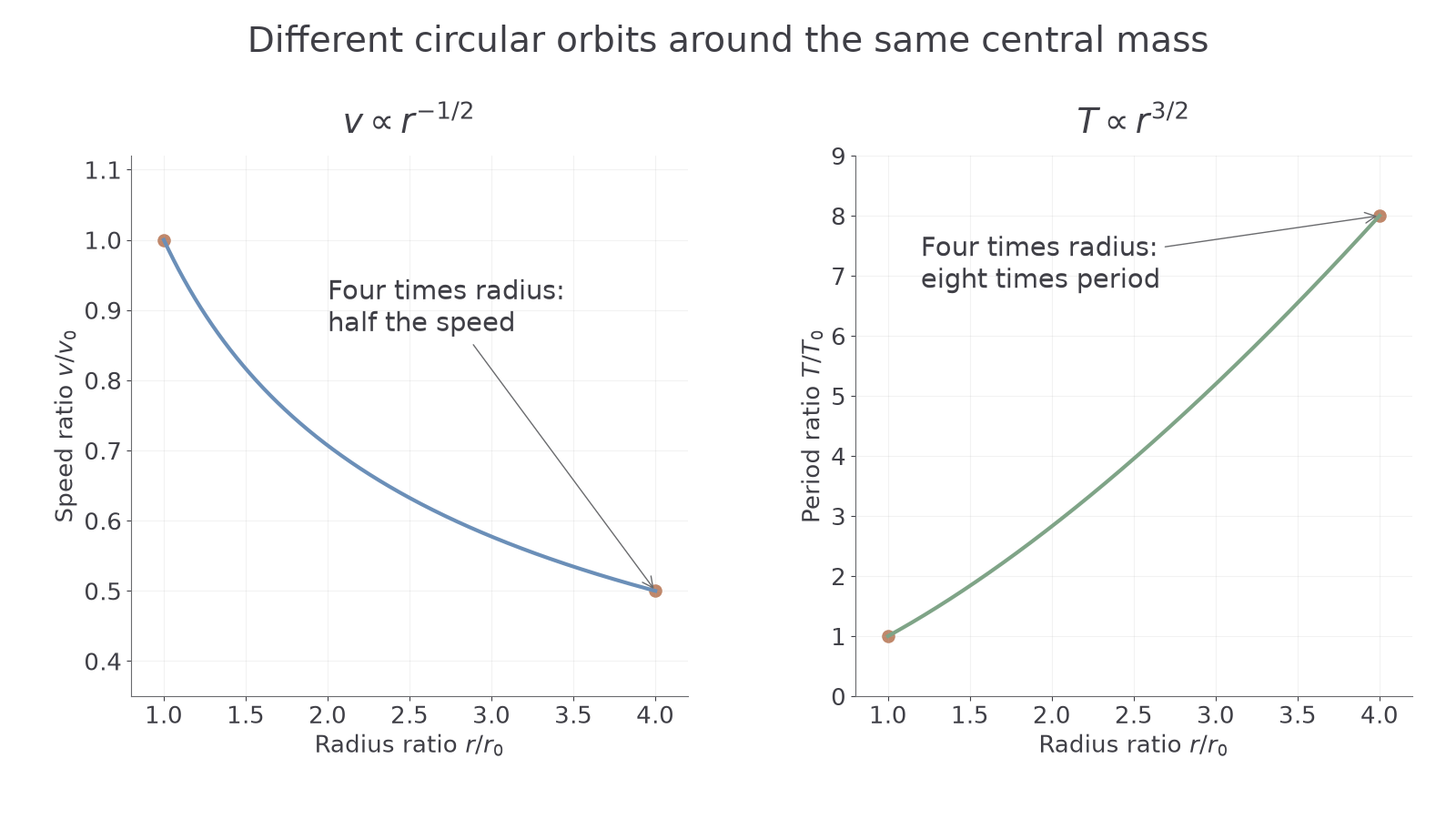
For two circular orbits around the same central mass,
For example, four times the radius gives eight times the period but half the speed. Do not confuse these separate orbits with points on one rigid rotating wheel: those points share angular speed, whereas separate satellites generally do not.
[DIAGRAM: asset_name: Different radii give different orbital rates; asset_slug: circular-orbit-scaling; caption: For a fixed central mass, larger circular orbits are slower and take longer; description: Two dimensionless graphs use a reference circular orbit. The first plots speed ratio against radius ratio as the inverse square root, marking four times the radius and half the speed. The second plots period ratio against radius ratio as radius to the power three halves, marking four times the radius and eight times the period.]
Continue this lesson.
You’re previewing NovaLearn without an account. Create a free account to read the rest.
Create free account