22.2 - The photoelectric effect
Explain photoelectric emission using individual photons and work function, calculate threshold and maximum electron energies, and distinguish the effects of light intensity and frequency.
Photoelectric emission and its threshold
A metal emits electrons under faint violet light but not under brighter red light: why can changing colour succeed when adding more light fails? The deciding quantity is the energy of an individual photon, rather than the total energy arriving each second.
In the photoelectric effect, electrons are emitted from a metal surface when electromagnetic radiation is incident on it. These emitted electrons are called photoelectrons. The metal needs a minimum incident frequency for this emission to occur in the single-photon model.
Threshold frequency and threshold wavelength
Threshold frequency is the minimum frequency of incident electromagnetic radiation that causes photoelectric emission from a particular surface. Threshold wavelength is the maximum wavelength that can cause this emission.
The two thresholds describe the same boundary because : a higher frequency means a shorter free-space wavelength. Light below the threshold frequency, equivalently above the threshold wavelength, cannot supply enough energy in one photon to release an electron. Increasing its intensity supplies more inadequate photons rather than increasing their individual energies.
The relevant observations are not just that electrons leave. Emission has a threshold frequency; above threshold it can begin promptly after absorption even with low intensity. Increasing frequency increases the largest emitted kinetic energy, while increasing intensity at fixed frequency increases the number emitted per second under fixed collection conditions.
Model limit
The threshold rule here is the ordinary single-photon model: one electron absorbs a photon's energy in one interaction. Do not imagine that an electron must gradually save energy from many low-frequency photons until it can escape.
For a surface with a threshold between red and violet frequencies, the violet photons can each release an electron while the red photons cannot. The next part makes that energy requirement quantitative.
Work function and maximum kinetic energy
An electron needs energy to escape from a metal surface. The least energy needed is the work function energy, , for that surface. It is a property of the material and its surface condition, not of the chosen light intensity.
Work function energy
Work function energy is the minimum energy required to remove an electron from a metal surface.
If a photon has more energy than this minimum, the excess can appear as the kinetic energy of an emitted electron. Electrons do not all leave with the same kinetic energy: some lose more energy on their way out. The maximum corresponds to an electron requiring only the minimum escape energy.
Photoelectric energy equation
is Planck constant in , is incident frequency in Hz, is work function energy in J, is electron mass in kg and is maximum emitted speed in . Use consistent energy units. The kinetic-energy expression is non-relativistic; it is suitable for the electron energies considered here.
Not on the data sheet: learn it.
At threshold, the maximum kinetic energy is zero in the ideal model. Thus and . These threshold relations are deductions from the photoelectric equation, rather than additional formulae printed on the data sheet.
Worked example 1: threshold and an emitted electron
Question. A surface has work function . Calculate its threshold wavelength and the maximum kinetic energy of electrons emitted by light of frequency . Use , and .
Plan. Convert the work function to joules; at threshold photon energy equals work function, and above it subtract the escape energy.
Answer. Threshold wavelength ; maximum kinetic energy , or (3 s.f.).
Check. The illuminating frequency exceeds , so a positive kinetic energy is physically possible. A negative calculated excess would mean no emission, not an electron with negative kinetic energy.
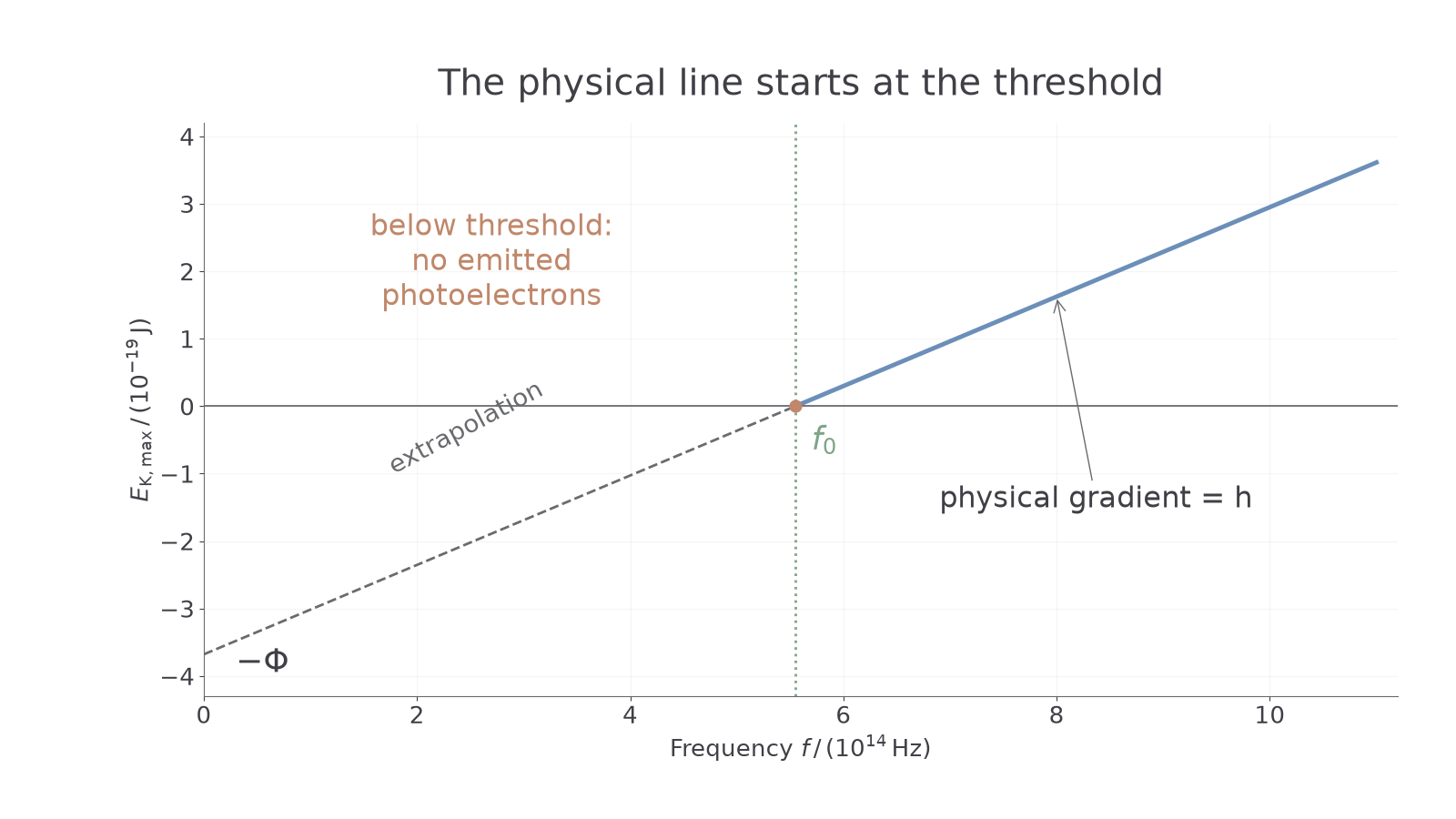
A graph of vertically against horizontally is straight above threshold. Its gradient is , its frequency-axis intercept is , and a backward extrapolation reaches on the energy axis. That negative extrapolation is a way to find a parameter; it does not describe real emitted electrons below threshold.
[DIAGRAM: asset_name: Maximum kinetic energy and threshold frequency; asset_slug: quantum-photoelectric-graph; caption: The physical line starts at threshold; its backward extrapolation finds the work function; description: Maximum photoelectron kinetic energy in units of ten to the minus nineteen joules is plotted against frequency in units of ten to the fourteen hertz. For work function 3.68 times ten to the minus nineteen joules, the solid positive-energy line starts at f0 about 5.55 times ten to the fourteen hertz. A dashed backward extrapolation reaches minus Phi on the energy axis. The below-threshold region is labelled no emitted photoelectrons, not negative electron energies.]
Continue this lesson.
You’re previewing NovaLearn without an account. Create a free account to read the rest.
Create free account