23.1 - Mass defect and binding energy
Connect rest mass with energy, balance nuclear reaction equations, and calculate a nucleus's mass defect and binding energy. Keep nuclear and atomic masses separate so that the energy calculation accounts for the same particles on both sides.
Rest mass and energy
If you separated a helium nucleus into its protons and neutrons, would their total rest mass go up, down, or stay the same? Counting the particles will not settle this: the energy of their arrangement matters too.
A nucleus contains protons and neutrons, collectively called nucleons. Its rest mass is the mass measured in its own rest frame. Rest mass is associated with energy; a change in the internal energy of a system changes its rest mass. A bound nucleus can therefore have a different mass from the same nucleons separated and at rest.
Mass–energy equivalence
Here is rest energy in joules, is rest mass in kilograms and is the speed of light in vacuum. For a change in rest energy, . This does not say that a particle's kinetic energy is .
Not on the data sheet: learn it. The value of is supplied.
The large value of explains why a small nuclear mass difference can correspond to substantial energy. For example, a decrease of just in a system's rest mass corresponds to released from its rest energy. This is an energy equivalence, not a promise that any chosen material can release all its rest energy.
You already know
One electronvolt is the energy transferred when one elementary charge moves through a p.d. of one volt: . Thus . The charge is supplied on the data sheet; the prefix conversion must be applied.
Worked example 1: a small mass difference
Question. In a nuclear process, the total rest mass of all the particles decreases by . Calculate the energy made available in joules and in megaelectronvolts.
Plan. Use the positive decrease in mass for the released energy, then divide by the number of joules in one megaelectronvolt.
Check. is a joule. A mass decrease gives energy available to the products and radiation, rather than energy that must be supplied.
Mass–energy is conserved overall. If the products have less total rest energy, the difference can appear as their kinetic energy or as radiation. Saying “mass disappears” hides that accounting. We will now identify exactly which particles belong in the two mass totals.
Accounting for the particles in a reaction
A nuclear equation records the nuclei and particles before and after a reaction. It is a conservation statement, not a drawing of their trajectories. In nuclide notation , is the nucleon number and the proton number. The neutron number is .
For the reactions here, the total nucleon number and total electric charge are conserved. Add the upper numbers on each side and then the lower numbers. Conserve each total separately; do not try to conserve the number of nuclei.
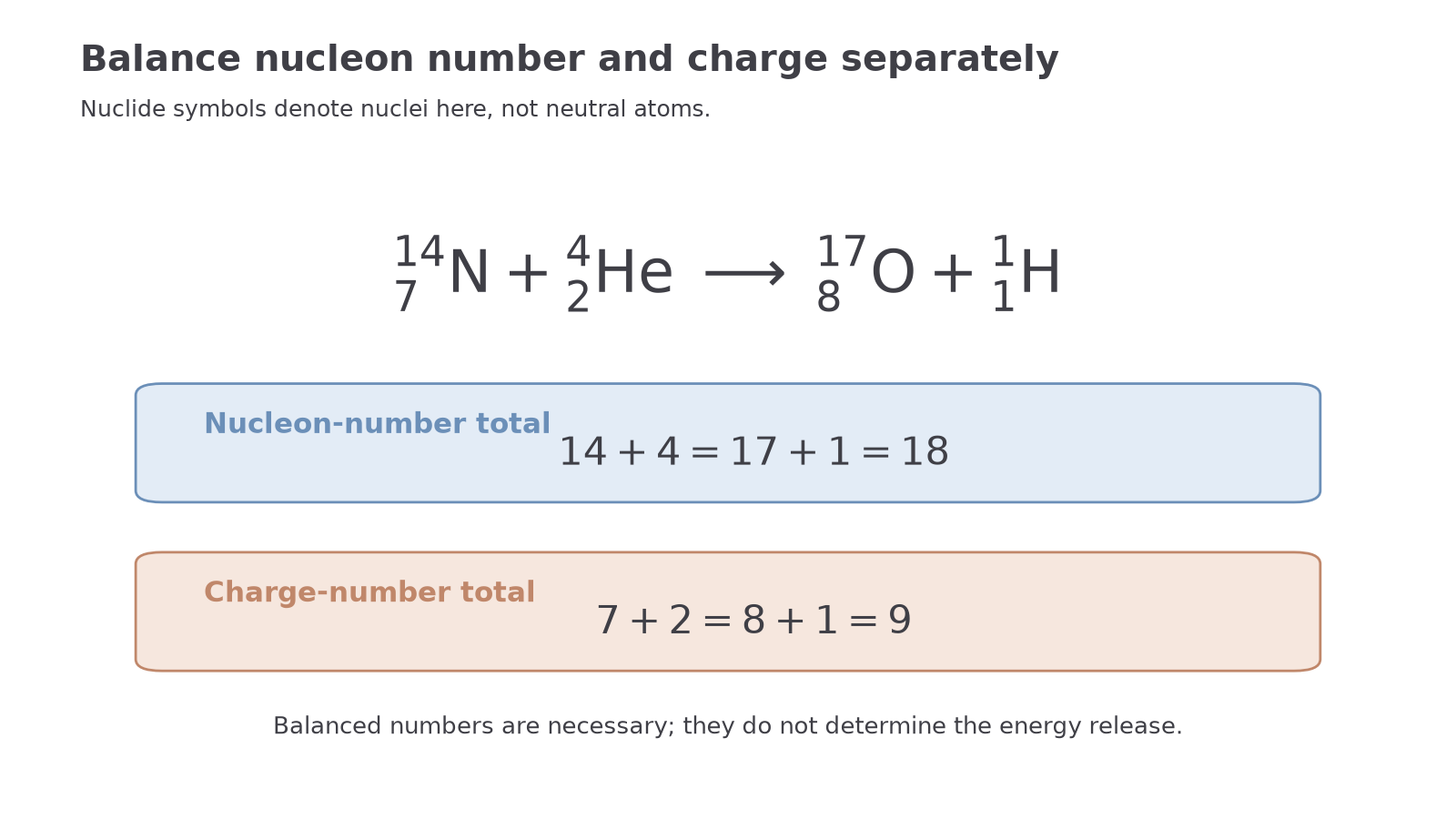
For example, an alpha particle can interact with nitrogen:
The upper totals are . The lower totals are . Here denotes an alpha particle and a proton, not neutral atoms. The total charge on either side is .
[DIAGRAM: asset_name: Two separate conservation checks; asset_slug: nuclear-equation-balance; caption: Nucleon number and charge number are conserved separately in the nitrogen reaction; description: A large nuclear equation for nitrogen-14 plus helium-4 giving oxygen-17 plus a proton. Separate blue upper-number and clay lower-number ledgers show 14 plus 4 equals 17 plus 1 and 7 plus 2 equals 8 plus 1. A note says that nuclide symbols denote nuclei in this equation.]
Finding a missing particle
Suppose . Subtract the known product totals from the reactant totals:
The particle is , a neutron. A photon would have zero nucleon number and zero charge, so it cannot supply the missing nucleon here.
Watch out
Conserving nucleon number does not mean that the sum of the rest masses is unchanged. The rest energy of a bound nucleus includes its binding, so it is smaller than the sum for the isolated constituent nucleons. Balance the particle equation first, then compare the actual masses.
Balancing these two numbers is necessary, but it does not establish that a proposed reaction will occur. The available energy and other physical conditions also matter. Do not infer the likelihood or energy release from balance alone.
Continue this lesson.
You’re previewing NovaLearn without an account. Create a free account to read the rest.
Create free account