5.1, 5.2 - Work, kinetic energy and potential energy
Use work to connect forces with energy changes, derive the expressions for gravitational potential energy and kinetic energy, and solve motion problems by keeping track of energy transfers.
Work done by a force
Would a heavy stone reach the ground faster than a light stone if both fell from rest through the same height in a vacuum? The heavy stone loses more gravitational potential energy. Yet that does not give it a greater final speed. To see why, start with what a force transfers when its point of application moves.
A force does work when there is displacement in its direction. Pulling a box transfers energy to it; friction can transfer energy from its motion to the internal energy of the box and floor. Work measures an energy transfer, rather than something contained in the force.
Work done
Work done by a force is the product of the force and the displacement in the direction of the force.
If a constant force acts at an angle to a straight displacement, resolve it along the displacement. Its perpendicular component does no work on that motion.
Work done by a constant force
is work done in joules (J), is force in newtons (N), is displacement in metres (m), and is the angle between force and displacement. For parallel force and displacement, . The force and angle must be constant for this expression to apply directly.
Not on the data sheet: learn it.
A force in the direction of motion does positive work. A force opposite to motion does negative work: . If you are asked for the work done against friction, report the positive energy that must be supplied to overcome it.
[DIAGRAM: asset_name: The part of a force that does work; asset_slug: energy-work-components; caption: Only the component parallel to the displacement contributes to this work; description: A box is pulled by a force F at 30 degrees above the horizontal. A horizontal arrow from the box shows displacement s to the right. A dashed horizontal force component is labelled F cos theta. The force arrow and its component begin at the same point on the box.]
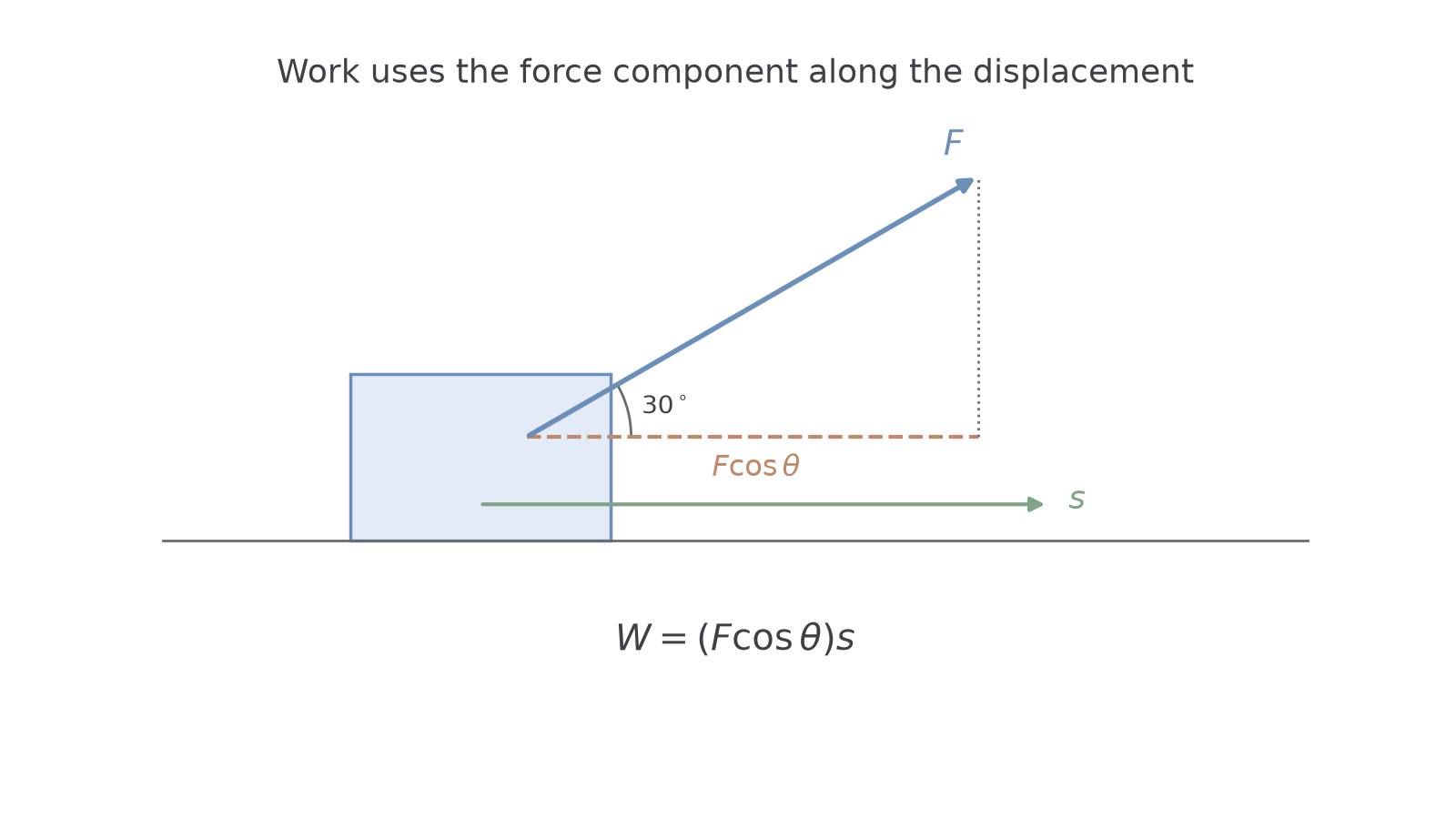
Worked example 1: pulling at an angle
Question. A force of pulls a box through horizontally. The force acts at above the horizontal. Calculate the work done by this force.
Plan. Use the component of the pulling force along the displacement.
Answer. (2 s.f.).
Check. The answer is less than , as only part of the force acts along the motion. This is the pulling force's work; finding the net work would also require any other forces doing work.
A force is not enough on its own: a wall does not gain mechanical energy just because you push it without moving it. Your muscles may still transfer chemical energy internally, which is a different process.
Changes in gravitational potential energy
Raising a mass separates it from Earth against the gravitational force. The work you supply can increase the gravitational potential energy of the Earth–object system. Near Earth's surface, we model the field as uniform, so the weight has constant magnitude .
Imagine lifting a mass slowly at constant speed through a vertical height . The upward lifting force equals its weight. Its work is therefore
There is no change in kinetic energy, so this work gives the increase in gravitational potential energy. This derivation uses the weight's constant value, not the total length of a sloping path.
Gravitational potential energy change
is the change in gravitational potential energy in J, is mass in kg, is gravitational field strength in , and is vertical height change in m. Upward height change is positive. This relation assumes a uniform gravitational field. The value is supplied on the data sheet, but this equation is not.
Not on the data sheet: learn it.
Only a change in height matters here. Choose a convenient reference height and use it consistently. A descent has negative , so the gravitational potential energy decreases; gravity then does positive work.
Worked example 2: a ramp and a height
Question. A crate moves up a ramp of length , gaining in vertical height. Calculate its increase in gravitational potential energy. Use .
Plan. Use the vertical rise, rather than the distance along the ramp.
Answer. (2 s.f.).
Check. The change is positive because the crate rises. A different ramp reaching the same height gives the same potential energy change, although friction could alter the work needed from the person moving it.
Model limit
Use when changes in height are small enough for to be effectively constant. It is not the appropriate general formula for journeys far from Earth; the A Level gravitational-potential lesson develops that model.
Check which displacement controls the energy change.
Kinetic energy and net work
Speeding up an object requires a transfer of energy to its motion. The faster it is already moving, the more energy is needed for the same further increase in speed. This is why kinetic energy is not simply proportional to speed.
You can derive its expression from mechanics you already know. Consider a mass accelerating in a straight line from speed to speed , under a constant resultant force . With displacement , Newton's second law and the constant-acceleration equation give
For an object accelerated from rest, the net work transferred to its motion is . This motivates the definition of kinetic energy. The derivation uses a constant force; the resulting work–energy relationship also applies when the force changes.
Kinetic energy
is kinetic energy in J, is mass in kg and is speed in . Kinetic energy is a scalar and is never negative. These expressions describe ordinary non-relativistic motion; the net-work statement refers to the object's translational kinetic energy in this model.
Not on the data sheet: learn it.
Doubling the speed quadruples the kinetic energy. That is a real physical consequence of the square, not a calculator trick: stopping from twice the speed requires four times the energy transfer. With the same constant braking force, the stopping distance is four times as large.
Exam-style example: speeding up rather than starting
Question. A vehicle increases its speed from to . Calculate the net work done on it.
Plan. Find the change in kinetic energy. Do not square the change in speed.
Answer. (2 s.f.).
Check. This is positive. Using would wrongly give , because a difference of squares is not the square of a difference.
The net work is the sum of the work by all forces. If a motor transfers to a trolley while friction removes from its motion, its kinetic energy increases by .
Conservation of energy
An energy account must include every relevant transfer. Energy can change form or move between objects, but the total does not disappear when an object slows down.
Conservation of energy
Energy cannot be created or destroyed; the total energy of an isolated system remains constant.
In a fall with negligible air resistance, the loss of gravitational potential energy equals the gain in kinetic energy. For a stone falling from rest through height in a uniform field,
The mass cancels because a larger mass loses proportionally more potential energy but also needs proportionally more energy for any given speed. That answers the opening puzzle: the heavier stone has more kinetic energy, but the same speed after the same drop.
Real falls can transfer energy to the surroundings through air resistance. Mechanical energy, meaning kinetic plus potential energy here, then decreases while total energy remains conserved. Avoid saying that friction “uses up energy”. It transfers energy to internal energy and sometimes sound.
Worked example 3: allowing for a resistive force
Question. A object slides from rest through a vertical drop of . A resistive force transfers to internal energy. Calculate the final speed. Use , and neglect rotational motion.
Plan. Subtract the transferred internal energy from the potential energy lost, then find the final kinetic energy.
Answer. (2 s.f.).
Check. With no resistance the speed would be , so the smaller answer makes sense.
Exam tip
State the energy transfers in your equation before substituting. “Potential energy lost = kinetic energy gained + energy transferred to the surroundings” makes the sign of the resistive term clear.
Now explain the physics without relying on identical wording.
Quick Recap
- Work is force multiplied by displacement in the force's direction; opposite forces can do negative work.
- In a uniform field, a vertical rise changes gravitational potential energy by .
- Kinetic energy is ; net work changes it by .
- Total energy is conserved, including transfers to internal energy when resistance acts.
In the stated vacuum fall, the stones land together: the heavier stone gains more kinetic energy but reaches the same speed because mass cancels from .