23.1 - Energy from fission and fusion
Use the binding-energy-per-nucleon curve to explain why both splitting heavy nuclei and joining light nuclei can release energy. Balance complete reactions, compare total initial and final masses, and calculate the energy available to their products.
Reading the binding-energy curve
How can both joining nuclei and splitting nuclei release energy? The answer depends on where the nuclei start on the binding-energy curve, rather than on whether the number of nuclei increases or decreases.
Binding energy measures how much energy would be needed to separate a nucleus completely into free nucleons. A large total binding energy can simply mean that there are many nucleons. To compare how tightly nucleons are bound on average, divide by the nucleon number.
Binding energy per nucleon
Here is the total binding energy of one nucleus, commonly in , and is its dimensionless nucleon number. The result is commonly stated in per nucleon. It is an average, not the energy required to remove any particular nucleon.
Not on the data sheet: learn it.
[DIAGRAM: asset_name: The broad binding-energy trend; asset_slug: nuclear-binding-curve; caption: Light nuclei can gain binding energy per nucleon by fusion and very heavy nuclei by fission; description: A graph of binding energy per nucleon in MeV against nucleon number rises steeply for light nuclei to a broad maximum around nucleon number 56 and then falls gradually towards very heavy nuclei. Pale arrows point towards the maximum from each side, labelled fusion of light nuclei and fission of very heavy nuclei. A note states that the curve shows the broad trend and individual light nuclei vary.]
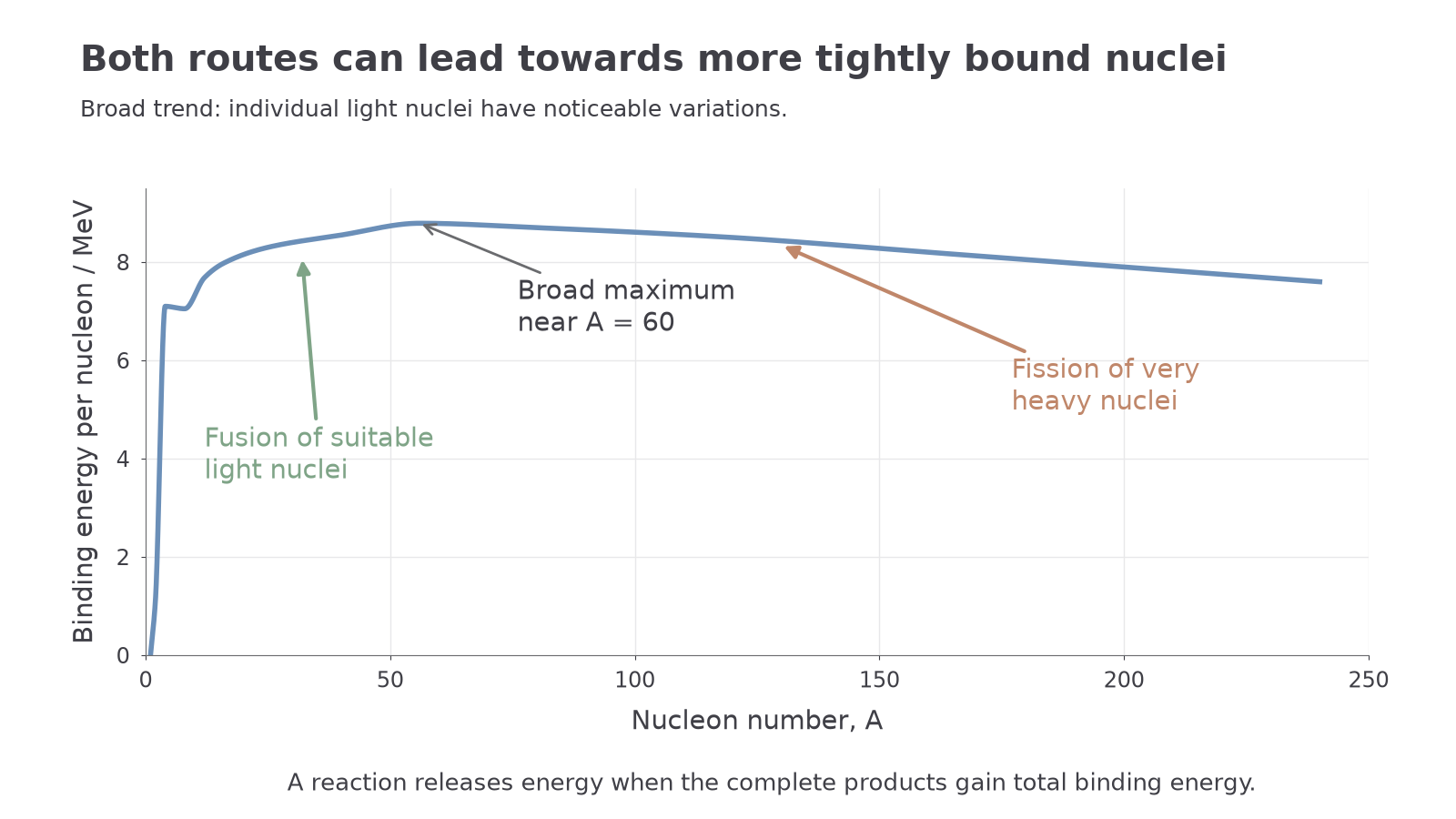
For the required sketch, label both axes, show the steep rise among light nuclei, a broad maximum around the iron/nickel region at near 60, and a much gentler fall towards very heavy nuclei. The maximum is about per nucleon. It is not a straight line, and the heavy-nucleus end does not fall back to zero. Individual light nuclei have noticeable departures from the broad trend.
Moving to products with a greater total binding energy lowers their combined rest energy relative to the same separated nucleons. The difference can be released. Higher binding energy per nucleon therefore suggests an energy-releasing direction when the reaction's complete nucleon accounting supports it. It does not guarantee that the reaction will occur readily.
Worked example 1: average versus total
Question. Nucleus P has nucleon number 40 and binding energy per nucleon . Nucleus Q has nucleon number 200 and binding energy per nucleon . Which has the greater total binding energy?
Plan. Multiply the average by the number of nucleons before comparing totals.
Q has the greater total binding energy, although its nucleons are less tightly bound on average. These are separate nuclei being compared, not a balanced reaction transforming P into Q.
Watch out
The curve's vertical axis is binding energy per nucleon. Do not subtract two graph heights and call the result the energy of a complete reaction. Calculate total binding energies for all relevant nuclei, including their numbers of nucleons.
Why fission and fusion can release energy
The two energy-releasing routes approach the more tightly bound middle region from opposite sides. Neither creates energy from nothing: both can transfer a decrease in total rest energy into kinetic energy and radiation.
Nuclear fission and nuclear fusion
Nuclear fission is the splitting of a heavy nucleus into two lighter nuclei, usually with neutrons emitted.
Nuclear fusion is the joining of two light nuclei to form a heavier nucleus. Other particles may also be emitted.
Fission: starting on the heavy side
A very heavy nucleus has a lower binding energy per nucleon than medium-mass nuclei. If it splits into suitable lighter nuclei, the products can have a greater total binding energy. Less rest energy then remains in the products, and the difference is released.
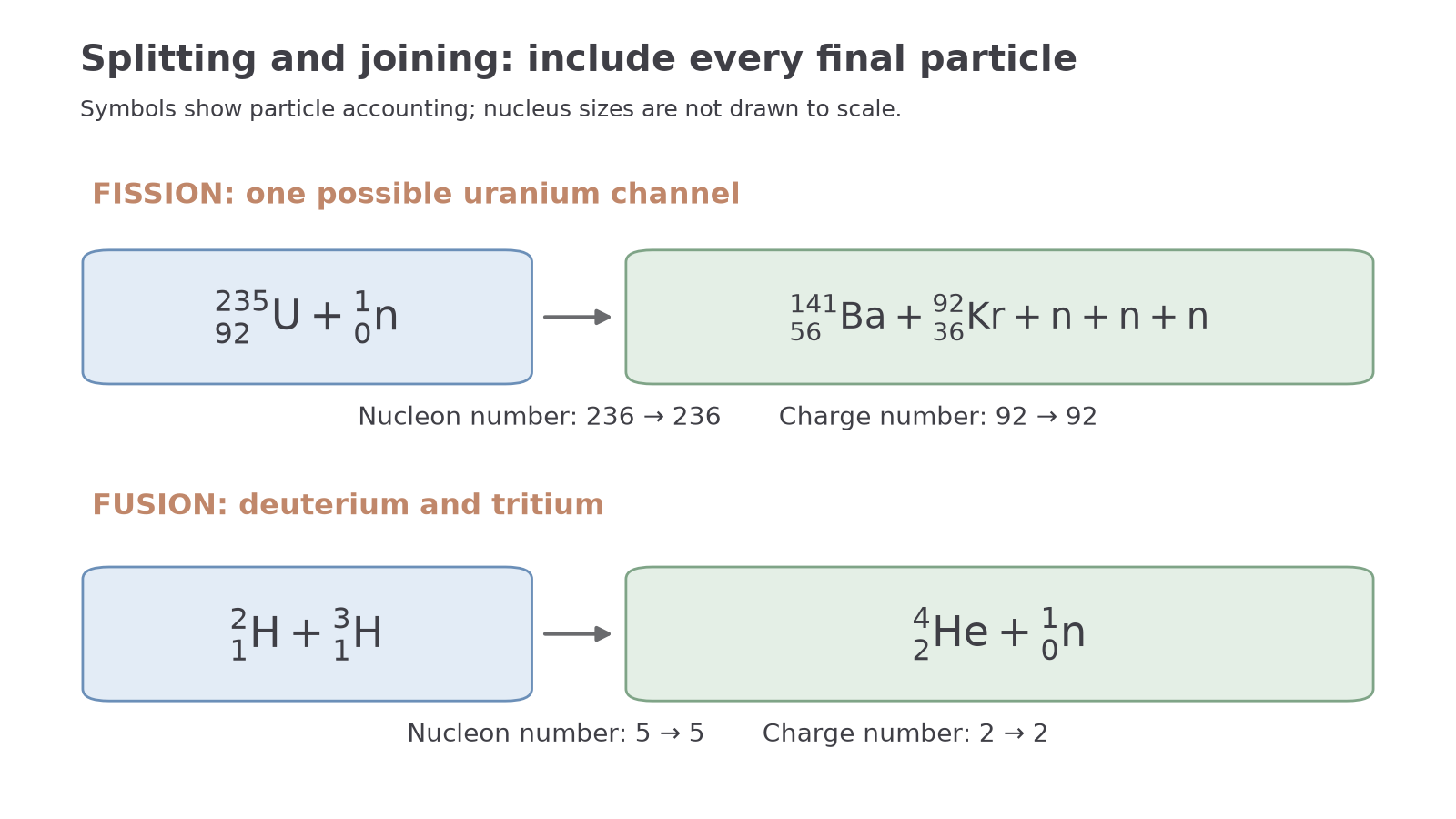
One possible neutron-induced fission channel is
Check and . The emitted neutrons belong in the final mass total, even though free neutrons have no nuclear binding energy. Fission has several possible product channels; this equation is one channel, not a unique universal split.
Fusion: starting on the light side
Suitable light nuclei can join to form more tightly bound products. For example,
The total nucleon number is 5 and charge number 2 on either side. The helium nucleus is much more tightly bound than the initial light nuclei. The increase in total binding energy releases energy, carried mainly as kinetic energy of the products in this reaction.
[DIAGRAM: asset_name: Two routes to more tightly bound products; asset_slug: nuclear-fission-fusion; caption: Fission splits a very heavy nucleus while fusion combines light nuclei and both require complete particle accounting; description: Two panels show the balanced uranium-235 plus neutron fission channel to barium-141, krypton-92 and three neutrons, and deuterium plus tritium fusion to helium-4 plus a neutron. Nuclei are labelled symbols rather than scale drawings. Blue initial nuclei and sage final nuclei are linked by arrows, with all free neutrons shown.]
Continue this lesson.
You’re previewing NovaLearn without an account. Create a free account to read the rest.
Create free account