8.2 - Diffraction at gaps and edges
Learn why waves spread into a geometrical shadow and how the amount of spreading depends on wavelength compared with an opening. You will use ripple-tank observations to separate diffraction from changes of wave speed or frequency.
Waves spreading beyond an opening
Why can you hear someone around a doorway while you cannot usually see them through the wall? Sound and light both diffract, but their very different wavelengths make the spreading very different on the scale of a doorway.
Diffraction
Diffraction is the spreading of waves as they pass through a gap or around an edge.
A straight-line ray picture predicts a sharp shadow behind an obstacle. A wave can spread into that region. Behind a gap, the wavefronts bend around the gap edges and the disturbance reaches directions outside the straight-ahead beam. Diffraction occurs for transverse waves, longitudinal waves and electromagnetic waves; it is not a special property of light.
A wavefront joins points in the same phase, such as successive crests on a water surface. The local direction of propagation is perpendicular to a wavefront. Straight wavefronts describe a plane wave travelling in one direction. Curved wavefronts show propagation directions spreading out. A ray arrow and a wavefront therefore represent different features of the same wave.
[DIAGRAM: asset_name: Diffraction at a single edge; asset_slug: superposition-edge-diffraction; caption: A wave spreads into the geometrical shadow behind an edge; description: Straight incident water-wave crests approach a barrier ending at one point. Beyond that edge, crest lines curve into the region that straight rays would leave in shadow. Propagation arrows are perpendicular to the wavefronts, and the barrier and geometrical shadow are labelled.]
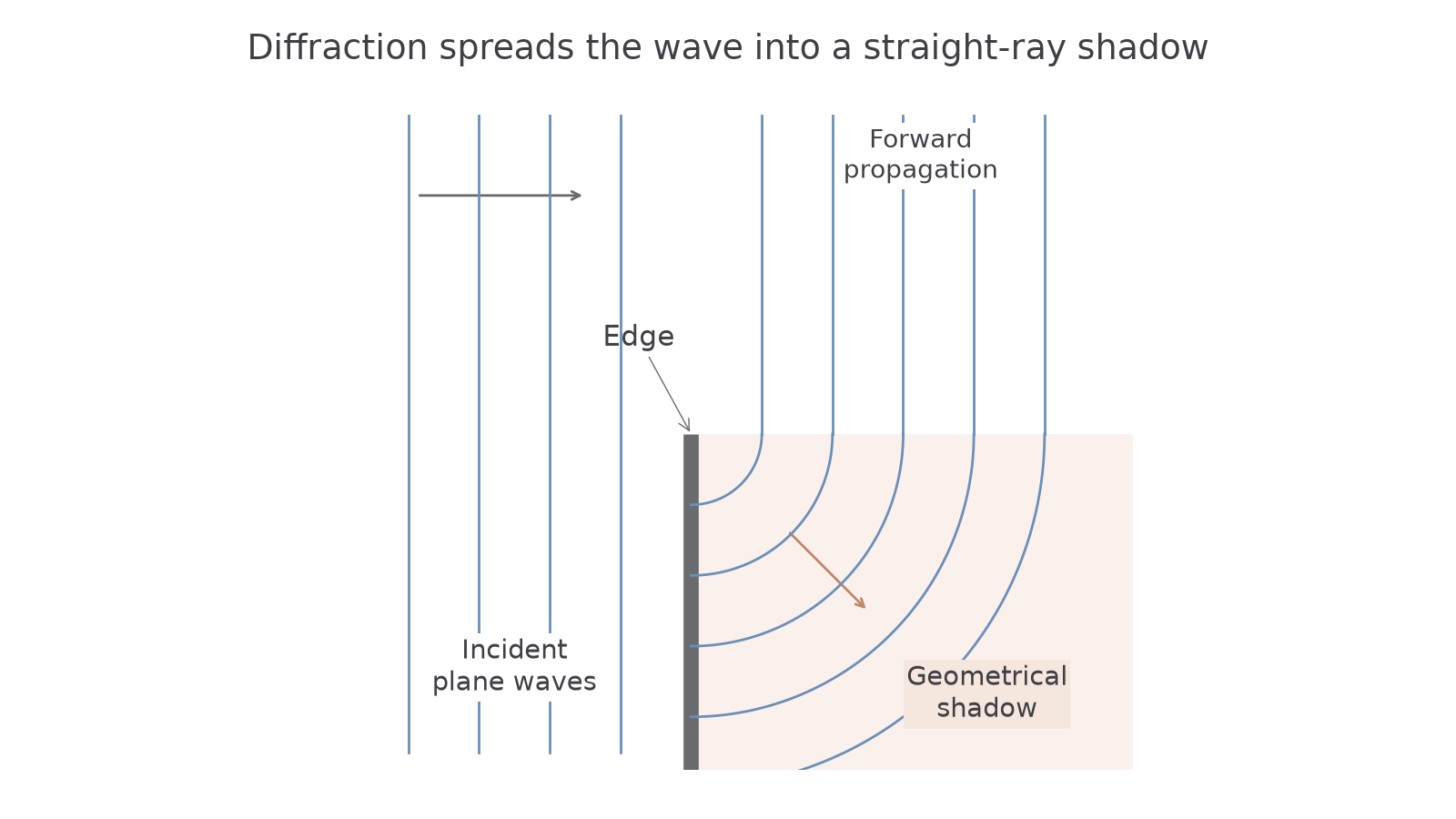
Diffraction does not require a new medium. If a wave passes a gap while staying in the same uniform medium, its speed and frequency stay the same, so its wavelength stays the same too. What changes is the range of directions in which it propagates. Refraction, which involves a change of wave speed, is a different process.
Watch out
Do not say “the wave slows down at the gap, so it bends”. In a uniform-depth ripple tank, diffraction through a gap occurs without a change of wave speed.
The physical distinction matters more than a memorised sketch.
Gap width compared with wavelength
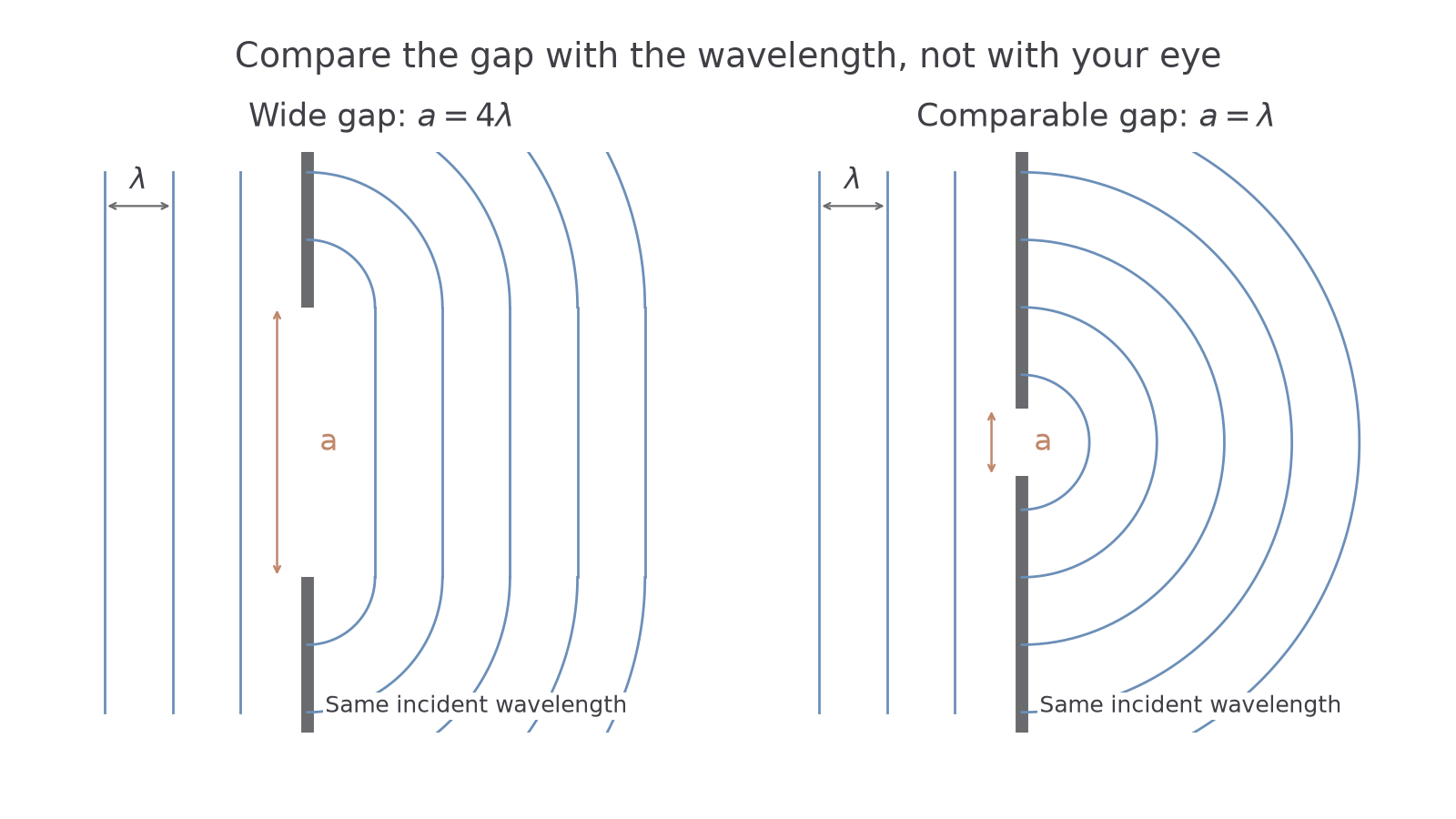
The important comparison is not whether a gap looks small to you, but whether it is small compared with the wavelength. A metre-wide opening is enormous for visible light and only a few wavelengths wide for many sounds.
When the gap width is much greater than wavelength , most wavefronts continue nearly straight ahead, with noticeable curvature mainly near the edges. When is comparable to , spreading is pronounced and the transmitted fronts can be approximately semicircular. Reducing a wide gap towards a size comparable to the wavelength makes this spreading more pronounced. A gap much narrower than the wavelength may transmit very little wave energy; it does not give unlimited increases in spreading.
[DIAGRAM: asset_name: Gap width and wavelength; asset_slug: superposition-gap-comparison; caption: The same wavelength spreads much more when the gap width is comparable to it; description: Two ripple-tank plan views use the same spacing of incident wavefronts. A wide opening of four wavelengths gives mostly forward wavefronts with edge curvature. An opening of one wavelength gives strongly curved, approximately semicircular outgoing wavefronts. Gap dimensions and wavelength spacings are shown consistently.]
Worked example: sound and light at a doorway
Question. Sound of frequency travels at towards a -wide doorway. Compare its diffraction with that of light of wavelength at the same doorway.
Plan. Find the sound wavelength, then compare each wavelength with the gap width. The wave equation is not on the data sheet: learn it.
The sound wavelength and doorway width are of similar size, so substantial spreading is expected. The light wavelength is about a million times smaller than the doorway width, so its diffraction angle is tiny on this scale.
Answer. Sound spreads much more around the doorway. Light also diffracts, but this opening does not usually make its spreading visible to you.
Check. This explains the opening observation without claiming that light always travels in perfectly straight lines.
Continue this lesson.
You’re previewing NovaLearn without an account. Create a free account to read the rest.
Create free account