18.3, 18.4 - Point charges and Coulomb's law
Calculate forces between point charges, recognise when a charged sphere can be represented by a point at its centre, and determine the strength and direction of a radial electric field. Add fields as vectors rather than treating their magnitudes as signed charges.
The inverse-square force between point charges
If you double the distance between two charges, does their force merely halve? It falls to a quarter. The same inverse-square pattern you met in gravitation appears here, but electric forces can repel as well as attract.
Coulomb's law gives the force between stationary point charges in free space. Like signs repel and unlike signs attract; the force acts along the line joining them. Each charge experiences an equal-magnitude opposite force, even when their charges differ in magnitude.
Coulomb's law
Here is force magnitude in , are charges in , is their separation in , and is free-space permittivity in . Use the charge signs to determine attraction or repulsion. The data sheet supplies , expressed there in equivalent units.
Not on the data sheet: learn it.
The absolute-value signs make clear that this version calculates a magnitude. You can instead use signed components in a chosen direction, but a negative product alone is not a complete vector direction statement. “Attractive, towards the other charge” is unambiguous.
Worked example 1: unlike charges
Question. Point charges and are apart in free space. Calculate the force magnitude and state whether it is attractive or repulsive.
Answer. , attractive.
Check. Use before squaring. The two charges feel equal forces; the larger charge does not get a larger share of the interaction force.
When separation changes by a factor with both charges fixed, force changes by . When one charge doubles, force doubles; when both double, force quadruples. Distinguish these changes rather than applying “square” to every variable in the formula.
Exam-style example: finding an unknown equal charge
Question. Two equal positive point charges separated by repel with force . Determine each charge, using .
Plan. Both charge factors are the same unknown, so solve for its square before taking the root.
Answer. Each charge is .
Check. Repulsion alone would establish equal signs, not whether both were positive or negative; the question supplies positivity.
Model limit
A point charge has negligible size compared with the separation relevant to the calculation. Coulomb's free-space form is not a universal formula with the same permittivity for every material medium.
A spherical conductor's exterior field
A charged metal sphere has a finite size, yet its exterior field can be especially simple. For an isolated spherical conductor in electrostatic equilibrium, its spherically symmetric charge distribution gives the same exterior field as its total charge placed at the centre.
For an observation point outside a sphere of radius , use the centre-to-point distance , with , rather than the distance from the surface. At height above the surface, . Forgetting the radius overestimates the field, especially close to a large sphere.
[DIAGRAM: asset_name: Exterior field of a charged sphere; asset_slug: charged-sphere-field; caption: An isolated positive conducting sphere has a radial exterior field, with distances measured from its centre; description: Non-crossing radial field lines point outward from a positively charged spherical conductor. Radius R and a centre-to-observation-point distance r are labelled, with r equal to R plus the surface clearance h. No point-charge field lines are drawn through the conductor.]
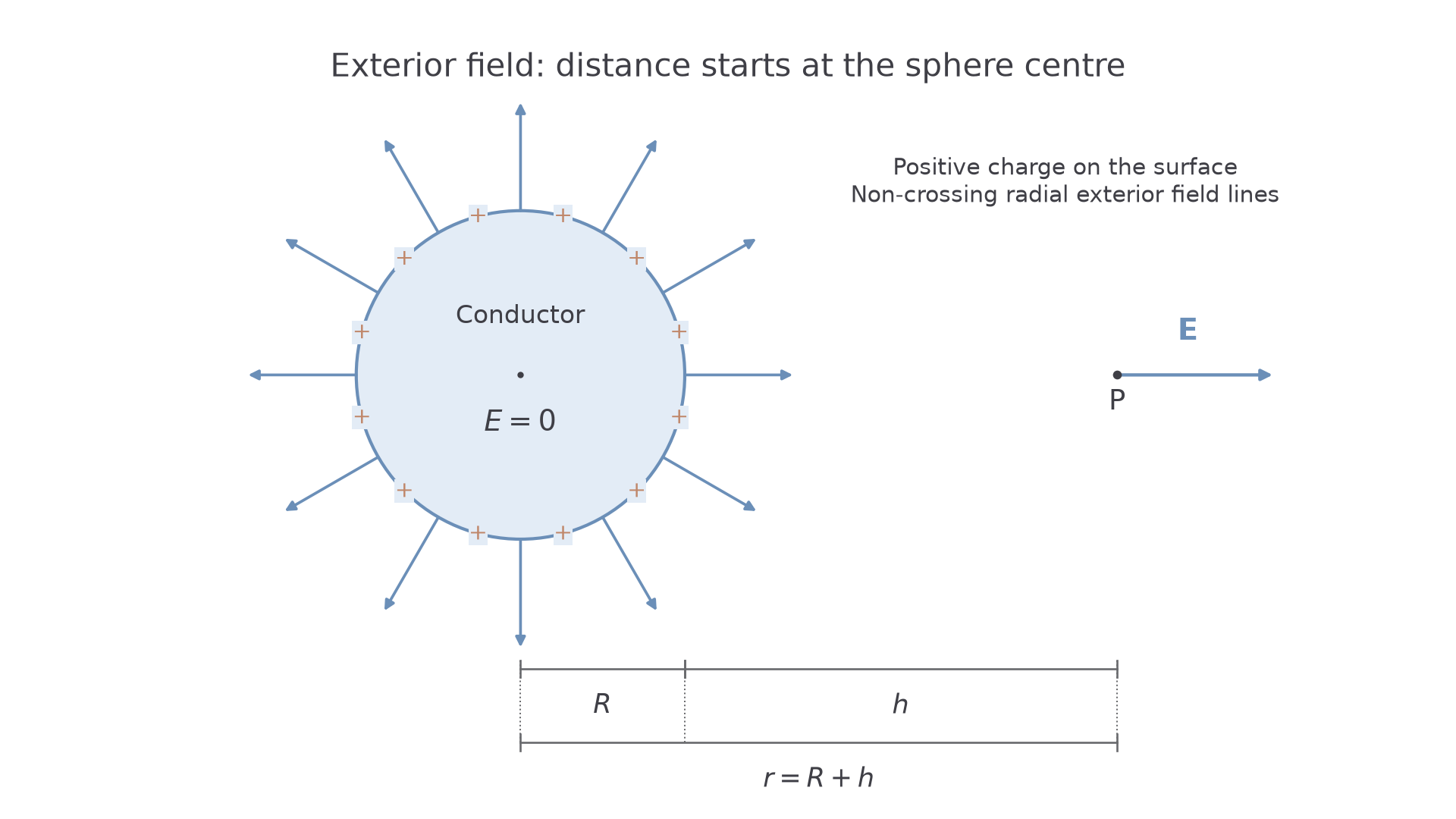
The point representation is an exterior result, not permission to shrink the conductor physically. In electrostatic equilibrium the field inside its conducting material is zero, so the exterior inverse-square expression must not be extended down to . Nearby charges or conductors can distort the surface distribution; the isolated-sphere symmetry would then need checking.
Continue this lesson.
You’re previewing NovaLearn without an account. Create a free account to read the rest.
Create free account