3.1 - Momentum and changing motion
Learn to calculate momentum as a vector, connect resultant force with the rate at which momentum changes, and use a force–time area to find that change. Apply the ideas to stopping, rebounding and a force that varies throughout an impact.
Linear momentum has direction
Why can a thick landing mat reduce the average stopping force even when you still come to rest? The beginning and end of the motion can be the same while the stopping time differs. To explain that properly, first identify the quantity whose change matters: momentum.
Both mass and velocity affect the momentum. A heavier trolley at the same velocity has greater momentum; the same trolley at a greater speed also has greater momentum. A stationary trolley has zero momentum, regardless of its mass. Momentum is not a force hidden inside a moving object.
Linear momentum
Linear momentum is the product of an object's mass and its velocity.
Because velocity has direction, momentum is a vector in the same direction as velocity for a positive mass.
Momentum
Momentum is in , mass in kilograms and velocity in . In more than one dimension, the equation applies to each corresponding component. For one direction, choose a sign convention and retain velocity signs.
Not on the data sheet: learn it.
Worked example 1: a signed momentum
Question. A ball travels east at . Calculate its momentum.
Plan. Take east as positive and multiply mass by velocity.
Answer. east.
Check. Doubling the mass or velocity would double this momentum; reversing only the direction would reverse its sign.
For a velocity with components, multiply each component by the same mass. A object moving at east and north has momentum components east and north. Its momentum magnitude is , not the component sum 1.4.
The change in momentum is final momentum minus initial momentum. In a rebound, the final velocity reverses direction. Subtracting one speed from the other loses that reversal, usually giving a much too small change.
Watch out
Momentum and change in momentum both need direction. An object can finish with the same speed but have changed momentum because its velocity direction has changed.
Use a sign convention before calculating the change.
Force as the rate of change of momentum
A force changes momentum; a larger momentum change in a shorter time requires a larger average resultant force. This states Newton's second law in terms of momentum rather than only acceleration.
Force and momentum
The resultant force on a fixed collection of matter is the rate of change of its momentum, in the direction of that change.
For a constant mass, substituting gives . Dividing by time recovers . The momentum form therefore agrees with the law you already know, while making a collision's beginning and end particularly useful.
Average resultant force
Average resultant force is in newtons, initial and final velocities and in , mass in kilograms and interaction time in seconds. The second expression assumes constant mass. The direction is the direction of , not necessarily the direction of either velocity. Over a sufficiently short interval the rate gives instantaneous force; over a full changing impact it gives the average.
Not on the data sheet: learn it.
Worked example 2: stopping without a rebound
Question. A trolley moving at is brought to rest in . Calculate the average horizontal resultant force.
Answer. opposite to the initial motion.
Check. , so , agreeing with the momentum method.
For a rebound, keep the final velocity negative if the initial direction is positive.
Exam-style example: a ball rebounds
Question. A ball approaches a bat at and rebounds along the same line at . Contact lasts . Calculate the average force from the bat, neglecting other forces during the short contact.
Plan. The ball reverses. Take its initial direction as positive and convert milliseconds to seconds.
Answer. opposite to the ball's initial motion.
Check. Using would miss most of the momentum change: slowing to rest and then gaining speed in the reverse direction both contribute.
The landing mat extends stopping time. For the same initial and final momentum, doubling that time halves the average resultant stopping force. A person's contact force from the mat also has to account for weight; it is not always exactly the resultant force. The mat comparison explains the effect of a longer stopping interval without pretending the impact force is constant throughout.
A momentum–time graph gives the same information another way: its gradient is resultant force. A curved momentum graph needs a tangent for an instantaneous force; the chord gives the average force over its interval.
Impulse and the area under a force-time graph
A real impact force usually rises to a peak and falls again. The peak alone cannot tell you the momentum change, because the duration matters too.
For a constant resultant force, rearranging the average-force relation gives . On a force–time graph this is a rectangle's area. For a changing force, add the areas of narrow strips: the total signed area still gives the momentum change. This area is called the impulse of the force.
Impulse
Force is in newtons and time in seconds, so impulse is in , equivalent to . A constant force gives . If the graph shows only one force rather than the resultant, its area is that force's contribution to the momentum change; include any other significant force impulses separately.
Not on the data sheet: learn it.
[DIAGRAM: asset_name: Different peaks with the same impulse; asset_slug: motion-force-time-impulse; caption: Both force pulses enclose the same area, so give the same momentum change; description: Force-time graph in milliseconds and newtons overlays a blue triangular pulse from 0 to 6 milliseconds with peak 400 newtons at 3 milliseconds, and a dashed clay rectangular pulse of 200 newtons for 6 milliseconds. Both enclose area 1.2 newton seconds. A note reminds the reader to convert milliseconds to seconds before calculating.]
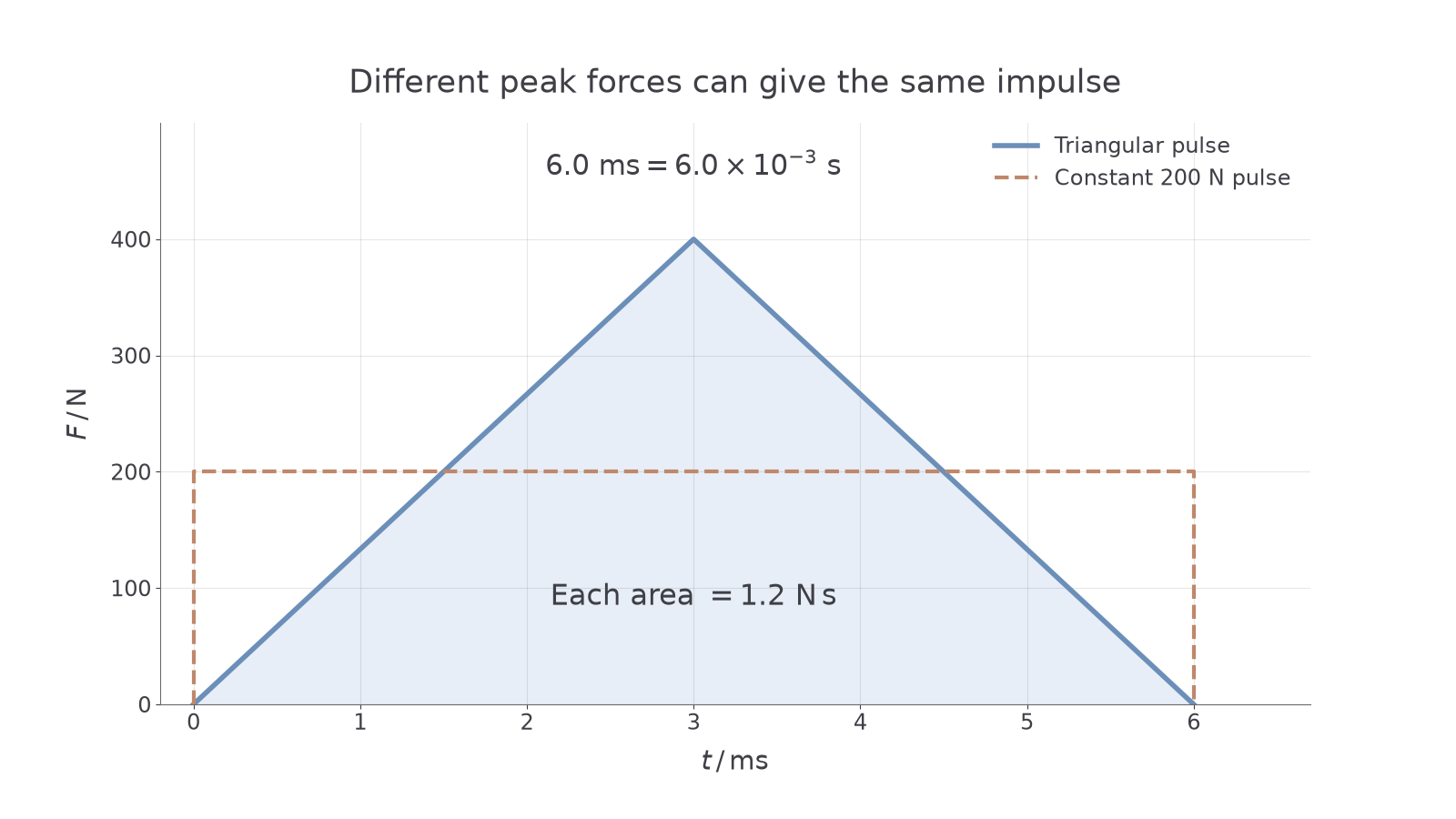
Worked example 3: a triangular force pulse
Question. The horizontal resultant force on a puck rises linearly from zero to in , then falls linearly to zero at . The puck starts from rest. Determine its final speed.
Plan. Use the triangle's area, not peak force times total time.
Check. The average force is , half the triangular peak, and gives the same impulse.
For a curved pulse, use a numerical area estimate or small squares on a fully scaled graph. A region below zero gives an impulse in the negative direction. Opposite signed areas can cancel, leaving the same final momentum despite a temporary change during the interval.
Watch out
The graph's horizontal scale may be milliseconds. An area calculated as newtons times milliseconds is of the same numerical area in newton seconds. Also, a peak force is not an average force unless the pulse is a constant rectangle.
Combine area with a non-zero initial momentum.
Quick Recap
- Momentum is , a vector with the same direction as velocity.
- Momentum change is final minus initial; a rebound needs opposite velocity signs.
- Resultant force is the rate of change of momentum; a whole collision usually gives an average force.
- The signed area under a resultant-force–time graph is impulse, equal to momentum change.
- Convert graph time units and include any significant forces omitted from the plotted force.
The mat can reduce the average resultant stopping force by extending the time over which the same momentum change occurs.