2.1 - Projectile motion
Learn to treat a projectile as two perpendicular motions sharing one clock: constant horizontal velocity and constant vertical acceleration. Use that model for horizontal launches, angled launches, landing velocities and positions along a flight, while keeping its assumptions clear.
Two motions sharing one clock
A ball is pushed horizontally off a table just as another ball is released from rest at the same height. Which lands first? In the model with no air resistance, both land together. Giving one ball horizontal velocity does not give it extra time in the air when their initial vertical velocities and drop heights are the same.
The important idea is not that gravity “waits” for horizontal motion. Gravity acts downwards throughout. In this model there is no horizontal acceleration, while the vertical acceleration is constant. The motions are independent in perpendicular directions, but they happen during the same time interval.
You already know
Resolve a vector into perpendicular components. If the launch velocity has magnitude at angle above the horizontal, then and . Check that your calculator is in degrees when the angle is given in degrees.
Choose positive horizontally along the launch and positive upwards, with the launch point as the origin. Apply the constant-acceleration model separately:
| Direction | Initial velocity | Acceleration | Displacement after time |
|---|---|---|---|
| Horizontal | 0 | ||
| Vertical |
All displacements are in metres, velocities in , time in seconds and in . The vertical equation is the supplied with the signed vertical components. The horizontal equation follows from the definition of constant velocity and is not printed separately on the data sheet: learn it.
The velocity components at time are and . These are component forms of the velocity definition and constant-acceleration relation, not additional printed formulae. The total speed is the magnitude , rather than the sum of the component magnitudes.
[DIAGRAM: asset_name: Horizontal and vertical motion of a projectile; asset_slug: motion-projectile-components; caption: Equal time intervals give equal horizontal steps and increasingly large downward steps; description: A horizontal launch follows a parabolic path. Positions at equal time intervals are marked. Blue horizontal velocity arrows have equal length at successive positions; clay vertical velocity arrows start at the positions and grow downward in proportion to elapsed time. The launch point has zero vertical velocity. A dashed horizontal line marks launch height.]
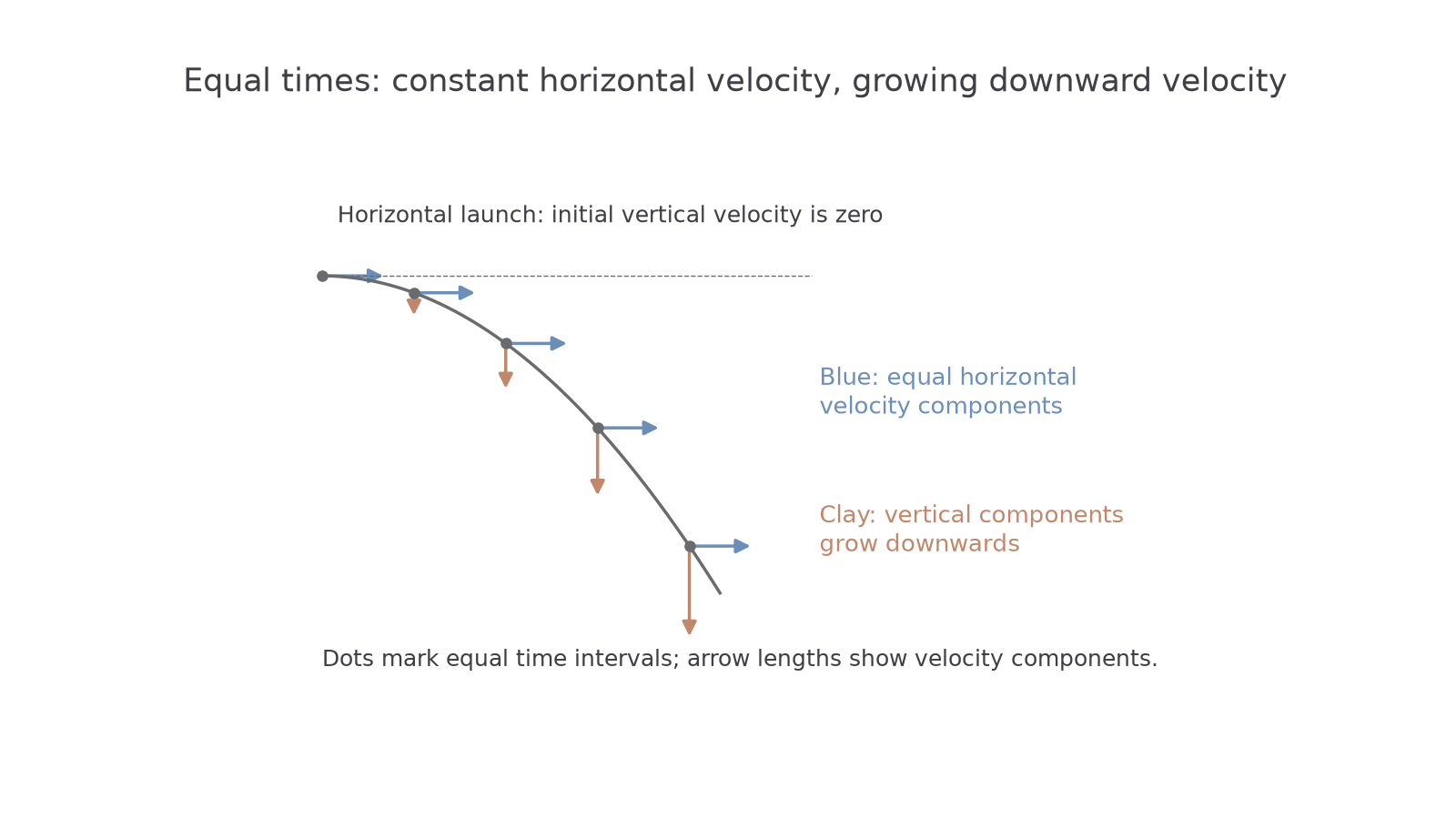
Why the path curves
For a horizontal launch, . Eliminate time using :
The path is a parabola in this model. The coefficient has unit , so multiplying by produces a length. Doubling horizontal speed makes the vertical drop at a fixed horizontal distance one quarter as large, because reaching that distance takes half the time.
Model limit
Treat the projectile as a point particle, neglect air resistance and use a uniform gravitational field. Spin, lift and drag can change the path; a thrown sheet of paper is unlikely to follow this model closely. The clock is shared between the components, but neither component is an extra force.
Explain the prediction rather than just naming a formula.
Horizontal launches and landing velocity
For a horizontal launch, the drop height determines the flight time. Once that time is known, it tells you how far the ball moves horizontally and how much downward velocity it gains.
Use one origin consistently. If the launch point is above the ground and upwards is positive, the landing displacement is . It is often convenient to use the positive drop magnitude and write ; do not then accidentally use in an upwards-positive velocity equation.
Worked example 1: from drop time to range
Question. A ball leaves a horizontal ledge at , above level ground. Neglect air resistance. Calculate its horizontal range. Use and .
Plan. The initial vertical velocity is zero. Find the fall time vertically, then use it horizontally.
Answer. to two significant figures.
Check. The fall takes about half a second, so a horizontal speed of four metres per second gives a range of about two metres.
The ball lands moving diagonally. To specify its velocity fully, you need both magnitude and direction.
Worked example 2: the same flight's landing velocity
For the ball above, the horizontal component remains . With upwards positive,
Answer. The landing velocity is about , directed below the horizontal.
Check. The total speed exceeds either component. The negative vertical component means the angle is below, rather than above, the horizontal.
A horizontal launch does not imply horizontal velocity forever. It specifies only the initial direction. Gravity changes the vertical component immediately after release. The horizontal component stays constant because the model has zero horizontal acceleration, not because there is a horizontal force keeping the ball moving.
Angled launches and positions during flight
An angled launch starts with both horizontal and vertical velocity. The vertical component decreases to zero at the highest point, while the horizontal component continues. The projectile is therefore still moving at the top unless its horizontal component is also zero.
Exam-style example: a level-ground launch
Question. A ball is launched at , above horizontal, and lands at its launch height. Neglect air resistance. Determine its maximum height above launch and its horizontal range. Use , and .
Plan. Resolve the launch velocity first. At maximum height the vertical velocity is zero; the full flight time comes from returning to zero vertical displacement.
For the landing, . The root is launch; the later root is
Answer. Maximum height ; range .
Check. The time to the top is , half the total time because the landing height equals the launch height.
[DIAGRAM: asset_name: An angled flight; asset_slug: motion-angled-flight; caption: Vertical velocity is zero at the top, while horizontal velocity remains; description: A parabolic trajectory for initial speed 20 metres per second at 35 degrees above horizontal returns to launch level at range 38.3 metres. Initial velocity and its horizontal and vertical components are drawn at the origin. The top is marked at height 6.71 metres, with a horizontal velocity arrow and a label vertical velocity zero.]
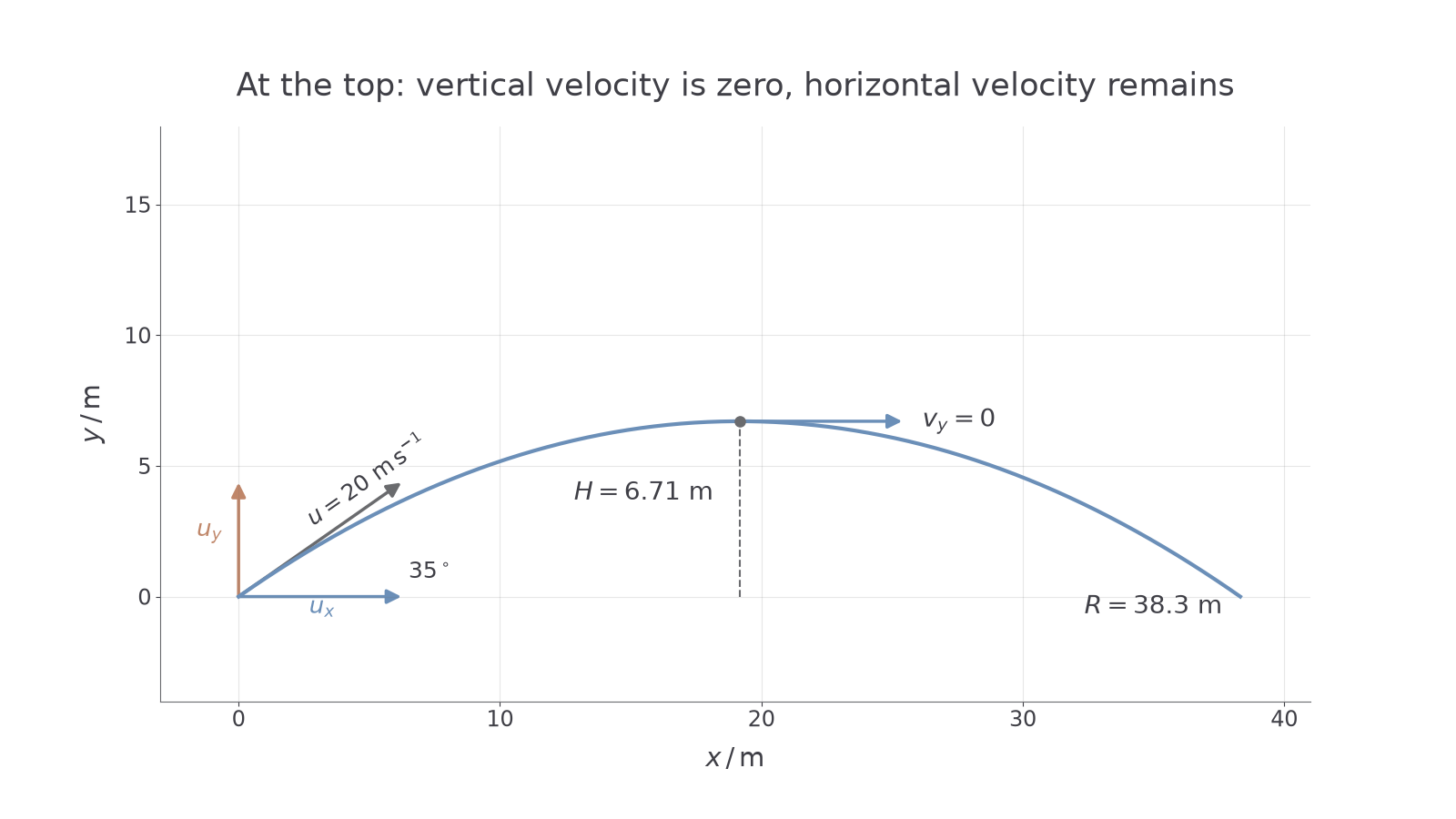
To find the height at a specified horizontal position, find time from the horizontal motion before using vertical motion. In this flight, at , . Substitution into gives , slightly below the maximum. Do not put the horizontal distance into a vertical displacement equation.
If the landing is above or below launch height, use its actual signed and solve the resulting vertical quadratic, as you learnt in free fall. Doubling the time to the top works only for landing at the same height in this model. The launch angle also changes the component sizes; it is not enough to substitute the total launch speed into both directions.
Watch out
Wrong: “The velocity is zero at maximum height.” Only the vertical component is zero for an ordinary angled projectile. Its horizontal velocity remains non-zero, so it has a horizontal velocity and a downward acceleration at the top.
Apply the components to a new launch.
Quick Recap
- Horizontal and vertical motions use the same elapsed time.
- Without air resistance, horizontal velocity is constant and vertical acceleration is downwards.
- Resolve an angled launch before calculating; vertical velocity alone is zero at the top.
- Find the time from whichever component gives it, then use that time in the other component.
- Equal ascent and descent times require equal launch and landing heights in the ideal model.
The horizontally launched and released balls land together in the air-free model because their vertical initial conditions and vertical accelerations are identical.