3.1 - Newton's laws, mass and weight
Learn how forces change motion, why mass measures resistance to that change, and how Newton's three laws work together. Distinguish forces balancing on one object from interaction forces acting on different objects, then apply the distinction to mass, weight and supporting forces.
Inertia and Newton's first law
Why can a book stay still while two forces act on it? Gravity acts downwards and the table pushes upwards, yet the book does not accelerate. “A force acts” is therefore not enough to predict a change of motion. You need the resultant force, the vector sum of all forces acting on that object.
Recall that a force describes an interaction: a push or pull from another object, including a contact interaction or gravity. Forces have magnitude and direction, and are measured in newtons. A free-body diagram includes forces acting on the chosen object, rather than forces it exerts on something else.
Newton's first law
An object remains at rest or continues moving with constant velocity unless acted on by a non-zero resultant force.
Rest is only one possible unchanged state. A glider on a nearly frictionless horizontal air track can keep moving after the push ends. In the ideal model with zero resultant force, no continuing forward force is needed. Everyday objects often stop because friction or drag gives a backward resultant, not because motion “uses up” an internal force.
Inertia is resistance to a change in motion. Mass measures that resistance: for the same resultant force, a greater mass has a smaller acceleration. Mass is measured in kilograms. A heavy trolley is harder to start and harder to stop because both require changing its velocity; inertia is not a separate force resisting the push.
Forces can balance while an object moves. A car travelling at constant velocity has zero resultant force, even though driving and resistive forces may each be large. Zero resultant force does not mean that each individual force is zero.
Model limit
Apply these laws in a reference frame that is not itself accelerating appreciably, such as an ordinary laboratory for these problems. A lurching vehicle can make motion relative to the vehicle misleading; identify the frame before interpreting what you see.
Use the law to separate motion from a change in motion.
Newton's second law and resultant force
A non-zero resultant force changes velocity. For a constant mass, the acceleration is proportional to the resultant force and inversely proportional to the mass. Its direction is the direction of that resultant, even when the object is moving another way.
Newton's second law for constant mass
Resultant force is in newtons, mass in kilograms and acceleration in . The equation is a vector relation; apply it to the whole resultant or to components along chosen axes. It assumes constant mass. The more general momentum form is taught in the next lesson.
Not on the data sheet: learn it.
One newton is the resultant force that gives a mass of an acceleration of . Thus . If you double the force on a fixed mass, you double its acceleration; if you double the mass for a fixed resultant, you halve its acceleration.
Worked example 1: more than one horizontal force
Question. A crate is pulled horizontally by . Friction is in the opposite direction. Calculate its acceleration.
Plan. Add the forces with signs before applying the law.
Answer. in the pulling direction.
Check. Using alone would predict too much acceleration, because it would omit friction.
For perpendicular forces, either find the resultant vector first or apply the law separately in each direction. For example, forces of east and north on a object give acceleration components east and north. The acceleration magnitude is , at north of east. Adding force magnitudes as would ignore their directions.
A resultant opposite to velocity slows the object. It need not instantaneously make the object travel in the force direction. A rising ball continues upwards for a while despite its downward resultant force.
Exam tip
Write the force balance for the object you selected. In , is the resultant, not whichever force happens to have been named first.
Try a signed balance with a different set of forces.
Newton's third law and different objects
When you push another person on low-friction skates, you can both move apart. Each person exerts a force on the other. The forces belong to one interaction, rather than one force causing a delayed response.
Newton's third law
When one object exerts a force on a second object, the second exerts an equal-magnitude force in the opposite direction on the first. The two forces act on different objects and are of the same interaction type.
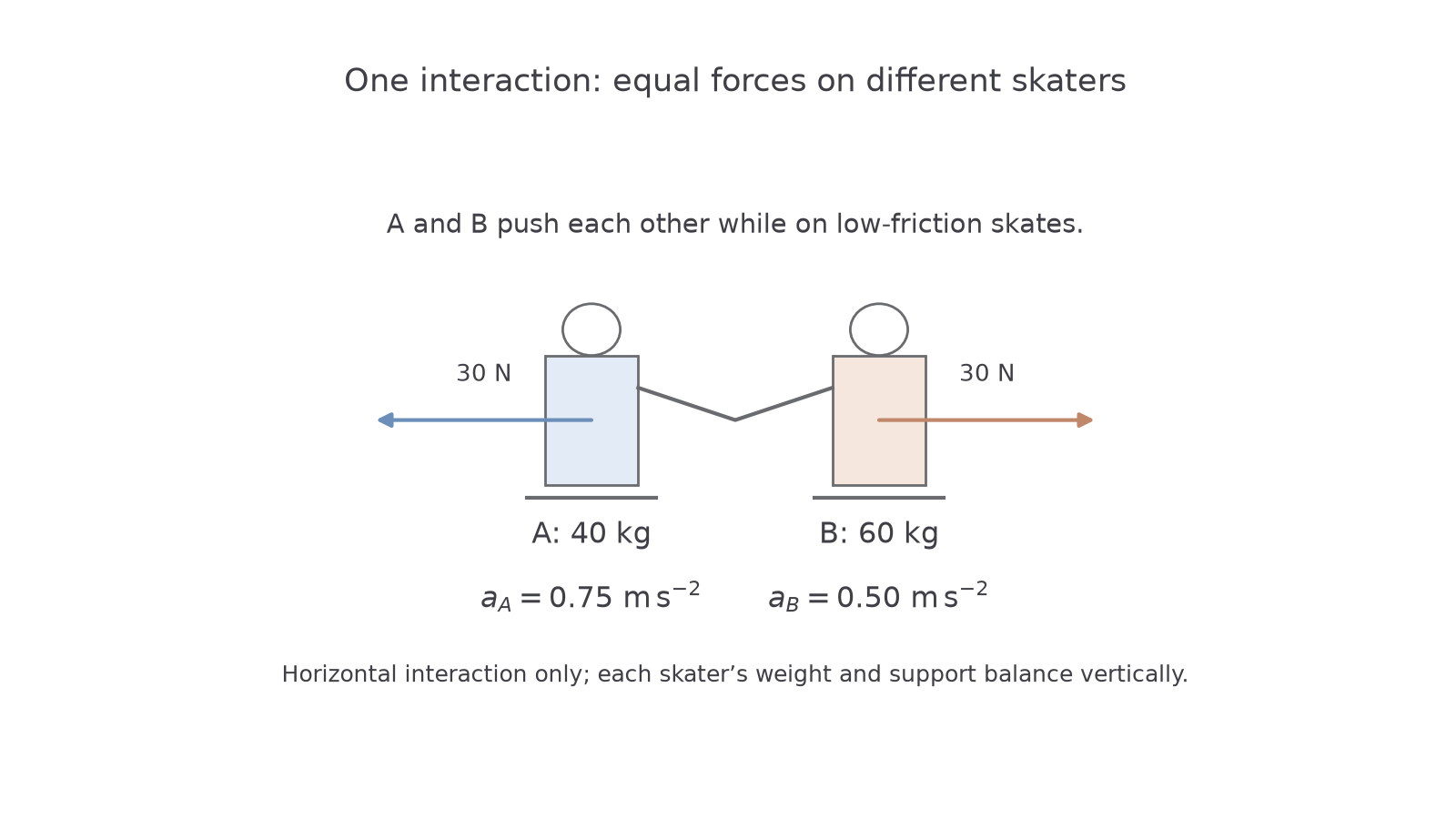
These forces occur simultaneously. They do not cancel in a free-body diagram of either person, because that diagram contains only one of the two forces. If the masses are different, equal forces produce different acceleration magnitudes: . The smaller mass accelerates more; the third law does not require equal accelerations.
[DIAGRAM: asset_name: Equal forces do not imply equal accelerations; asset_slug: motion-third-law-skaters; caption: The two equal forces act on different skaters, so each skater can accelerate; description: Two skaters A and B are represented by separate labelled bodies of masses 40 and 60 kilograms on a horizontal surface. A 30-newton arrow acts left on A and an equal-length 30-newton arrow acts right on B, each starting at its body. Text gives acceleration magnitudes 0.75 and 0.50 metres per second squared. Vertical support and weight are omitted from this horizontal interaction diagram and explicitly identified as balanced.]
Return to the book. Its downward weight is Earth's gravitational force on the book. Its partner is the book's gravitational force on Earth, upwards towards the book. The table's upward support on the book has another partner: the book's downward contact force on the table.
Weight and support can be equal and opposite on a stationary book, but they are not a third-law pair. They act on the same object and come from different interactions. Their equality here follows from zero acceleration. If the table and book accelerate vertically, support and weight need not be equal, while each genuine third-law pair remains equal in magnitude.
Watch out
“Equal and opposite” is not a complete third-law explanation. Name both objects and state which force acts on which. Balancing forces on one object and interaction forces on two objects are different pairs.
Use that test on a clear contact interaction.
Mass, weight and support
Mass is a property of the object; weight is the gravitational force acting on it. Moving an object to a weaker gravitational field changes its weight without changing the mass that resists acceleration.
A gravitational field describes what gravitational force a test mass would experience at each point. It is a model for the force, not material emitted by Earth. Near Earth's surface, an object's weight is approximately constant because the field changes little over ordinary laboratory heights.
Weight
Weight is in newtons, mass in kilograms and gravitational field strength in . Its direction is that of the local gravitational field. In free fall, , so the same is the acceleration of free fall in . These units are equivalent because .
Not on the data sheet: learn it. The value is supplied.
For a object near Earth's surface, . If it is freely falling, its mass remains , and its weight has not disappeared. Its acceleration is . The cancellation of mass explains why different masses have the same free-fall acceleration in the model with negligible air resistance.
A supporting scale measures a contact force, not gravity directly. It can be calibrated to display mass when support equals weight. In an accelerating lift, those forces differ.
Exam-style example: a supporting force in a lift
Question. A passenger of mass accelerates upwards at . Calculate the upward support force from the floor. Use .
Plan. The resultant is upwards, so support exceeds weight.
Answer. About .
Check. The weight is about , so a larger upward force is needed for upward acceleration. The passenger's mass has not increased.
This also answers the book question precisely: on a stationary horizontal table, support and weight balance, so the resultant is zero. The two forces do not disappear; they give zero acceleration when added as vectors.
Quick Recap
- Zero resultant force means zero acceleration, allowing rest or constant velocity.
- For constant mass, resultant force equals mass times acceleration, with both vectors in the same direction.
- Newton's third-law forces are equal and opposite on different objects; they do not balance within one object's force diagram.
- Mass is measured in kilograms; weight is the gravitational force , measured in newtons.
- Support equals weight only when the relevant vertical acceleration is zero and these are the only vertical forces.
The book stays still because support and weight balance on the book, giving zero resultant force; they are balancing forces, not each other's third-law partners.