16.2 - The first law of thermodynamics
Calculate work during constant-pressure volume changes, use Cambridge's heating-and-work sign convention, and explain how compression or expansion can change a gas's internal energy and temperature.
Work by a gas and work on a gas
Why can a gas become hotter when it is compressed quickly, even if almost no energy enters by heating? Compression transfers energy by doing work on the gas. The sign of that work matters, so begin with a piston that makes the boundary movement visible.
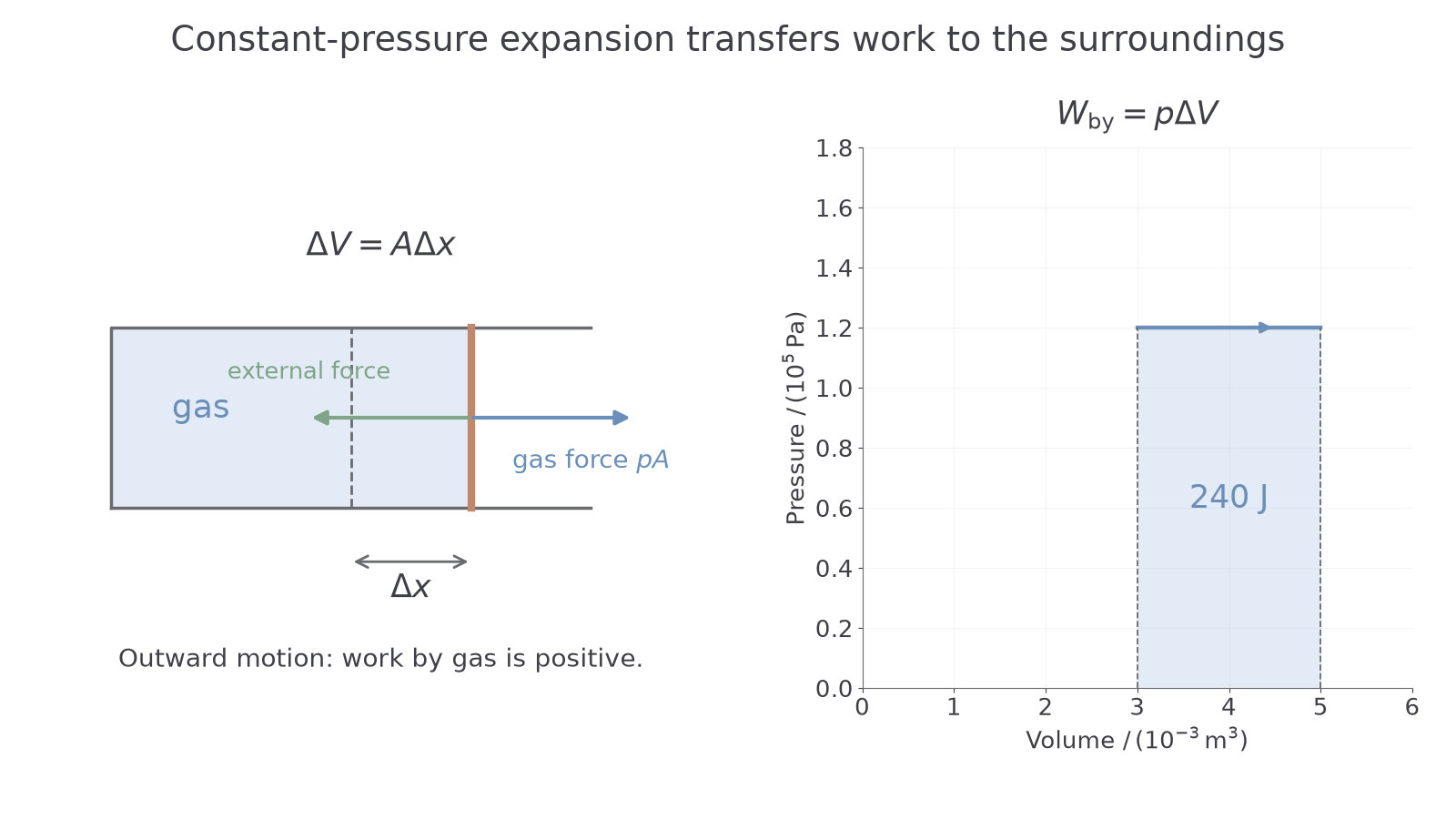
A gas pushes on a piston. If the piston moves outwards, the gas does work on its surroundings; if an external force pushes it inwards, the surroundings do work on the gas. These are opposite descriptions of the same mechanical transfer.
Consider a slow expansion with approximately equal gas and external pressures and negligible piston friction or acceleration. If the pressure is constant, the gas force on a piston of area is . Moving the piston out by increases volume by , so
For this calculation is in Pa, in , in m and in . Their product gives work in J.
[DIAGRAM: asset_name: Piston displacement and gas work; asset_slug: thermal-piston-work; caption: Outward piston motion increases gas volume and gives positive work by the gas; description: A cylinder contains gas behind a vertical piston. A dashed line marks the piston’s initial position and an arrow shows its outward displacement delta x. Gas force pA and an equal opposing external force act on the piston in the slow balanced model. A second panel plots pressure against volume for the worked expansion at 1.2 times ten to the fifth pascals, from 3.0 to 5.0 times ten to the minus third cubic metres. The shaded rectangular area represents 240 joules of work by the gas.]
Constant-pressure volume work
is work done by the gas in J; is work done on it in J. is signed volume change in , and is constant pressure in Pa for the stated quasi-static piston model. Expansion gives positive and negative ; compression reverses both signs.
Not on the data sheet: learn it.
Worked example 1: an expansion
Question. A gas expands slowly at constant pressure from to . Calculate work done by the gas and work done on it.
Plan. Find the signed volume increase, then name the work convention.
Check. The gas transfers energy mechanically to the surroundings, so its work-on quantity is negative. It cannot gain energy from that expansion work alone.
On a pressure–volume graph, a constant-pressure expansion gives a rectangular area of magnitude . The sign comes from the direction of the process and whether the question asks for work by or work on. If pressure varies, the appropriate quasi-static work is found from the area under the actual pressure–volume path rather than one pressure multiplied by the entire volume change.
Model limit
Do not apply the gas's initial pressure times to every rapid expansion. The simple expression needs the specified pressure conditions; a free expansion into a vacuum has no external pressure to overcome and no such expansion work on the surroundings.
Now change both the direction of the process and the requested convention.
The first law and its signs
Internal energy can change because energy enters by heating, because work is done on the system, or both. The first law is an energy-conservation statement that combines these transfers.
Choose the gas as the system. In Cambridge's convention, heating into it is positive, and work done on it is positive. Energy leaving by heating and work done by the gas have negative values in this account.
First law of thermodynamics
is increase in internal energy in J, is energy transferred to the system by heating in J, and is work done on the system in J. Thus , not . Equivalently, . The first law is a general energy balance; include every relevant heating and work transfer across the chosen boundary.
Not on the data sheet: learn it.
A negative does not by itself mean that internal energy decreases: sufficiently large positive work can more than compensate. Likewise, energy can enter by heating while an expanding gas does even more work and loses internal energy.
Worked example 2: losing energy by heating while being compressed
Question. During compression, of work is done on a gas while is transferred from the gas to its surroundings by heating. Determine the internal-energy change.
Plan. Assign each sign from its direction across the gas boundary.
Answer. Internal energy increases by .
Check. The input of 140 J is shared between 80 J transferred out and 60 J remaining as increased internal energy. The total energy is conserved.
Continue this lesson.
You’re previewing NovaLearn without an account. Create a free account to read the rest.
Create free account