3.3 - Collisions and momentum conservation
Use total momentum to analyse collisions and separations, keep directions consistent, and distinguish an elastic collision from an inelastic one. Extend the same conservation law to two perpendicular directions when objects scatter in a plane.
Total momentum in an isolated system
Can two moving trolleys collide and come to rest without momentum disappearing? Yes: their individual momenta may cancel before the collision. What is conserved is the vector total for the system, rather than the momentum of each trolley.
A system is the collection of objects you choose to analyse. During a collision, each trolley exerts a force on the other. These are internal forces for the two-trolley system. Newton's third law makes the forces equal and opposite at each instant, so their impulses are equal and opposite. One trolley's momentum change cancels the other's.
Forces from outside the chosen system are external forces. If their resultant is zero, the total momentum cannot change. In a short collision, external forces such as friction may have such a small impulse compared with the collision forces that the system can be treated as approximately isolated during that interval.
Conservation of momentum
The total momentum of a system remains constant provided the resultant external force on the system is zero.
Both parts of that statement matter: total momentum and the external-force condition. Saying that “momentum is constant” for one colliding object would be wrong; its momentum is changing precisely because the other object exerts a force on it.
For example, a trolley moving right at and a trolley moving left at have total momentum
If they stick together, a stationary final system has exactly that same zero total momentum. Substantial motion before an interaction does not guarantee non-zero total momentum.
You already know
Momentum is a vector: . Choose a positive direction and give velocities signs before substituting. Adding speeds treats opposite directions as though they were the same direction.
Choose the system before choosing the equation.
Collisions and separations along a line
A momentum equation compares the same system just before and just after an interaction. It is not an equation adding the before and after momenta together.
Momentum conservation along one direction
The masses are in ; the signed velocities before the interaction are , and those afterwards are , all in . It applies when the resultant external impulse in that direction is zero or negligible during the chosen interval. Each term is a momentum in .
Not on the data sheet: learn it.
Draw a before-and-after sketch. Decide whether the objects have separate final velocities or move together. If they stick, both final velocities are the same unknown; you do not need a separate unknown for each object.
Worked example 1: trolleys that stick
Question. A trolley moves right at . It collides with a trolley moving left at . They stick. Determine their common velocity, neglecting external horizontal impulse.
Plan. Take right as positive and use the combined mass after the collision.
Answer. to the right.
Check. The positive initial total momentum predicts a rightward final velocity. The common speed is smaller than either initial speed in this example.
Conservation also applies when objects separate. A compressed spring can push two initially stationary trolleys apart. Their total momentum remains zero, even though both acquire kinetic energy from the spring.
Worked example 2: recoil from a release
Question. Two initially stationary carts are pushed apart by an internal spring. One has mass and moves right at . The other's mass is . Determine its velocity, neglecting external horizontal impulse.
Answer. to the left.
Check. The heavier cart moves more slowly, giving equal-sized opposite momenta. Their speeds are not equal because their masses differ.
Use a different interaction to check your sign convention.
Momentum and kinetic energy are different tests
Momentum conservation does not tell you that kinetic energy is conserved. In a sticking collision, some initial kinetic energy becomes internal energy through deformation, heating and sound. Total energy is conserved, but kinetic energy alone is not.
Kinetic energy is the energy associated with motion. Use , where is mass in , is speed in , and is in joules. This is the non-relativistic relation used for these ordinary-speed objects. It is not on the data sheet: learn it. Because velocity is squared, kinetic energy is non-negative even for a negative signed velocity.
An elastic collision conserves the total kinetic energy of the colliding objects. An inelastic collision does not conserve that total kinetic energy. “They bounce” is not a sufficient test for elasticity: objects can separate after a collision and still have less total kinetic energy than before.
For a head-on elastic collision, the relative speed of approach equals the relative speed of separation. With the objects arranged so that object 1 approaches object 2 from the left, and both velocities signed to the right, this gives
Relative speeds in a head-on elastic collision
The and values are the velocities before and after in . The expression uses this approach-and-separation arrangement; apply the relative speeds, not an unsigned sum of speeds, in another arrangement. This relation is an extra condition for an elastic collision, used alongside momentum conservation.
Not on the data sheet: learn it.
Exam-style example: solving an elastic collision
Question. A trolley moving at hits a stationary trolley in a perfectly elastic head-on collision. External horizontal impulse is negligible. Determine both final velocities and check the energy conservation.
Plan. Two final velocities need two independent equations. Take the incoming direction as positive. Momentum conservation gives , while elasticity gives , with velocities in . Substitute into the momentum equation:
Both positive signs mean motion in the original direction; this was found, not assumed. Now check the two system totals.
Both totals agree. The approach speed is , and the separation speed is .
Check. The lighter trolley's final speed exceeds the incoming speed. That is possible; compare the system's energy, rather than assuming that no individual object can gain speed.
A useful consequence follows for identical masses in an isolated, perfectly elastic head-on collision: they exchange velocities. If one was stationary, the incoming one can stop while the other leaves with its original velocity. The condition “perfectly elastic” matters; it is an ideal model, rather than a promise about every pair of real balls.
Watch out
To test elasticity, compare the sums of the kinetic energies of both objects before and after. One object gaining energy and the other losing energy is compatible with either type of collision.
Now separate the conservation laws in words.
Momentum conservation in two directions
When objects scatter in a plane, momentum is conserved in each of two perpendicular directions. One scalar equation for “total momentum” is not enough to determine two unknown velocity components.
Choose axes, resolve every momentum along them, and write a separate conservation equation for each direction. A component can be negative even when a speed is positive. After finding components, use Pythagoras' theorem for the magnitude and a tangent ratio for the direction.
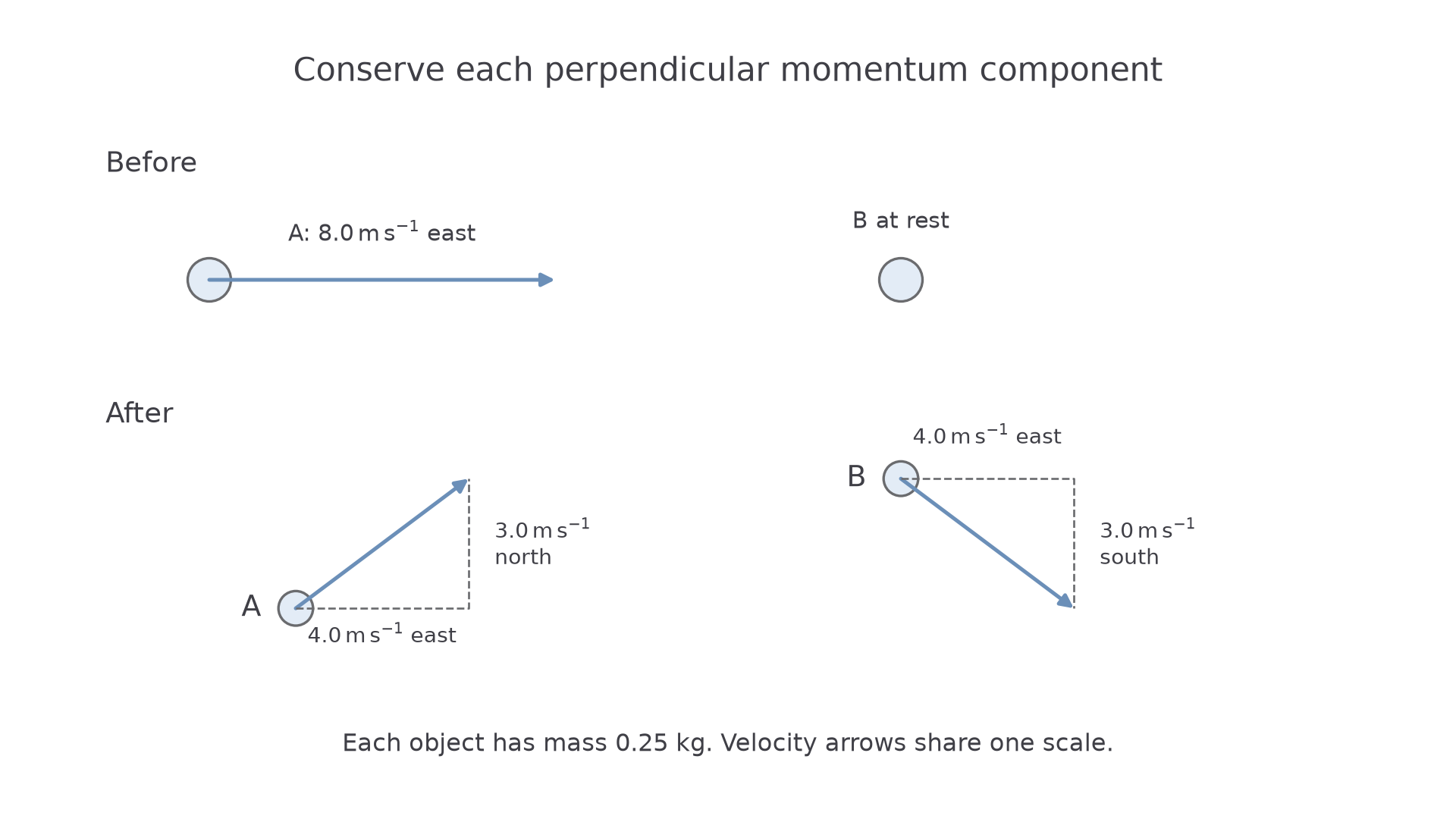
[DIAGRAM: asset_name: Momentum in two perpendicular directions; asset_slug: momentum-two-directions; caption: The final north–south momenta cancel, while their eastward components add to the initial momentum; description: Before an interaction a 0.25 kilogram object has velocity 8 metres per second east and an identical object is stationary. Afterwards one has components 4 east and 3 north and the other 4 east and 3 south, in metres per second. Velocity arrows and a separate component rectangle show the two final velocities.]
Worked example 3: a collision in a plane
Question. An object A of mass moves east at and collides with an identical stationary object B. Afterwards A has velocity components east and north. Determine B's velocity. Neglect external horizontal impulse.
Plan. Conserve eastward and northward momentum separately. Let B's components be east and north.
Answer. B moves at , south of east.
Check. A's northward momentum is cancelled by B's southward momentum; there was no initial northward momentum. Both final objects move east, so their eastward momenta can add to the initial total.
Do not set the magnitudes of the two final momenta equal just because the initial target was stationary. Equal and opposite final momenta require a zero initial vector total, as in a separation from rest.
Exam tip
For a two-dimensional collision, show two component equations with explicit directions. A conservation equation along only one axis cannot establish conservation in the whole plane.
Quick Recap
- The total vector momentum of an isolated system is constant; internal interactions redistribute it.
- Choose signs and distinguish separate final velocities from a common velocity after sticking.
- An elastic collision conserves total kinetic energy and, head-on, has equal relative approach and separation speeds.
- In two dimensions, conserve momentum separately along two perpendicular axes, then reconstruct the velocity.
Two moving trolleys can finish at rest because equal and opposite initial momenta already have a zero vector total.