3.2 - Drag and terminal velocity
Explain how friction and drag change motion, why a falling object can stop accelerating while it is still moving, and how a parachute changes the balance of forces. Use force diagrams and the gradient of a velocity–time graph to connect the explanation to evidence.
Friction and drag oppose relative motion
A hammer and a feather are released together: must the hammer land first? On the Moon in 1971, Apollo 15 astronaut David Scott let both fall, and they reached the surface together within the accuracy of the demonstration. Earth's air makes the familiar version of this experiment look very different.
Friction is a contact force that opposes sliding, or a tendency to slide, between surfaces. A book sliding across a table experiences friction opposite its motion relative to the table. If you push a stationary book gently, friction can balance your push; it need not have a fixed value regardless of what you do. Here you need a qualitative understanding, rather than a formula involving a coefficient of friction.
Drag, or fluid resistance, acts on an object moving relative to a fluid. A fluid is a liquid or a gas, so air resistance is one kind of drag. The object interacts with the surrounding fluid and transfers momentum to it. The fluid exerts a force opposing the object's motion relative to that fluid. Drag can act on an object moving upwards, downwards or horizontally.
For a given object in a given fluid, drag generally increases as relative speed increases. Shape and the area presented to the flow also matter. A broad parachute experiences much more drag than a compact body at the same speed. The precise relation depends on the flow; do not assume that doubling speed must always double drag.
Model limit
For this course, a model in which drag increases with speed is sufficient. A particular proportionality between drag and speed is valid only when a question supplies it or states its conditions. Friction and drag are forces, not quantities of motion stored in an object.
Air resistance is often neglected when modelling a dense, compact falling object over a short distance. That is an approximation about the forces. It is much poorer for a feather, whose drag can become important compared with its small weight. The Moon demonstration removed nearly all the air resistance; it did not remove gravity.
A falling object's acceleration changes
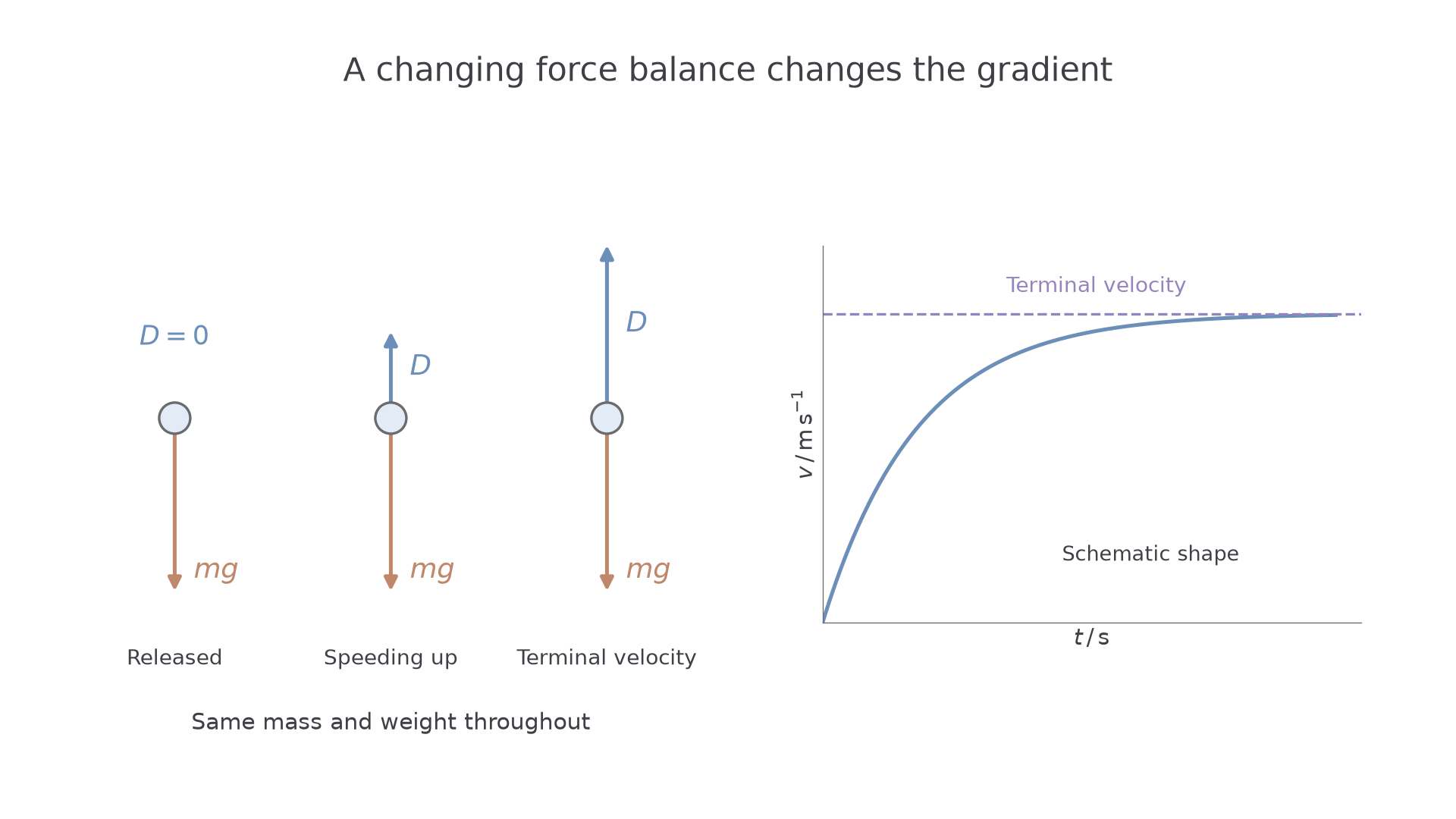
A falling object starts to accelerate because its weight initially exceeds the upward resistance. As it speeds up, drag grows. Its weight stays approximately constant in a uniform gravitational field, so the resultant downward force becomes smaller.
You already know
Newton's second law links the resultant force to acceleration. A downward velocity tells you which way an object is moving; it does not by itself tell you the direction of its acceleration.
Choose downwards as positive. If upthrust is negligible and the only forces are weight and drag, then
Resultant force during a fall
Here is mass in , is gravitational field strength in , is the upward drag force in , and is the downward acceleration in . This is Newton's second law applied to this particular force diagram. If upthrust is significant, include it as another upward force.
Not on the data sheet: learn it.
The important sequence is cause and effect: increasing speed leads to increasing drag; increasing drag reduces the resultant force; the smaller resultant force reduces the acceleration. The object is still speeding up while the resultant force is downward, but it gains less speed each second.
[DIAGRAM: asset_name: Falling with increasing air resistance; asset_slug: drag-force-balance; caption: Weight stays fixed while drag grows; the velocity graph becomes less steep; description: Three force diagrams show a body just released, later in the fall, and at terminal velocity. Weight arrows have equal lengths; upward drag is zero, half the weight, and equal to the weight. A schematic velocity-time curve rises from zero and approaches a horizontal terminal-velocity line.]
Worked example 1: a snapshot of a fall
Question. An object of mass falls through air. At one instant its upward drag force is . Calculate its acceleration. Neglect upthrust and use .
Plan. Find the weight, subtract the opposing drag, then divide the resultant force by mass.
Answer. downwards.
Check. It is less than , as upward drag reduces the downward resultant. This is an instantaneous acceleration, rather than a constant acceleration for the whole fall.
On a downward velocity–time graph, acceleration is the gradient. The curve starts steep and becomes flatter. The area beneath it still gives downward displacement. Because acceleration changes, the constant-acceleration equations cannot describe the whole fall.
Terminal velocity is a force balance
A falling object can reach a speed at which upward drag balances its weight. There is then no resultant force and no acceleration. It continues moving at a constant velocity: its terminal velocity.
Terminal velocity
Terminal velocity is a constant velocity reached when the resultant force on an object moving against resistance is zero.
In the simple falling model, at terminal velocity. If upthrust is appreciable, the correct balance is weight equals drag plus upthrust. A sphere sinking through a liquid, for example, may need both upward forces. Later you will calculate upthrust from displaced fluid volume.
Zero acceleration does not mean zero forces or zero velocity. Weight and drag are individually non-zero, but their vector sum is zero. The velocity–time graph is horizontal. The displacement–time graph has a constant, non-zero gradient.
Exam-style example: a parachute opens
Question. A parachutist is already falling at terminal velocity. Explain the change in motion when the parachute opens, before a new steady speed is reached.
Plan. Compare drag and weight immediately after opening, then follow how drag changes as the speed changes.
The open parachute presents a much larger area to the air. At the original speed the drag becomes greater than the weight. The resultant force and acceleration are upward, although the parachutist is still travelling downward. The downward speed decreases. As it decreases, drag falls until it again balances the weight. A new, lower terminal speed is reached.
Check. The weight has not suddenly become smaller, and an upward acceleration does not require upward motion. The parachute changes the resistance at a given speed.
For an object driven horizontally, a similar balance can occur when the driving force equals drag and other resistance. “Terminal” is not restricted to things falling. If the driving force or the object changes, the old balance need not last.
Watch out
After a parachute opens, do not automatically repeat “speed increases, so drag increases”. Read the actual stage of motion. During the slowing stage, speed and drag decrease, while the resultant remains upward until the forces balance.
Explain the balance without relying on a memorised phrase.
Quick Recap
- Friction opposes relative sliding or its tendency; drag opposes motion relative to a fluid.
- Increasing speed usually increases drag, reducing the resultant force on a freely falling object.
- Terminal velocity means zero resultant force and zero acceleration, rather than zero weight or zero speed.
- An open parachute increases drag at a given speed and gives a lower terminal speed.
The hammer and feather need not land at different times: without significant air resistance, both have the same gravitational acceleration when released together.