25.2 - Stellar temperatures and radii
Use a star's continuum spectrum to estimate its surface temperature, connect temperature and surface area to luminosity, and combine radiation measurements to estimate stellar radius.
Spectral peaks and surface temperature
Two stars have the same luminosity, but one has a continuum peak at half the other's wavelength. Must their radii be the same? A spectrum can reveal temperature, and temperature changes how much power each square metre of stellar surface emits.
A hot, opaque body emits a broad thermal continuum. An ideal black body absorbs all incident electromagnetic radiation and, at a given temperature, emits the greatest possible thermal radiation per unit area. Its spectrum has a characteristic shape determined by its temperature. A stellar surface can often be approximated by this model, although real spectra also contain absorption lines and other departures.
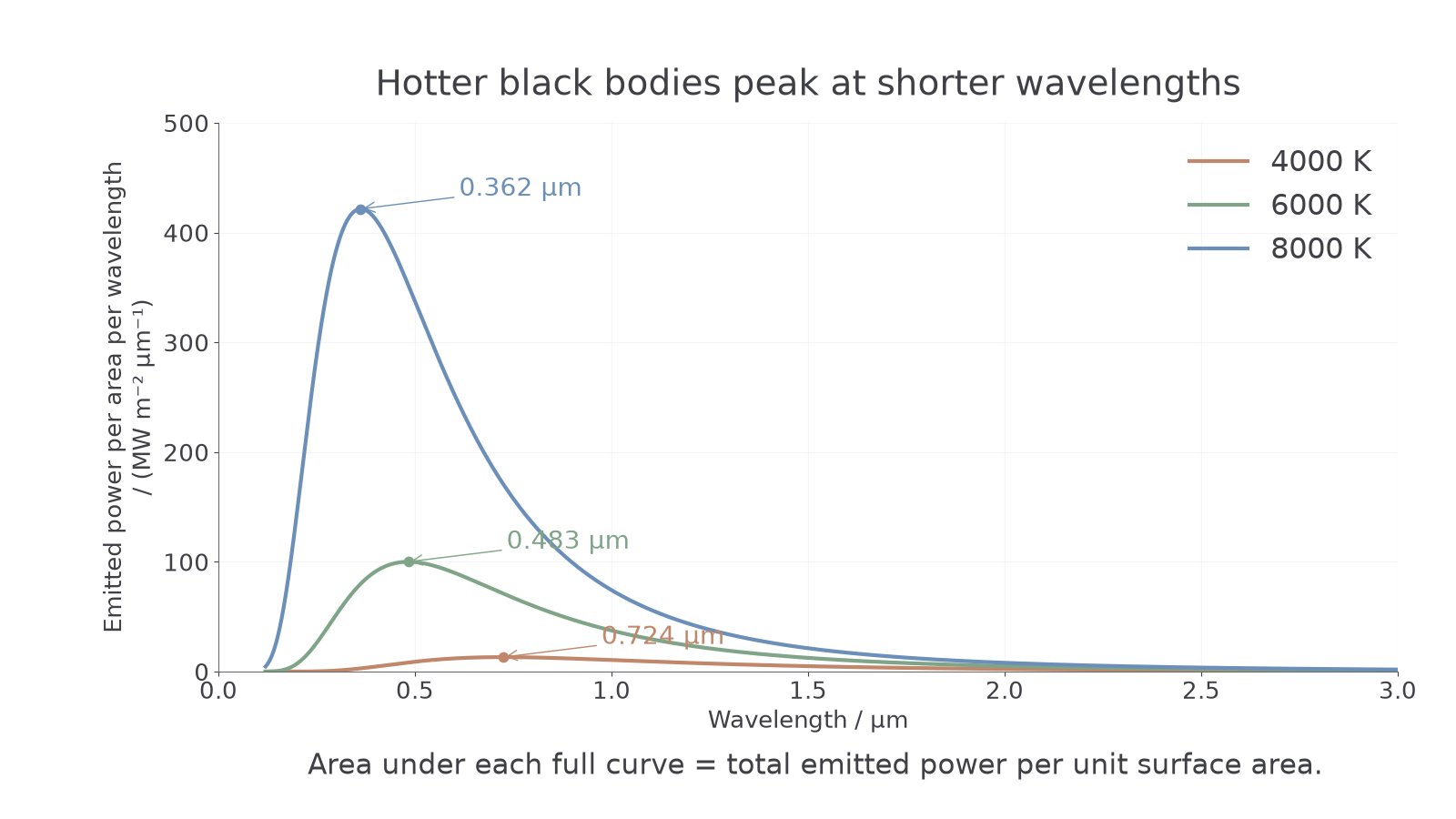
The graph below shows emitted power per unit surface area per unit wavelength interval. Its maximum is at . As temperature rises, this peak moves towards shorter wavelengths. The hotter black body also emits more power per unit area across the spectrum; the peak has not merely slid sideways at an unchanged height.
[DIAGRAM: asset_name: A hotter black body has a shorter wavelength peak; asset_slug: cosmology-blackbody-spectra; caption: These spectra are plotted per unit wavelength interval, and their areas give total power per unit emitting area; description: Three calculated blackbody spectra at 4000, 6000 and 8000 kelvin share an unnormalised vertical scale of spectral radiant exitance in megawatts per square metre per micrometre. The horizontal axis is wavelength in micrometres. The hotter curves have higher spectral values and peaks at shorter wavelengths, near 0.724, 0.483 and 0.362 micrometres. The curves are model spectra, not measured stellar data.]
Wien's displacement law
is thermodynamic surface temperature in K, is the wavelength in m at the maximum of the spectrum plotted per unit wavelength, and is a constant in . For this blackbody model, doubling halves . A numerical value of is given when needed here; the required recall is the inverse relationship.
Not on the data sheet: learn it.
Worked example 1: reading temperature from a peak
Question. A star's emitted continuum has its wavelength-spectrum maximum at . Estimate its surface temperature using .
Plan. Convert the peak wavelength to metres and rearrange Wien's law.
Check. The wavelength unit cancels, leaving K. Using a Celsius value in this inverse relationship would not describe the blackbody spectrum.
A peak does not mean that all the radiation has one wavelength. Radiation is emitted across the broad curve. Its area represents total emitted power per unit surface area, while the peak position gives a temperature estimate. A spectrum plotted per unit frequency has a different peak convention; do not take its maximum and silently treat it as the wavelength-spectrum maximum.
Watch out
Use the wavelength of the continuum maximum, rather than the position of a narrow absorption line. Use the emitted/rest spectrum for the surface temperature: a wavelength shift during travel can bias an estimate made from the observed peak.
Compare two peaks without needing the value of the constant.
Surface area, temperature and luminosity
The total emission from a stellar surface depends on two different things: how much area radiates and how much power each square metre emits. A larger star provides more area, while a hotter blackbody surface emits more power per unit area.
The Stefan–Boltzmann relation gives emitted power per unit area as . This is a derived form of the supplied luminosity relation. It is not the radiant flux intensity measured far away at Earth: the latter also depends on the distance from the star.
Stefan–Boltzmann luminosity
is total luminosity in W, is stellar radius in m, is thermodynamic surface temperature in K, and is the Stefan–Boltzmann constant. The area is the emitting spherical surface. This equation assumes a spherical black body with a single surface temperature; real stars are treated approximately this way.
On the data sheet. Paper 4 only.
At fixed temperature, doubling radius multiplies surface area and luminosity by four. At fixed radius, doubling temperature multiplies luminosity by . Temperature therefore has a strong effect even before you change the size of the star.
Worked example 2: luminosity of a spherical model star
Question. A model star has radius and surface temperature . Estimate its luminosity using .
Plan. Multiply the emitting surface area by the blackbody power per unit area.
Answer. (2 s.f.).
Check. The units are . The full surface area is used, rather than the disc area seen in a photograph.
Continue this lesson.
You’re previewing NovaLearn without an account. Create a free account to read the rest.
Create free account