12.1 - Radians and angular speed
Measure angles in radians, describe rotation using angular speed, and connect circular motion to a point's tangential speed. Explain why points on one rigid rotating object share an angular speed while moving at different linear speeds.
Angles measured by arc length
Why is one complete turn radians, whatever the circle's size? A radian compares two lengths on the same circle. Enlarge the circle and both lengths scale together, so their ratio stays unchanged.
Take an arc of length on a circle of radius . The angle at the centre, measured in radians, is . This definition turns angle into a geometrical ratio rather than an arbitrary division of a turn into 360 pieces.
Radian
One radian is the angle subtended at the centre of a circle by an arc whose length is equal to the radius.
The definition needs both the centre and the arc. A straight chord joining two points on the circle is shorter than the curved arc between them and must not replace it.
[DIAGRAM: asset_name: The radian uses an arc; asset_slug: radian-arc-radius; caption: An arc equal in length to the radius subtends one radian at the centre; description: A circle has two radii separated by exactly one radian,57.3 degrees. The curved arc between them is highlighted and labelled arc length s equals r. The angle at the centre is labelled one radian. A dashed chord is shown separately and labelled not the arc.]
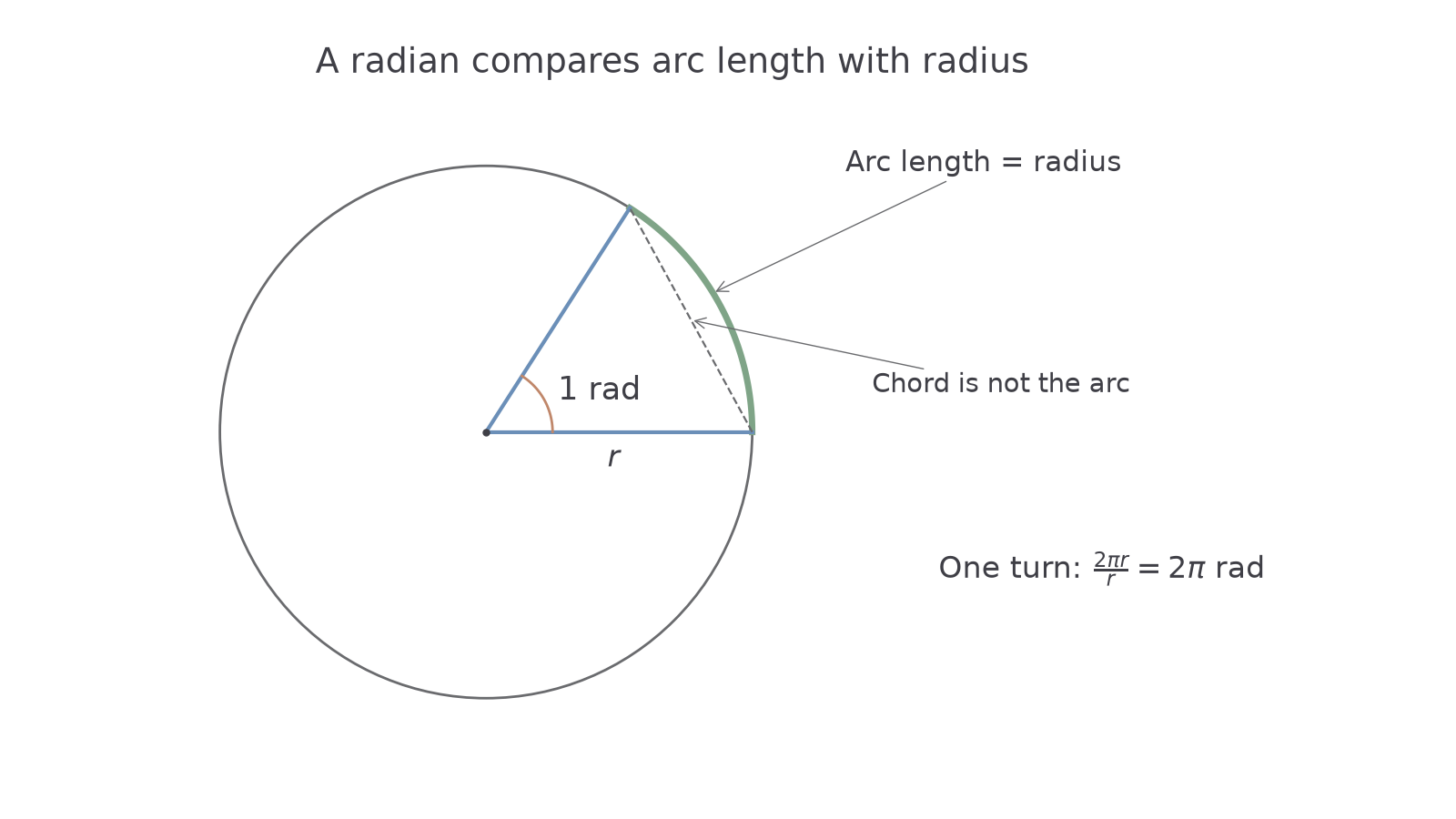
For a whole circle, . Hence radians. Half a turn is radians, and a right angle is radians. Since arc length and radius both have unit metre, their ratio is dimensionless; the label rad identifies it as an angle.
Arc length and angle conversion
Here and use the same length unit and is in radians. For conversion,
Not on the data sheet: learn it.
Worked example 1: an arc and a radius
Question. A point moves through an arc of on a circle of radius . Determine its angular displacement in radians and degrees.
Plan. Divide arc length by radius, then convert the radian result.
Answer. , about .
Check. A quarter circumference would be , slightly longer than the given arc; the angle should be slightly below .
For comparison, . Keep the factor of when an exact angle is useful, then use a decimal only when needed.
Watch out
The formula needs in radians. Substituting an angle of 90 as though it were 90 radians gives the wrong arc. Convert degrees first.
Angular speed, period and frequency
Linear speed tells you how quickly distance is covered. Angular speed tells you how quickly the direction from the axis to a rotating point turns. For uniform circular motion, equal angles are swept out in equal times.
Angular speed
Angular speed is the rate of change of angular displacement. Its usual unit is .
For a constant angular speed, divide the angle swept out by the time taken. One complete turn sweeps radians in period , while frequency counts turns per second.
Uniform angular speed
Here is angular speed in , is angular displacement in radians, and are in seconds, and is in . For rotation in one sense, the magnitude of gives the constant or average angular speed over the stated interval.
Not on the data sheet: learn it.
Worked example 2: a rotating platform
Question. A platform completes one turn every . Determine its angular speed.
Plan. Divide the angle of a whole turn by its period.
Answer. About .
Check. In 1.6 seconds it sweeps radians, one complete turn.
Continue this lesson.
You’re previewing NovaLearn without an account. Create a free account to read the rest.
Create free account