4.2 - Forces in equilibrium
Recognise both conditions for equilibrium, use a closed vector triangle for three coplanar forces, and combine force and moment equations to calculate support forces. Learn why balanced forces alone do not guarantee that an extended object will remain at rest.
Force balance and moment balance
A beam rests on two supports: must each support carry half its weight and load? It seems a fair division, but equilibrium follows the positions of the forces, rather than fairness. Move a load towards one end and the support near that end normally carries more.
An object in static equilibrium remains at rest because it has neither a resultant force nor a resultant moment. These are separate conditions. Zero resultant force prevents translational acceleration; zero resultant moment prevents angular acceleration.
Equilibrium
A system is in equilibrium when both its resultant force and its resultant torque are zero.
For coplanar forces, choose two perpendicular directions, usually horizontal and vertical. Balance force components along each, then balance moments about any convenient point:
Here the sums are signed totals: forces in , and moments about the same chosen point in . These equations express the two physical conditions; they are not supplied on the data sheet. A body initially at rest then stays at rest. Zero resultant force can also describe a body moving with constant velocity, so “equilibrium” does not by itself establish zero velocity.
Two equal, opposite, parallel forces on the same line can balance both force and moment. Move their lines apart and they form a couple: the resultant force is still zero, but the resultant moment is no longer zero. That distinction is why a force diagram must show lines of action as well as arrow directions.
Watch out
“No resultant moment” does not mean “no individual moments”. Several non-zero clockwise and anticlockwise moments can have a zero signed total. Similarly, non-zero forces can have a zero vector total.
For an object treated as a particle, all forces act through one point in the model, so only the force balance is needed. For a beam, ladder or sign of appreciable size, check moments as well. A force balance alone leaves out part of the physics.
Three forces form a closed vector triangle
Three coplanar forces in equilibrium have a zero vector sum. Draw them head-to-tail, preserving their directions and relative magnitudes, and the last arrow returns to the first arrow's tail. This is a closed force triangle.
The force triangle is a separate vector construction, rather than a picture of three forces acting head-to-tail on the object. In the actual free-body diagram, each force starts where it acts. Three non-parallel forces acting on a rigid body in equilibrium have concurrent lines of action; otherwise their moments cannot all balance. A point junction automatically meets that moment condition.
[DIAGRAM: asset_name: A free-body diagram and its closed force triangle; asset_slug: equilibrium-force-triangle; caption: The physical forces act at one junction; the same vectors placed head-to-tail close; description: A junction has a 30 newton rightward force, a 40 newton downward force, and a 50 newton upward-left tension. Alongside it, the same vectors form a closed right triangle with the 50 newton arrow returning to its starting point.]
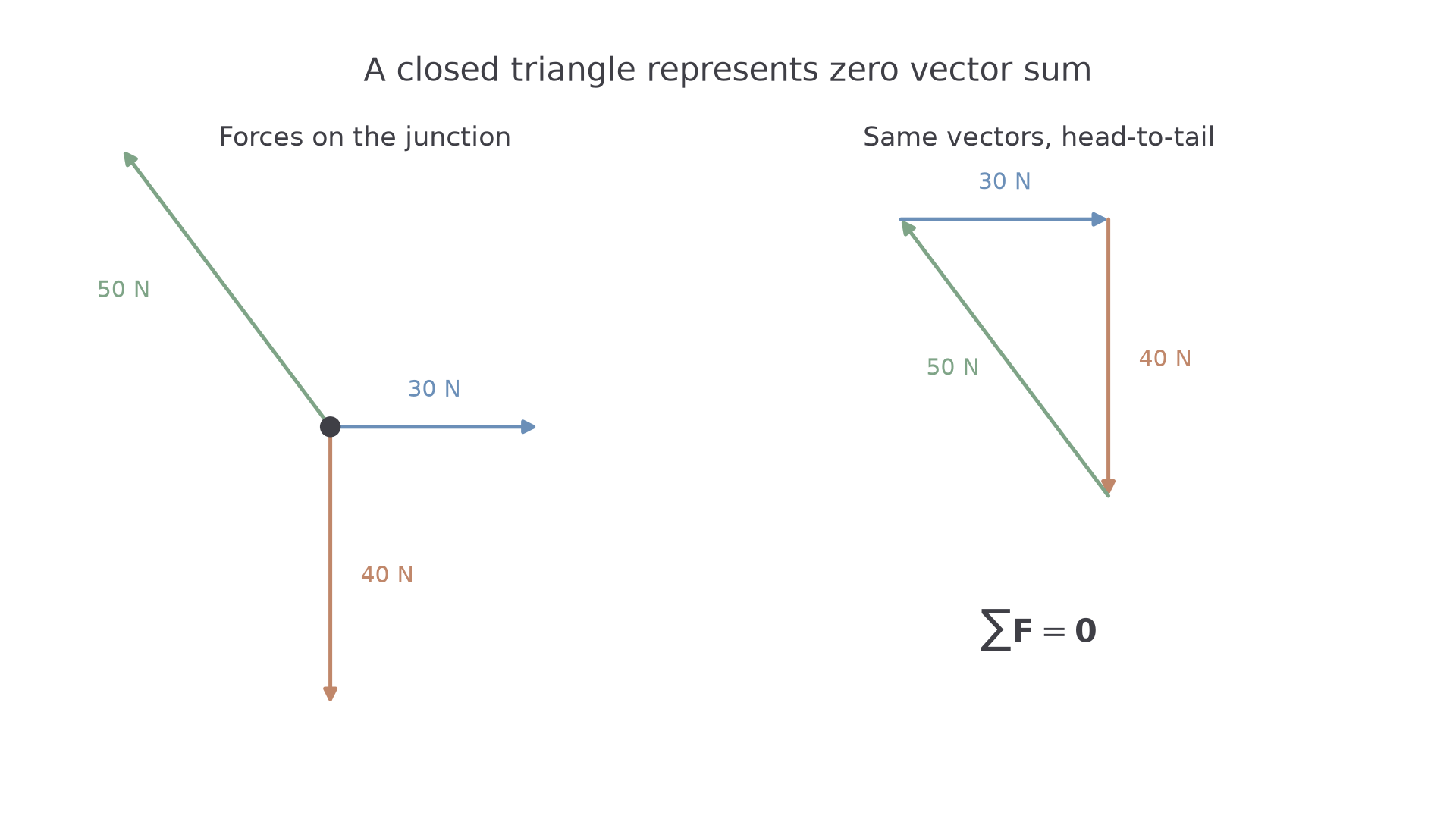
Worked example 1: a junction with perpendicular loads
Question. A junction is pulled to the right and downwards. A third force keeps it in equilibrium. Find that force's magnitude and direction.
Plan. The third force must cancel both components: left and up.
Answer. , above the horizontal to the left.
Check. The diagonal force is larger than either component, and its direction opposes the resultant of the other two forces.
For a triangle that is not right-angled, use the sine or cosine rule from your vector lessons. Be careful: an angle inside the head-to-tail triangle may be the supplement of the angle between the forces when drawn tail-to-tail. Resolving components avoids that ambiguity.
Worked example 2: a symmetric suspended load
Question. Two identical light cords support a load. Each cord is at to the horizontal. Find the tension in each cord.
Plan. Symmetry gives equal tensions ; horizontal components cancel. The two upward components support the weight.
Answer. in each cord.
Check. Each cord's vertical component is , but its tension is larger. If the cords became nearly horizontal, a very large tension would be needed to give those upward components.
The force triangle also allows a scale drawing: choose a scale, draw two known vectors, and measure the closing vector's magnitude and direction. Accurate measuring or construction should be done on paper, with the drawing submitted for assessment when requested.
Combining support forces and moments
For an extended body, moments often find one unknown support force first. Force balance then finds the other. Choose a moment point through an unknown force's line of action: that force has zero moment about the point and disappears from the moment equation without disappearing from the actual force diagram.
[DIAGRAM: asset_name: Unequal reactions supporting a loaded beam; asset_slug: beam-support-reactions; caption: The load near the right support makes the right reaction larger; description: A three metre horizontal beam is supported at its ends. Its 120 newton weight acts at the midpoint and a 180 newton load acts 2.4 metres from the left end. Upward reaction arrows at the ends are labelled 96 newtons and 204 newtons, with lengths in that ratio.]
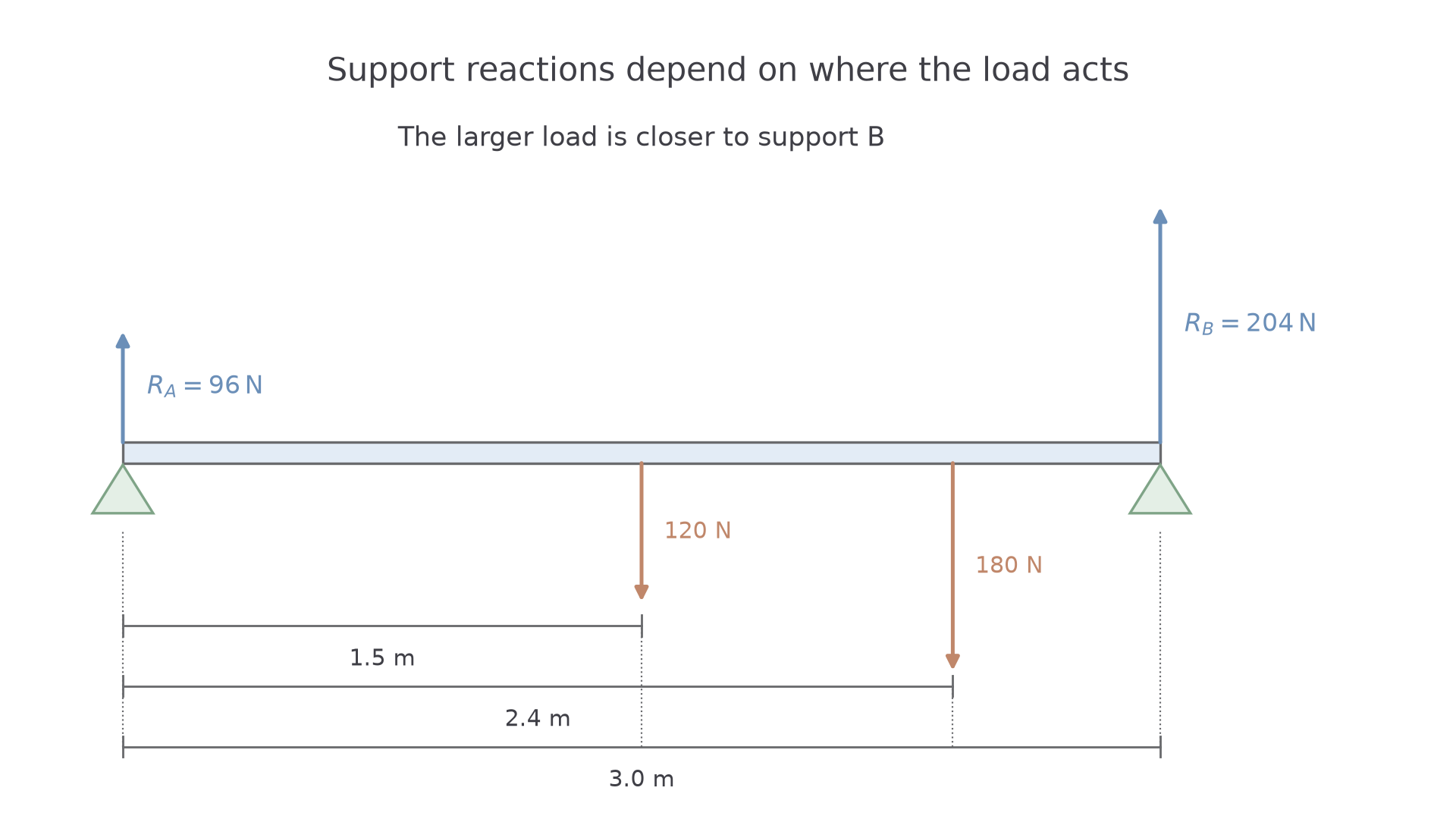
Worked example 3: reactions at two supports
Question. A uniform horizontal beam of length and weight rests on supports at its ends A and B. A load of acts from A. Calculate the upward reactions and .
Plan. Take moments about A, then balance vertical forces. The beam's own weight acts at its midpoint.
Answer. and .
Check. The reactions sum to . B is closer to the added load, so its larger share is physically sensible. Equal reactions would give the wrong resultant moment.
An angled support force contributes only its perpendicular component to the moment about a pivot. It can also require a horizontal reaction, even when all the weights are vertical.
Exam-style example: a hinged sign
Question. A uniform horizontal sign of weight and length is hinged at its left end. A cable from its right end runs upwards and left at to the sign. Calculate the cable tension and the horizontal and vertical hinge-force components.
Plan. Take moments about the hinge to find the cable's vertical component. Resolve forces to find the hinge components.
Answer. Tension ; hinge force to the right and upwards.
Check. The cable pulls left, so the hinge must push right. Its upward component supplies only half the weight because it acts twice as far from the hinge as the weight does.
Exam tip
Name the object whose forces you draw. A cable's tension on the sign and the sign's force on the cable act on different objects; putting both on the sign's diagram would create a false balance.
Finish by combining a moment equation with a horizontal force equation.
Quick Recap
- Equilibrium requires zero resultant force and zero resultant moment.
- Three coplanar equilibrium forces form a closed vector triangle when placed head-to-tail.
- Take moments about a convenient point, then balance horizontal and vertical forces.
- Include the object's weight at its centre of gravity, and distinguish each support force from its components.
The supports do not generally share a load equally: their reactions must balance its turning effect as well as its total weight.