20.3 - Charged particles and velocity selection
Apply magnetic force to individual moving charges, explain circular particle paths, and select a beam speed using crossed electric and magnetic fields. Track the actual particle velocity and charge sign rather than substituting electron motion into a conventional-current rule.
Force on a moving charge
Can a magnetic field bend an electron beam without speeding the electrons up? It can: the magnetic force acts perpendicular to each electron's instantaneous motion. The direction changes even though the force transfers no kinetic energy to the particle.
For a positive charge, the force direction is the same as for conventional current along its velocity. Use Fleming's left-hand rule with the current finger pointing along a positive particle's motion. For a negative charge moving the same way, reverse the force. Always begin with the actual velocity, not the direction you think an electron ought to be moving in a metal wire.
For example, a positive charge moving rightwards through a field into the page has an upwards magnetic force. An electron moving rightwards through that same field has a downwards force. If its velocity is reversed as well as its charge sign, the force returns upwards.
Magnetic force on a moving charge
is force magnitude in newtons, magnetic flux density in teslas, the magnitude of the particle's charge in coulombs, its speed in , and the angle between velocity and field. Determine direction separately, reversing the positive-charge direction for a negative charge.
Not on the data sheet: learn it.
A stationary charge has no magnetic force. A moving charge parallel to the field also has none. A perpendicular velocity gives the maximum force, . The force is perpendicular to both velocity and field, not along a field line.
Worked example 1: charge and force scale
Question. A proton with charge moves at , perpendicular to a field. Calculate its magnetic force.
Plan. The sine factor is one because velocity and field are perpendicular.
Answer. .
Check. The tiny force is consistent with the tiny charge; it can still give a large acceleration because the particle's mass is also extremely small.
The angle matters for a beam too. An electron at making with a field has force magnitude
That is half the perpendicular value. Its negative charge determines direction; it does not make a force magnitude negative.
Watch out
A magnetic field can change momentum without changing kinetic energy. Momentum includes direction. With force always perpendicular to motion, the magnetic force does no work on the particle.
This statement concerns the magnetic force alone. An electric field, collisions or another force may change the speed at the same time.
Circular motion at constant speed
A particle entering a uniform field perpendicular to that field experiences a force of constant magnitude. As the velocity turns, the force turns too, remaining perpendicular to the velocity. It supplies the centripetal resultant needed for a circular path.
[DIAGRAM: asset_name: Opposite charges in a uniform field; asset_slug: circular-charged-particle-paths; caption: Opposite charges entering with the same velocity bend in opposite directions; description: A uniform field into the page fills two panels. A positive particle enters rightwards and follows an anticlockwise circular arc, with velocity tangent and force towards the centre. An electron enters rightwards and follows a clockwise arc, with its own tangent velocity and inward force. Paths are schematic and their radii are not asserted equal.]
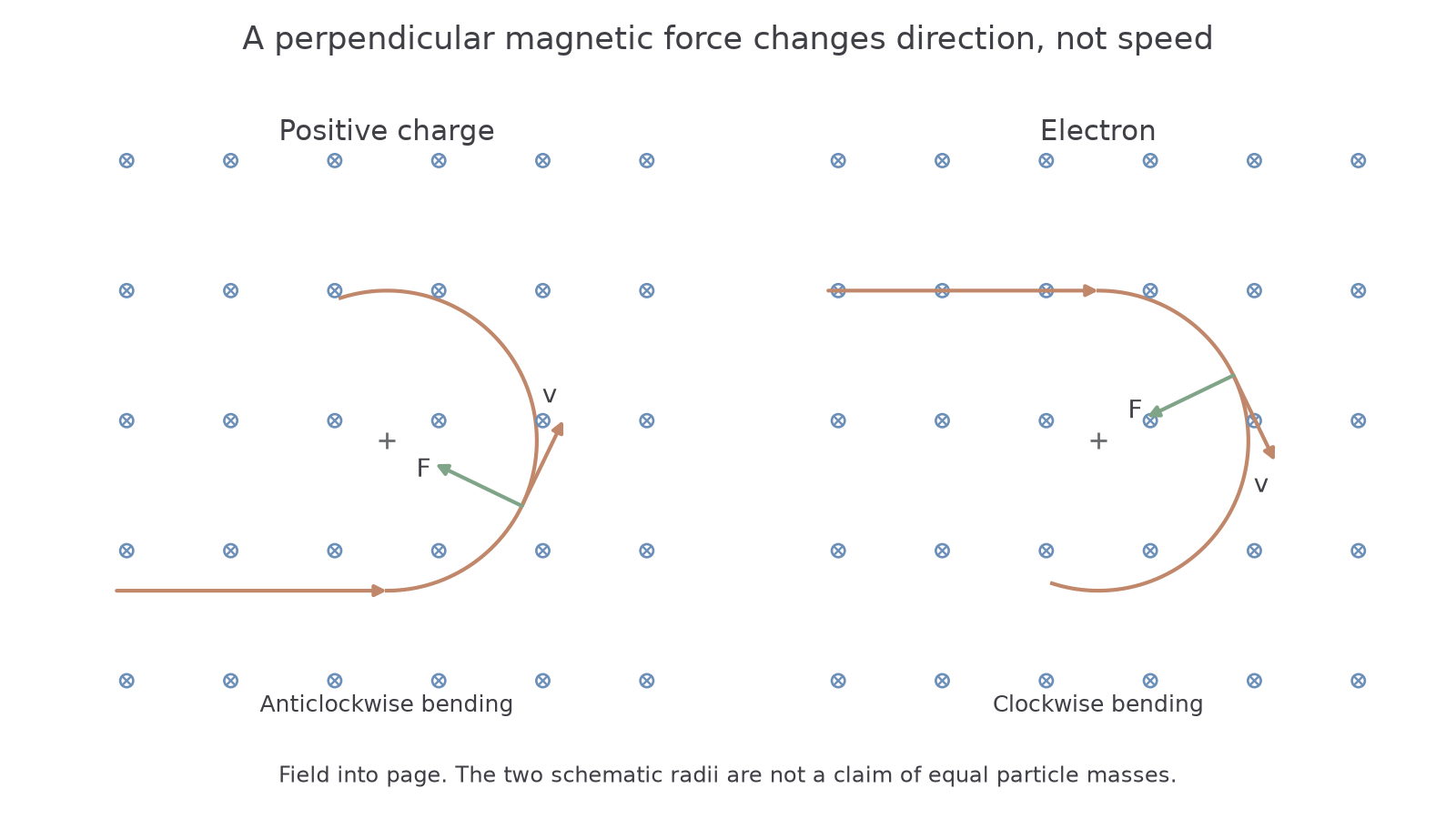
Recall that centripetal force is a description of the resultant's role, not an extra force. Here the magnetic force provides that resultant:
The particle mass is in kilograms and the orbit radius in metres. This radius relation is derived from two recalled relations; it is not printed on the data sheet. A faster or more massive particle has a larger radius at fixed charge and field; a greater charge magnitude or field gives tighter curvature.
Model limit
The circular-path model requires a uniform magnetic field perpendicular to velocity, with other forces and collisions negligible, and speeds where is valid. If there is a velocity component along the field, the complete path is not this plane circle; do not apply the perpendicular-speed geometry to the total velocity without checking.
Worked example 2: a proton's orbit
Question. A proton of mass moves at perpendicular to a field. Its charge is . Determine the radius.
Plan. Equate magnetic force to the radial resultant and solve for radius.
Answer. .
Check. Doubling the field would halve this radius without changing the speed.
Sometimes the speed is established by an accelerating potential difference before the particle reaches the magnetic field. An electron accelerated from rest through p.d. , with negligible energy losses, gains kinetic energy . Do the energy step first; the accelerating electric field and the later magnetic bending field perform different jobs. The electrical-work and kinetic-energy relations require recall; they are not on the data sheet.
Continue this lesson.
You’re previewing NovaLearn without an account. Create a free account to read the rest.
Create free account