6.1, 6.2 - Springs and deformation
Describe how tensile and compressive forces deform solids, measure extension correctly, use Hooke's law, and distinguish the limit of proportionality from the elastic limit.
Loads, extension and compression
A spring has length before loading and afterwards: has it extended by 11 centimetres? No—the original length is still part of the final length. This small distinction matters whenever you turn a ruler reading into a physical deformation.
A load is an applied force. A tensile load pulls a solid along its length and may stretch it; a compressive load pushes inward and may shorten it. In this course, the forces and deformations are treated in one dimension. The material's particles are displaced from their equilibrium separations, and the forces between them oppose the deformation.
Extension and compression
Extension is the increase in length of an object when stretched. Compression is its decrease in length when compressed.
For a stretched spring, calculate extension from the loaded length and unloaded length : . These lengths and the extension are measured in metres when using SI equations. If the two lengths are read from different scale marks, take the difference of the readings rather than treating either reading as a length by itself.
[DIAGRAM: asset_name: Length is not extension; asset_slug: materials-length-extension; caption: Extension is the increase from unloaded length to loaded length; description: Two vertical springs share a fixed upper support. The unloaded spring ends at length l0 and the loaded spring, with a mass hanger, ends lower at length l. Dimension arrows show l0, l and the extra distance x equals l minus l0. Horizontal reference lines align the endpoints with the dimension arrows.]
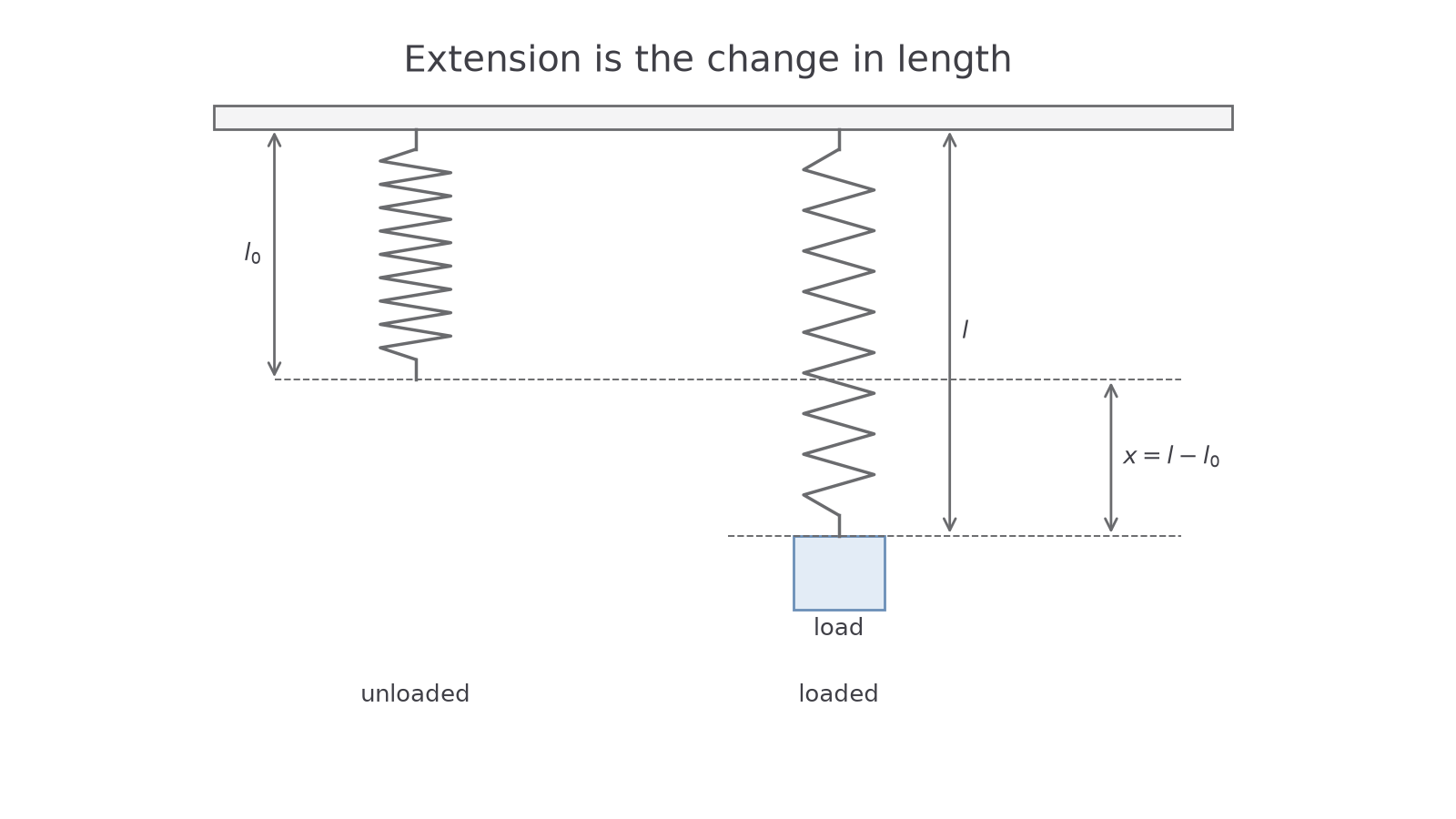
A mass hanger supplies a downward load through its weight. When it is stationary, the magnitude of the spring's upward force equals the total suspended weight: . Include the hanger's mass unless a reading has already been zeroed with the hanger attached. A mass in kilograms is not itself the force in newtons.
As the load increases, extension may remain directly proportional to it only over a limited range. The limit of proportionality marks the end of that range. Beyond it, the spring may still extend, but equal extra loads no longer give equal extra extensions.
Worked example 1: from readings to extension
Question. A spring's lower end is at on a fixed scale before a load is added, and at afterwards. Calculate the extension in metres.
Plan. Subtract the readings first, then convert the difference.
Answer. .
Check. This is the movement of the end, rather than the final scale reading or the spring's entire length.
In a school investigation, clamp the spring securely next to a vertical ruler, add masses gently, let oscillations settle, and read a pointer at eye level. A pointer close to the ruler helps reduce parallax. Keep your feet away from suspended masses and do not overload an untested spring.
Watch out
Zero on the ruler need not coincide with the spring's upper end. A difference between consistent endpoint readings still gives extension correctly. Moving the ruler between readings destroys that comparison.
Try a load and an extension together.
Hooke's law and spring constant
Many springs stretch by twice as much when the load doubles, provided the load is not too large. This proportional relationship is Hooke's law. A graph of load against extension is then a straight line through the origin.
Hooke's law
The extension of an object is directly proportional to the applied force, provided the limit of proportionality is not exceeded.
The limit of proportionality is the point beyond which force and extension are no longer directly proportional. The graph may start to curve. It is a statement about proportionality, rather than about whether the object can recover its original length.
Spring constant
is applied force in N, is extension in m and is spring constant in . These forms use a constant within the proportional region. A larger means more force is needed for the same extension: the spring is stiffer.
Not on the data sheet: learn it.
On a graph with force vertically and extension horizontally, the gradient is . If the axes are reversed, the gradient is . Always inspect the axes before interpreting a gradient. An offset caused by a forgotten initial load is also not evidence of a proportional relation through the origin.
Worked example 2: predicting a new extension
Question. A spring extends by under a load. Calculate its spring constant and the extension under , assuming it remains within its limit of proportionality.
Plan. Find using the first force–extension pair, then use it with the new force.
Answer. ; new extension .
Check. The load increased by a factor of 1.6, and so did the extension. The spring's stiffness did not change in this model.
Continue this lesson.
You’re previewing NovaLearn without an account. Create a free account to read the rest.
Create free account