18.1, 18.2 - Electric fields and parallel plates
Describe an electric field using the force on a positive test charge, interpret field lines, and calculate the field between parallel plates. Use that field to predict the force, acceleration and path of a charged particle, keeping its charge sign explicit.
A field describes force per unit positive charge
If a positive and a negative test charge are placed in turn at the same point, do they feel forces in the same direction? They experience the same external electric field, but their forces point in opposite directions. The field describes the surroundings; the test charge determines its response.
An electric field is a field of force. A source charge is associated with a pattern of forces that a small test charge would experience at different positions. The field describes those forces; it is not material emitted by the source. A test charge must be small enough not to change the source arrangement significantly.
Electric field strength
Electric field strength at a point is the force per unit positive charge at that point. Its direction is the force direction on a positive test charge.
Force and electric field
Here is the electric force in , is the signed charge in , and is electric field strength in . Positive charge gives force along the field; negative charge gives force opposite it. The field can exist at a point without a test charge there.
Not on the data sheet: learn it.
Field lines map direction and relative strength. A tangent gives the force direction on positive charge. Lines point away from positive source charges and towards negative source charges, or continue to/from far away if no opposite charge is shown. Closer spacing represents greater strength in a consistently drawn diagram. Lines cannot cross: the resultant field at a point has one direction. The lines are not physical threads or particle paths.
Worked example 1: a negative test charge
Question. The field at a point is to the right. Determine the force on a charge of there.
Plan. Calculate magnitude, then use the negative charge sign for direction.
Answer. to the left.
Check. Doubling the test charge's magnitude would double the force, while the specified external field would remain unchanged under the small-test-charge approximation.
Watch out
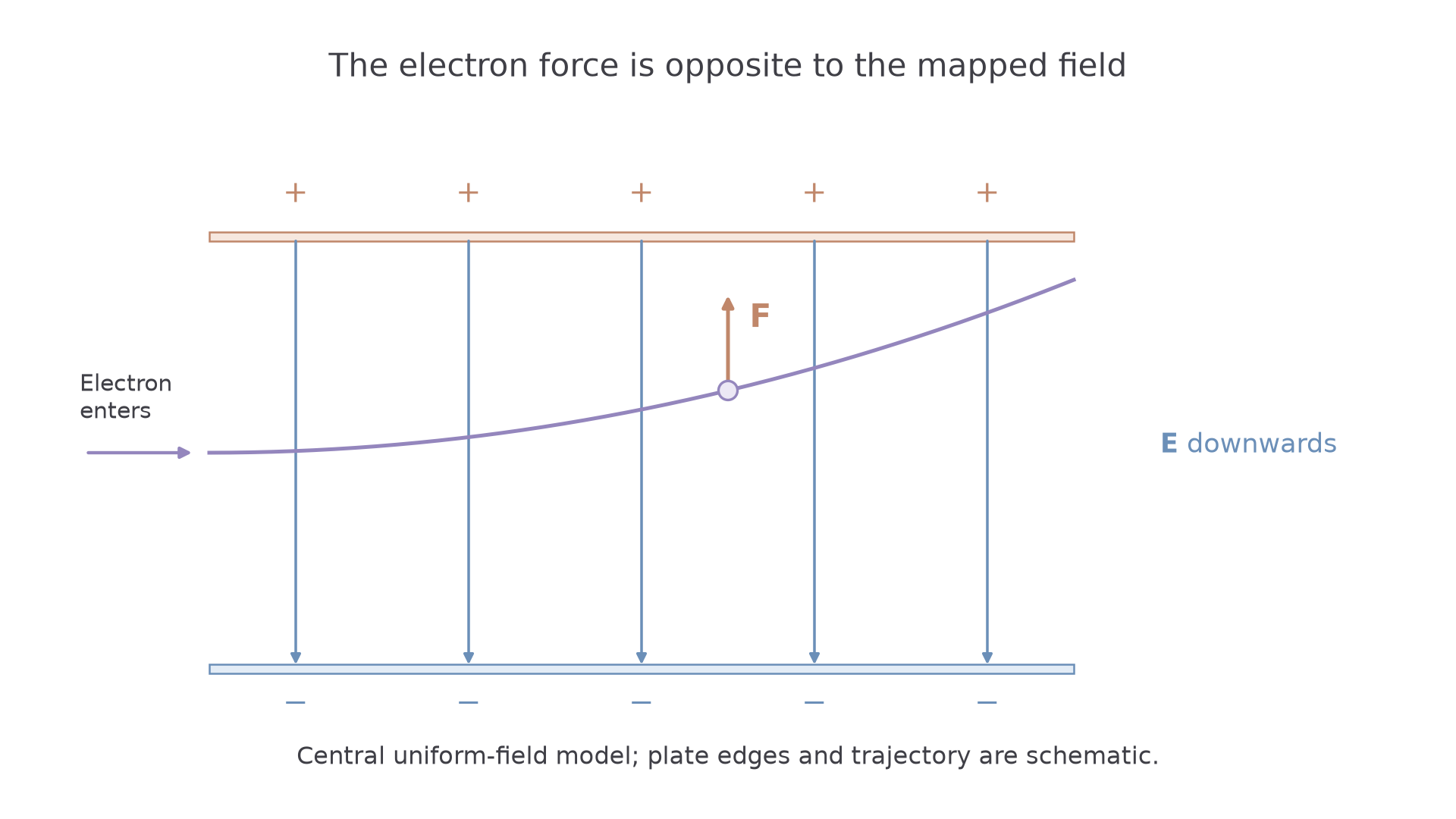
Do not reverse the field arrow because the test particle is an electron. Reverse the force direction. The source arrangement defines the field before the electron is introduced.
Explain that distinction directly.
A uniform field between parallel plates
Two broad parallel conducting plates at different potentials give an approximately uniform field in their central gap. Equal line spacing represents equal strength, and parallel arrows represent constant direction. The lines run from the positive plate towards the negative plate, perpendicular to their faces.
Uniform parallel-plate field
Here is field magnitude in , equivalent to , is potential difference magnitude in , and is perpendicular plate separation in . The plates are broad compared with the gap, and the point is well away from edges. Direction is from higher to lower potential.
Not on the data sheet: learn it.
The ratio describes how rapidly potential falls along the field. Greater potential difference across the same gap gives a stronger field. Doubling the separation with potential difference fixed halves the central strength. Near edges, lines bend outwards: this fringing field is not uniform, so the simple ratio is a central-region approximation.
[DIAGRAM: asset_name: A uniform field and electron deflection; asset_slug: plate-field-particle-path; caption: The field points from positive to negative, while an electron accelerates oppositely; description: Horizontal positive and negative plates bound a region with straight equally spaced downward field arrows. An electron enters horizontally midway between them and follows an upward-curving path. An upward force arrow starts at one marked electron position, opposite to the field. The particle stays between the plates.]
Worked example 2: finding a plate field
Question. Plates have potential difference and separation . Calculate the central field magnitude.
Answer. , equivalently .
Check. Treating 20 as a separation in metres would underestimate the field by a factor of 1000.
Continue this lesson.
You’re previewing NovaLearn without an account. Create a free account to read the rest.
Create free account