14.3 - Specific latent heat
Learn why energy can change a substance's state without raising its temperature, distinguish fusion from vaporisation and calculate energy transfers through several stages. You will analyse melting and boiling measurements while separating the intended energy transfer from the surroundings' contribution.
Changing state at constant temperature
Can boiling water keep absorbing energy while its temperature stays constant? It can: while liquid changes to vapour at a fixed pressure, the supplied energy changes its state rather than simply increasing its temperature.
A pure substance undergoing an equilibrium change of state has a constant temperature while both phases coexist, at the stated pressure. Fusion means melting from solid to liquid; its reverse is freezing. Vaporisation means changing liquid to gas; its reverse is condensation. Their specific latent heats are different quantities, even for the same substance.
Specific latent heat
Specific latent heat is the energy required per unit mass to change a substance's state without a change in temperature. Specific latent heat of fusion refers to solid becoming liquid; specific latent heat of vaporisation refers to liquid becoming gas, under the stated conditions.
During warming within one phase, energy transfer can increase temperature. During the phase change, energy changes the molecular arrangement and separation. Vaporisation involves a much greater increase of volume than fusion and can require work against the surrounding pressure as well. Do not claim that every joule supplied must increase random molecular kinetic energy: the temperature need not rise.
[DIAGRAM: asset_name: Warming and changing state; asset_slug: thermal-heating-curve; caption: Sloping regions show warming within a phase and plateaux show state changes while energy is supplied; description: A schematic temperature-versus-energy heating curve has a sloping solid region, a horizontal melting plateau, a sloping liquid region, a horizontal boiling plateau and a sloping gas region. The axes show temperature in degrees Celsius and transferred energy in joules, without a numerical energy scale. Labels identify fusion and vaporisation, and interval widths are explicitly not to scale.]
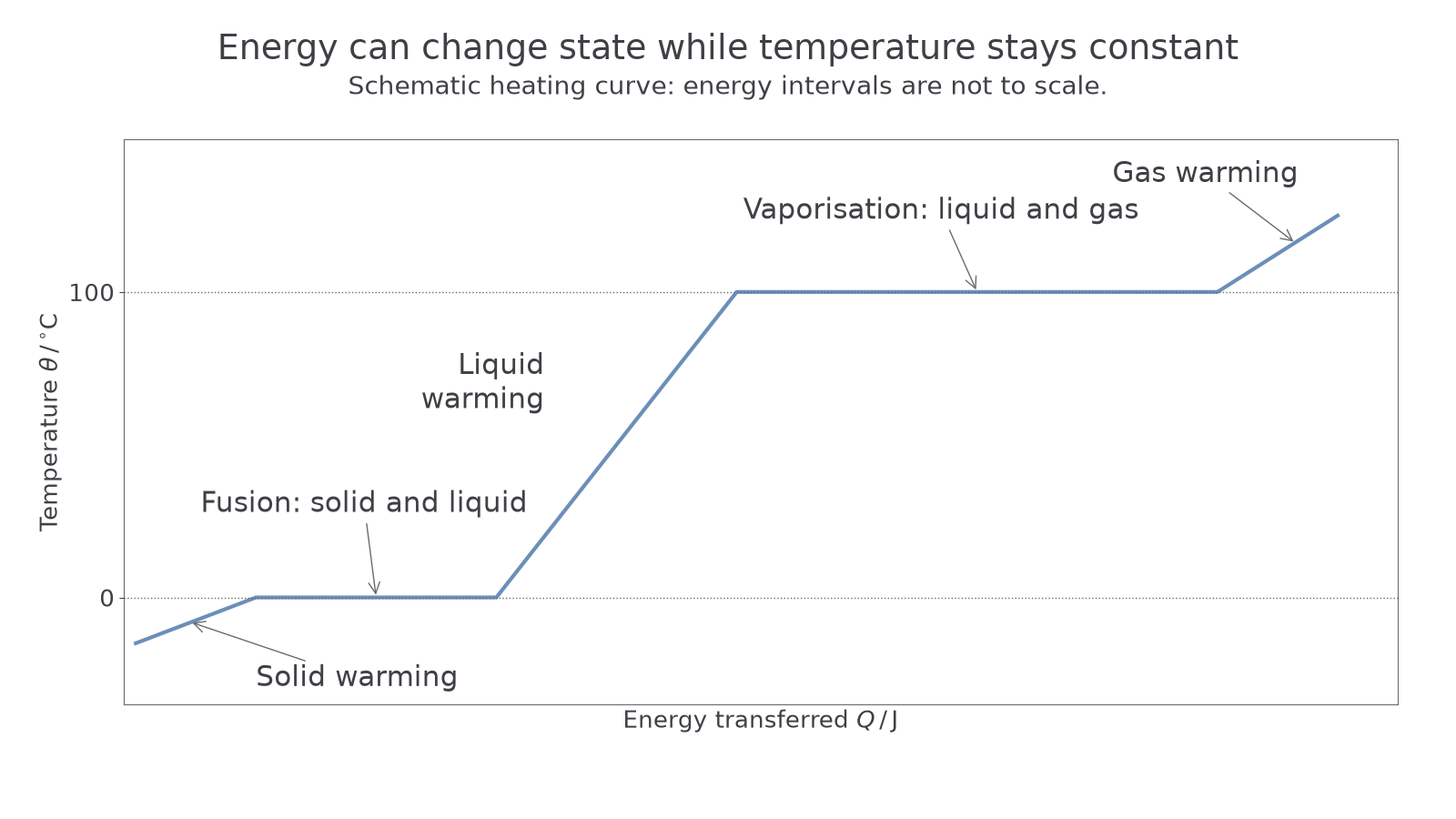
The plotted transition temperatures of and illustrate water near atmospheric pressure. Other substances, or different pressures, can have different melting and boiling temperatures.
For an ideal constant-power heating experiment, the flat portions of a temperature-time graph do not mean the heater has switched off. A larger energy requirement for a phase change means a longer plateau at the same useful power and sample mass. The reverse changes release energy to the surroundings without changing the phase-change temperature under the same conditions.
Watch out
Use the latent heat for the actual change. Melting ice is fusion, not vaporisation. An equal numerical temperature before and after does not imply zero energy transfer if the state has changed.
Make the definition complete enough to distinguish it from specific heat capacity.
Energy through warming and state changes
Separate a journey through temperature and phase into stages. A temperature rise within one phase uses its specific heat capacity. A phase change at constant temperature uses its specific latent heat. Add the energy transfers only after identifying every stage.
Energy for a state change
Here is the energy required for the change in joules, is the mass that changes state in kilograms, and is the appropriate specific latent heat in . The state change occurs without temperature change at the stated conditions. Freezing or condensation releases the corresponding energy; state the direction or use a consistent signed energy balance.
Not on the data sheet: learn it.
For example, melting of ice already at its melting temperature, using , requires
That calculation does not include warming colder ice to its melting temperature or warming the resulting water afterwards. Those are separate energy requirements.
Worked example: ice to warm water
Question. Determine the energy required to turn of ice at into water at . Use , and . Assume melting at and neglect other energy transfers.
Plan. Warm the ice to zero, melt it, then warm the water. Use the mass in every term.
Answer. About , or 18 kJ, to two significant figures.
Check. Melting dominates the total. Using for the entire change from minus 12 to plus 20 degrees Celsius would miss that largest contribution and use the wrong heat capacity for part of the journey.
For steam condensing and then cooling as water, both stages release energy. For a mixture reaching equilibrium, energy lost by warmer material equals energy gained in warming, melting and any subsequent warming of the colder material, with apparatus or environmental terms included when significant.
Before assuming that all the ice melts, compare the energy available on cooling the warmer material to the melting temperature with the energy needed to melt all the ice. If the available energy is smaller, ice remains and the equilibrium mixture stays at the melting temperature. Only a surplus after complete melting can raise the liquid's temperature further.
Worked example: decide which phases remain
An insulated container holds of water at . Add of ice already at . Use and , neglecting container heating and external transfers.
Cooling the water to zero releases . Melting all the ice would require , so that energy is unavailable. Instead, melts, leaving about of ice with liquid water at . This phase check avoids an impossible negative final liquid-water temperature from assuming complete melting.
Continue this lesson.
You’re previewing NovaLearn without an account. Create a free account to read the rest.
Create free account