15.1, 15.2 - Moles and the ideal gas equation
Learn to connect the amount of gas with its particle count, pressure, volume and thermodynamic temperature. You will use both forms of the ideal gas equation, choosing consistent units and distinguishing absolute pressure from a gauge reading.
Moles and numbers of particles
A tyre gauge reads zero gauge pressure. Does that mean the tyre contains no gas? The answer depends on what the pressure reading compares, rather than simply how many particles are present. First we need a practical way of counting those particles.
Amount of substance is an SI base quantity with unit the mole, symbol . One mole contains a number of specified particles equal to the Avogadro constant. Specify what is counted: atoms, molecules or another identified entity. One mole of a molecular gas counts molecules, not automatically its constituent atoms.
The Avogadro constant is supplied on the examination data sheet as . Use this rounded examination value unless a task gives another. Different substances can have the same amount and particle count but different masses because their particles have different masses.
Amount, count and molar mass
Here is the number of specified particles, a count with no physical unit; is amount in moles; is the Avogadro constant in . Mass and molar mass must use matching mass units: kilograms with , or grams with . Molar mass is mass per mole.
Not on the data sheet: learn it.
A measured mass therefore gives an amount first, then the number of specified particles.
Worked example 1: a gas sample's count
Question. Helium has molar mass . Determine the amount and number of helium atoms in a sample. Use .
Plan. Divide by molar mass using the same mass unit, then multiply the amount by particles per mole.
Answer. , containing helium atoms.
Check. One fifth of a mole contains one fifth of the Avogadro count. The count is not measured in moles: it is the number of atoms.
Keep the symbols separate. A lower-case is an amount in this lesson; upper-case is a particle count. A quoted molar mass of is , not 28 kilograms per mole.
Watch out
“Same mass” and “same number of particles” are different comparisons. Equal masses of gases with different molar masses generally contain different amounts and particle counts.
Reverse the counting method to find a mass.
Pressure, volume and absolute temperature
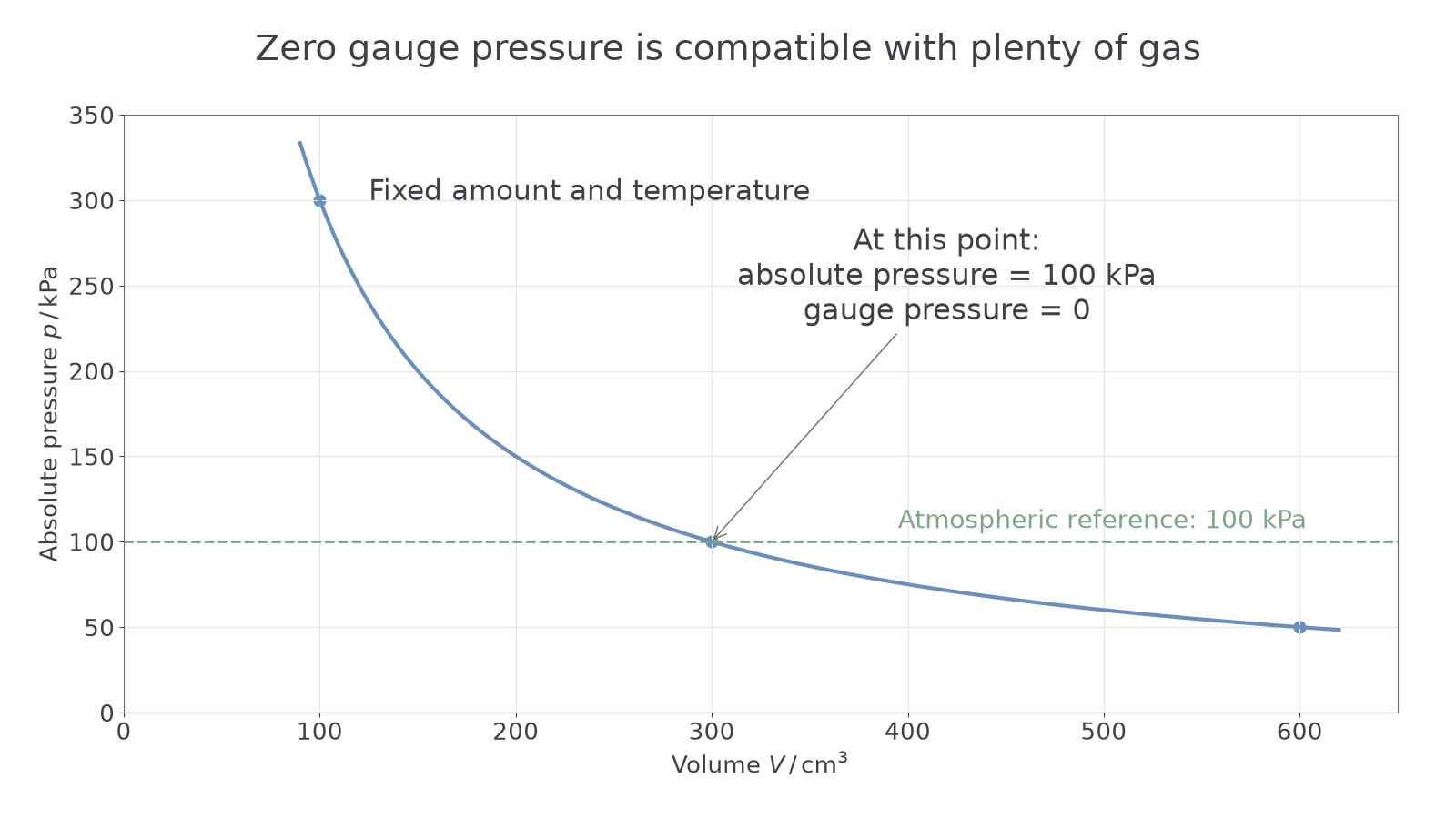
For a fixed amount of an ideal gas, the product of absolute pressure and volume is proportional to thermodynamic temperature. Raise temperature at fixed volume and pressure rises; compress the gas at fixed temperature and pressure rises because the same amount occupies less space.
Molar form of the ideal gas equation
Here is absolute pressure in pascals, volume in , amount in moles and thermodynamic temperature in kelvin. The molar gas constant is supplied as . For fixed amount, is constant.
Not on the data sheet: learn it.
An ideal gas obeys this equation of state exactly. Real gases approximate it best at low density and away from conditions where they condense. At high density or near condensation, molecular sizes and interactions make the simple model less accurate. The next lessons explain the microscopic assumptions and evidence.
Absolute pressure is measured relative to a vacuum. Gauge pressure is measured relative to the surrounding atmospheric pressure:
All pressures must use the same unit. This reference conversion is not on the data sheet. Zero gauge pressure means the gas matches atmospheric pressure, not that its absolute pressure or particle count is zero. A gauge reading can be negative if the gas pressure is below its surroundings.
[DIAGRAM: asset_name: An ideal-gas isotherm and a gauge zero; asset_slug: thermal-gas-isotherm; caption: At fixed temperature and amount, pressure is inversely proportional to volume and atmospheric absolute pressure can correspond to zero gauge pressure; description: A pressure-volume graph for a fixed amount and temperature has an inverse curve passing through 100 cubic centimetres and 300 kilopascals, 300 cubic centimetres and 100 kilopascals, and 600 cubic centimetres and 50 kilopascals. At the middle point a label gives atmospheric pressure 100 kilopascals and therefore gauge pressure zero.]
Continue this lesson.
You’re previewing NovaLearn without an account. Create a free account to read the rest.
Create free account