1.2 - Derived units and equation checks
Build derived units from SI base units and use them to test whether an equation could describe a physical situation. Learn what a unit check can expose, and why passing that check never proves an equation correct.
Building derived units
Could a pressure be measured in kilograms per metre per second squared? It sounds like an unlikely unit until you unpack what pressure measures. A complicated unit is often a short physical story written in symbols.
You already know that speed compares distance with time. Dividing metres by seconds gives . A derived unit is built by multiplying, dividing or raising SI base units to powers. The relationship defining a quantity tells you which operation to use.
You already know
The AS base units you must recall are , , , and . Prefixes must be converted before substituting into an equation that uses SI units.
For example, density is mass divided by volume. A volume has unit , so density has unit . Acceleration is change of velocity divided by time: divide by , giving . This is unit algebra: dividing by subtracts one from the power of .
Some derived units receive special names. A newton is the unit of force. Using force equals mass times acceleration gives
The symbol is convenient; the base-unit expression reveals how force connects to mass and motion. It does not change the quantity being measured.
| Quantity | Relationship used to build its unit | SI unit in base units |
|---|---|---|
| Frequency | number of cycles / time | |
| Momentum | mass × velocity | |
| Force | mass × acceleration | |
| Energy or work | force × distance along the force | |
| Power | energy / time | |
| Charge | current × time | |
| Potential difference | energy / charge | |
| Resistance | potential difference / current |
These relationships receive their full physical treatment later. Here, use the stated relationship to construct a unit rather than trying to memorise a long string of powers. The unit relationships are not listed on the data sheet: learn how to reconstruct them.
Worked example 1: the base unit of pressure
Question. Pressure is force divided by area . Express the pascal, the SI unit of pressure, in base units.
Plan. Replace force by and area by , then simplify.
Square brackets here mean “the unit of”.
Answer. .
Check. Multiplying pressure by area restores a force unit. A negative length power is perfectly sensible for force per area.
Sometimes the unknown unit belongs to a constant, rather than a named quantity.
Exam-style example: a constant in a force law
Question. In a particular model the magnitude of a resistive force is , where is speed. Determine the SI base units of .
Plan. Isolate before replacing quantities by units.
Answer. .
Check. , as required for force. This is a unit exercise, not a claim that every resistive force is proportional to speed squared.
Now build a unit from a different relationship.
Checking equation homogeneity
An equation can equate two physical quantities only if their units are compatible. You can add a length to a length, but adding a length to a time has no physical meaning. This requirement is called homogeneity.
Homogeneous equation
An equation is homogeneous when every term has the same base units. The units on the two sides must agree, and terms added or subtracted on either side must also agree.
Consider , a constant-acceleration relation. Displacement has unit , initial velocity has unit , acceleration has unit and time has unit . Therefore,
The numerical factor one half has no unit. Both terms on the right are lengths, matching the left. This equation passes the unit check. The relation is on the data sheet; the method of checking units is not.
Compare the proposed equation . The first term has unit , but the second has unit . You cannot add them. The missing power of time is detectable before you insert any numbers.
Exam tip
For “Use SI base units to show that …”, write the substitutions and simplify them. Merely saying “both sides have the same units” does not show the requested evidence. If there is a sum, check each term.
A useful routine is: identify quantities and their units, substitute base units, simplify, then compare. A prefix conversion is a separate step: and both measure length, but mixing their numerical values inside a calculation still gives the wrong answer.
Worked example 2: finding a wrong power
Question. A student proposes for an energy, where is mass and is speed. Use SI base units to show that the equation is not homogeneous.
Plan. Compare the energy unit with the unit of the proposed right-hand side.
Answer. The powers of length and time do not match, so the equation is not homogeneous.
Check. Each speed factor contributes both one length power and one inverse time power. Cube the whole unit, rather than just the metre.
You are ready to check a relation without numerical data.
What units cannot tell you
A successful unit check is a necessary condition, rather than a complete test of a physical law. An equation may have compatible units and still give the wrong magnitude, direction or dependence on conditions.
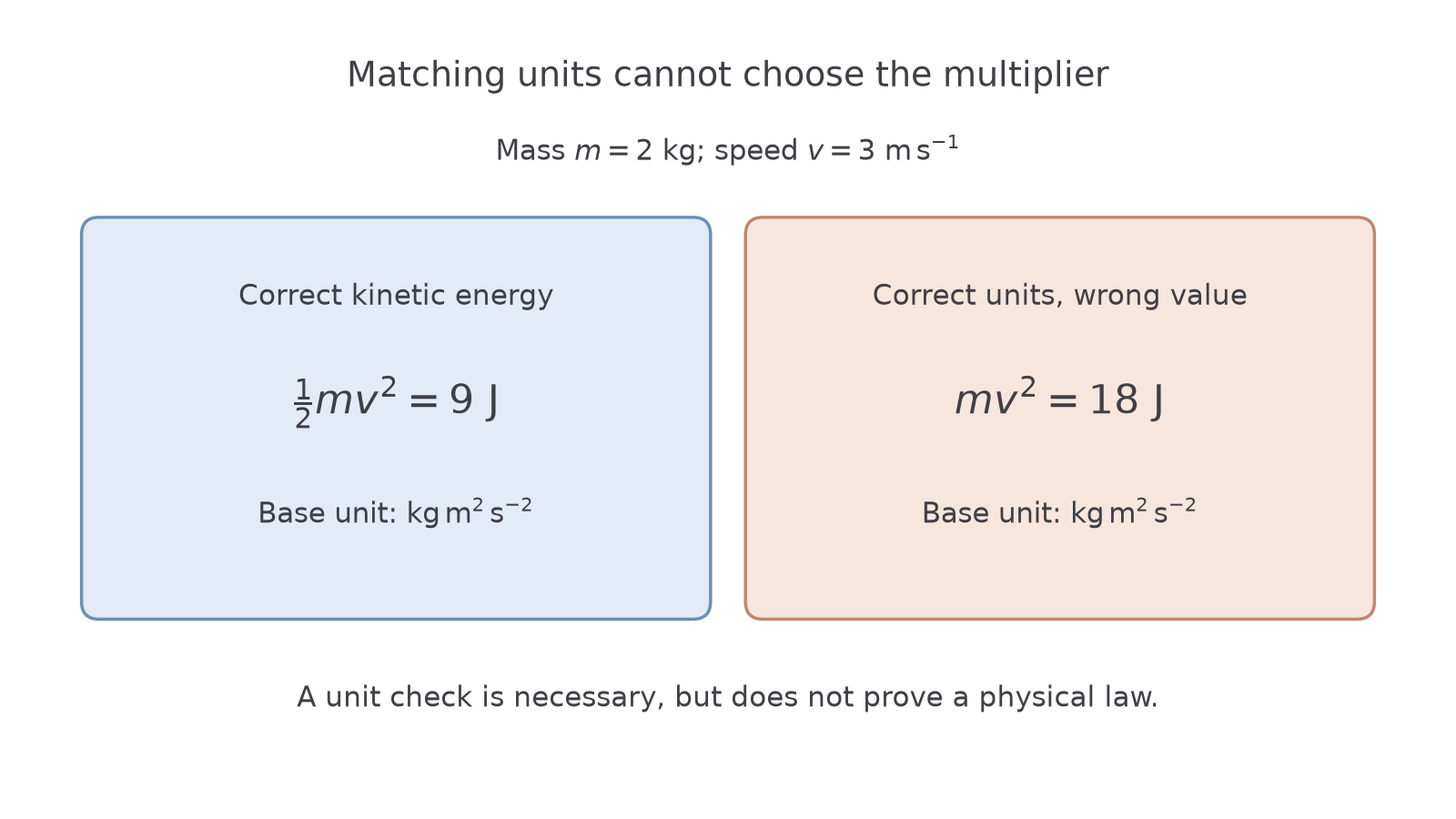
For example, the correct kinetic-energy relationship for a non-relativistic object is . The proposed relationship has exactly the same units. The factor one half is dimensionless, so units cannot detect its absence. You will derive the correct relationship in the energy lessons.
There is another surprising limitation: frequency, measured in hertz, and radioactive activity, measured in becquerels, both have base unit . One counts repeated cycles per second; the other counts nuclear decays per second. The named unit preserves physical meaning that the base-unit expression alone cannot supply.
[DIAGRAM: asset_name: Necessary but not sufficient; asset_slug: unit-check-limits; caption: Two expressions can share an energy unit while predicting different values; description: Two side-by-side calculation cards use mass 2 kilograms and speed 3 metres per second. One gives one half m v squared equals 9 joules; the other gives m v squared equals 18 joules. Both have base unit kilogram metre squared per second squared. The first is labelled correct kinetic energy, the second correct units but wrong value.]
A homogeneous formula also needs a physical model with stated conditions. The expression is a correct relation only for constant acceleration in the chosen straight-line direction. Keeping its units correct does not make it valid for arbitrary changing acceleration.
Model limit
Unit analysis can reject an equation with incompatible units. It cannot determine a dimensionless multiplier, establish the physical meaning of a quantity, or prove that the assumed model fits the situation.
Notice the difference between two judgements. “This equation is not homogeneous, so it cannot be correct as written” is decisive. “This equation is homogeneous, so it might be correct” is appropriately cautious. Experiment, a physical derivation or further reasoning must decide the rest.
Quick Recap
- Build a derived unit by applying the defining relationship to SI base units.
- Every term added in a homogeneous equation has the same base units.
- Show the unit substitution and simplification when asked to demonstrate homogeneity.
- Units cannot determine dimensionless multipliers or prove that a model is physically valid.
Pressure really can have unit : it is force per area, with the newton unpacked into base units.