17.1, 17.2 - Velocity and energy in oscillations
Learn how velocity is phased relative to displacement and acceleration, choose the correct velocity sign at a given displacement, and explain the exchange of kinetic and potential energy. Use the total-energy relation to connect mass, frequency and amplitude without confusing equilibrium with zero total energy.
Velocity, phase and two possible directions
If an oscillator's displacement is zero, has it run out of energy? In ideal SHM the opposite can be true: at equilibrium it has its greatest speed. Its position is zero, while the slope of its displacement graph is greatest in magnitude.
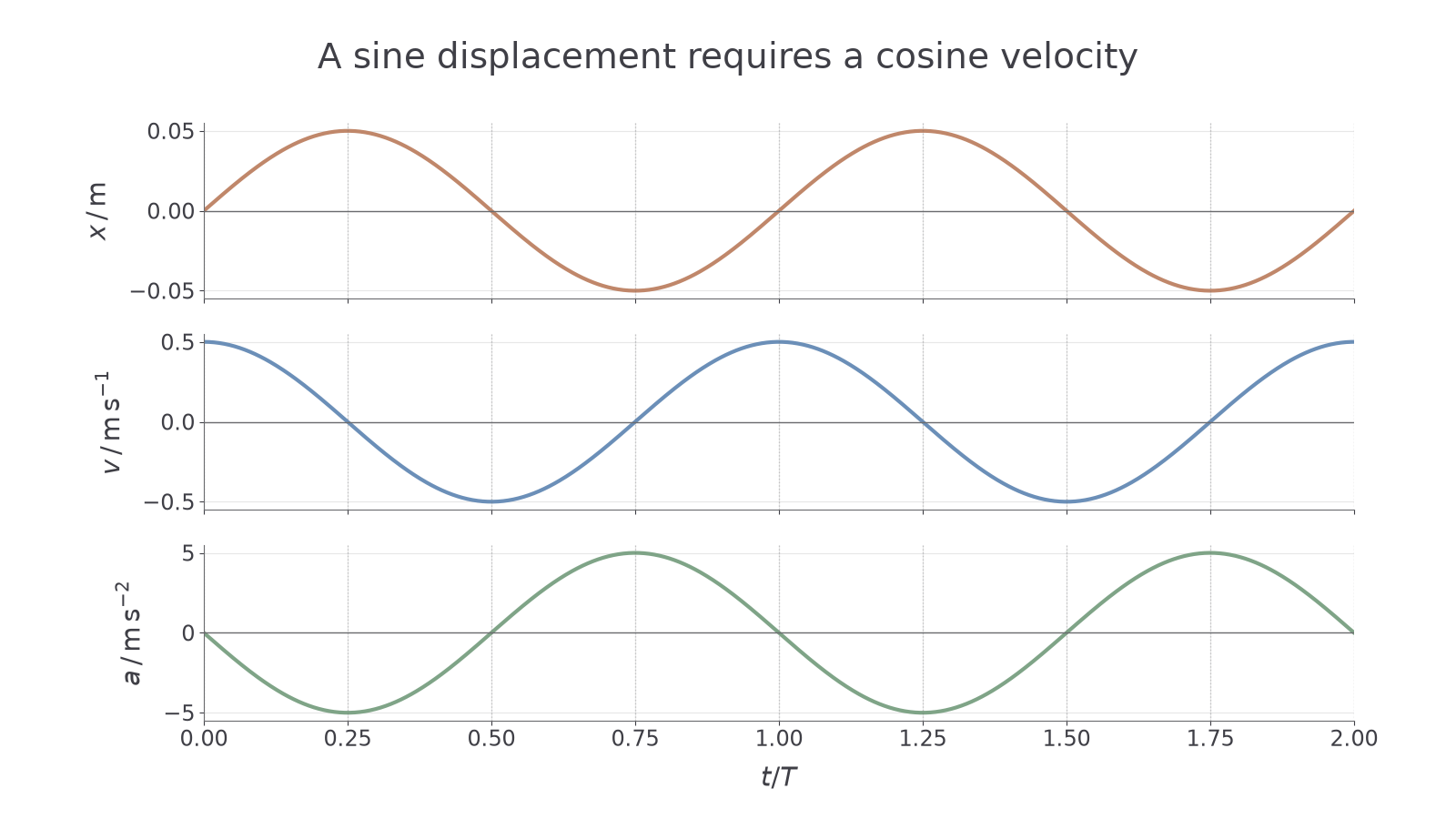
For the phase choice , the object crosses equilibrium moving positively at . Its velocity must therefore begin at a positive maximum, fall to zero at the positive turning point, and then become negative. A cosine describes exactly that timing.
Velocity for the sine displacement solution
Velocity and maximum speed are in , amplitude in metres, angular frequency in and time in seconds. This cosine velocity matches ; it is not the matching velocity for every possible starting phase.
On the data sheet, Paper 4 only.
The maximum-speed relation is . It follows by setting in the supplied displacement-dependent velocity equation below, rather than being printed as a separate formula.
The velocity is the gradient of the displacement curve. On a graph, check that its sign agrees with the slope at every instant, rather than choosing sine and cosine independently. Since , velocity leads displacement by radians for this phase convention.
| Time | Displacement | Velocity | Acceleration |
|---|---|---|---|
| 0 | 0 | 0 | |
| 0 | maximum negative | ||
| 0 | 0 | ||
| 0 | maximum positive |
[DIAGRAM: asset_name: Three phase-consistent SHM graphs; asset_slug: oscillations-three-phase-graphs; caption: Velocity has the sign of the displacement gradient while acceleration opposes displacement; description: Three aligned graphs plot displacement, velocity and acceleration for a sine-phase oscillator with amplitude 0.050 metres and angular frequency 10 radians per second. Displacement starts at zero rising, velocity at its positive maximum, and acceleration at zero becoming negative. Vertical guides mark quarter periods.]
Eliminating time with a trigonometric identity
On a unit circle, the horizontal and vertical coordinates are cosine and sine. Pythagoras gives the identity
It is exact for every angle , unlike the small-angle approximations. It is not on the data sheet: learn it. Using and ,
Taking the square root introduces two possible signs.
Velocity at a displacement
Use and in metres and in to obtain in . It applies to ideal SHM with fixed amplitude. The sign comes from the direction of motion, not the sign of displacement. At , it gives maximum speed .
On the data sheet, Paper 4 only.
Worked example 1: the same position, two velocities
Question. An oscillator has amplitude and angular frequency . Determine its velocity at when returning towards equilibrium. Use .
Since it returns from a positive displacement, its velocity is negative: . Earlier in the cycle it passed the same position moving positively at .
Check. Its maximum speed is , greater than the calculated speed away from equilibrium.
Kinetic and potential energy exchange
A restoring interaction can store potential energy as the oscillator is displaced. When the object moves back towards equilibrium, that potential energy decreases and kinetic energy increases. With negligible resistance and no driving force, total mechanical energy stays constant.
For a horizontal Hooke's-law spring, the area under its force–extension graph gives elastic potential energy , taking zero at equilibrium, where the spring has its natural length. Since for that system,
Mass is in kilograms, displacement in metres, angular frequency in and velocity in , giving both energies in joules. These energy relations are not on the data sheet: learn the kinetic relation and understand the potential-energy derivation. For general ideal SHM, the oscillation potential energy is measured relative to its equilibrium minimum and has the same quadratic form.
At , this potential energy is minimum and speed is maximum. At either turning point, speed and kinetic energy are zero while potential energy is maximum. The object is not “out of energy” there; its energy is in potential rather than kinetic form. Acceleration is greatest in magnitude, ready to change the direction of motion.
Continue this lesson.
You’re previewing NovaLearn without an account. Create a free account to read the rest.
Create free account