19.1 - Capacitance and capacitor combinations
Define capacitance for two-plate capacitors and isolated spherical conductors, and distinguish stored charge from net charge. Derive and use the parallel and series combination rules from their physical charge and potential-difference conditions.
Charge per unit potential difference
Can a capacitor store charge while its total net charge is zero? Yes: one plate can have charge and the other . The phrase “charge on the capacitor” means the magnitude on one plate, rather than their sum or twice that magnitude.
A capacitor separates charge on two conductors. Moving more charge onto the positive side and off the negative side increases their potential difference. For a fixed arrangement and insulating medium, an ideal linear capacitor has charge proportional to potential difference.
During charging, a source removes electrons from one plate and adds them to the other through the connecting wires. It does not push them through the ideal insulating gap. Once an ideal capacitor is fully charged at a fixed d.c. p.d., the steady conduction current ceases.
Capacitance
Capacitance is charge per unit potential difference. For a capacitor, use the magnitude of charge on either plate and the potential difference between its plates.
Capacitance
Here is capacitance in farads, , is charge on one plate in , and is the p.d. between plates in . One farad is one coulomb per volt. A fixed ideal capacitor has constant , rather than its capacitance increasing simply because it is charged to a higher voltage.
Not on the data sheet: learn it.
For an isolated spherical conductor, capacitance instead means its charge divided by its potential relative to infinity. For a negative sphere, both charge and potential are negative, giving the same positive capacitance. There is no second metal plate in that definition; the reference is infinity.
Worked example 1: charge on the plates
Question. A capacitor has a p.d. of . Calculate the magnitude of charge on either plate.
Answer. About on each plate, with opposite signs.
Check. Their net charge is zero if the capacitor was charged by transferring charge from one plate to the other. Using in the definition would double-count the separation.
An isolated conducting sphere in free space has surface potential . Substituting in the definition gives
Radius is in , and in , so the result has unit . This relation is derived from the supplied point-potential expression; it is not separately printed on the data sheet. It applies to an isolated spherical conductor, with the infinity reference and no nearby objects significantly altering the field.
For , it gives , about . A hand-sized isolated sphere therefore has a remarkably small capacitance compared with a typical microfarad capacitor. That is a consequence of geometry and the reference arrangement, rather than a different meaning of electric charge.
Watch out
The potential in an isolated-sphere capacitance is measured relative to infinity. In a two-plate capacitor, it is the p.d. between plates. Do not silently exchange these references.
Parallel capacitors share the same p.d.
Capacitors are in parallel when each is connected across the same two nodes. Every branch has the same potential difference. The source must supply the sum of the positive-plate charges, rather than that same charge to every branch.
[DIAGRAM: asset_name: Parallel and series capacitor connections; asset_slug: capacitor-combinations; caption: Parallel branches share voltage and an initially uncharged series chain carries equal charge magnitudes; description: Two complete circuits show a battery across two parallel capacitor branches and a battery across a two-capacitor series chain. Nodes, capacitor plates and wire joins are distinct. The parallel circuit labels equal branch p.d.s and added charges. The series circuit labels the same charge magnitude and added p.d.s, with the middle connected conductors initially neutral.]
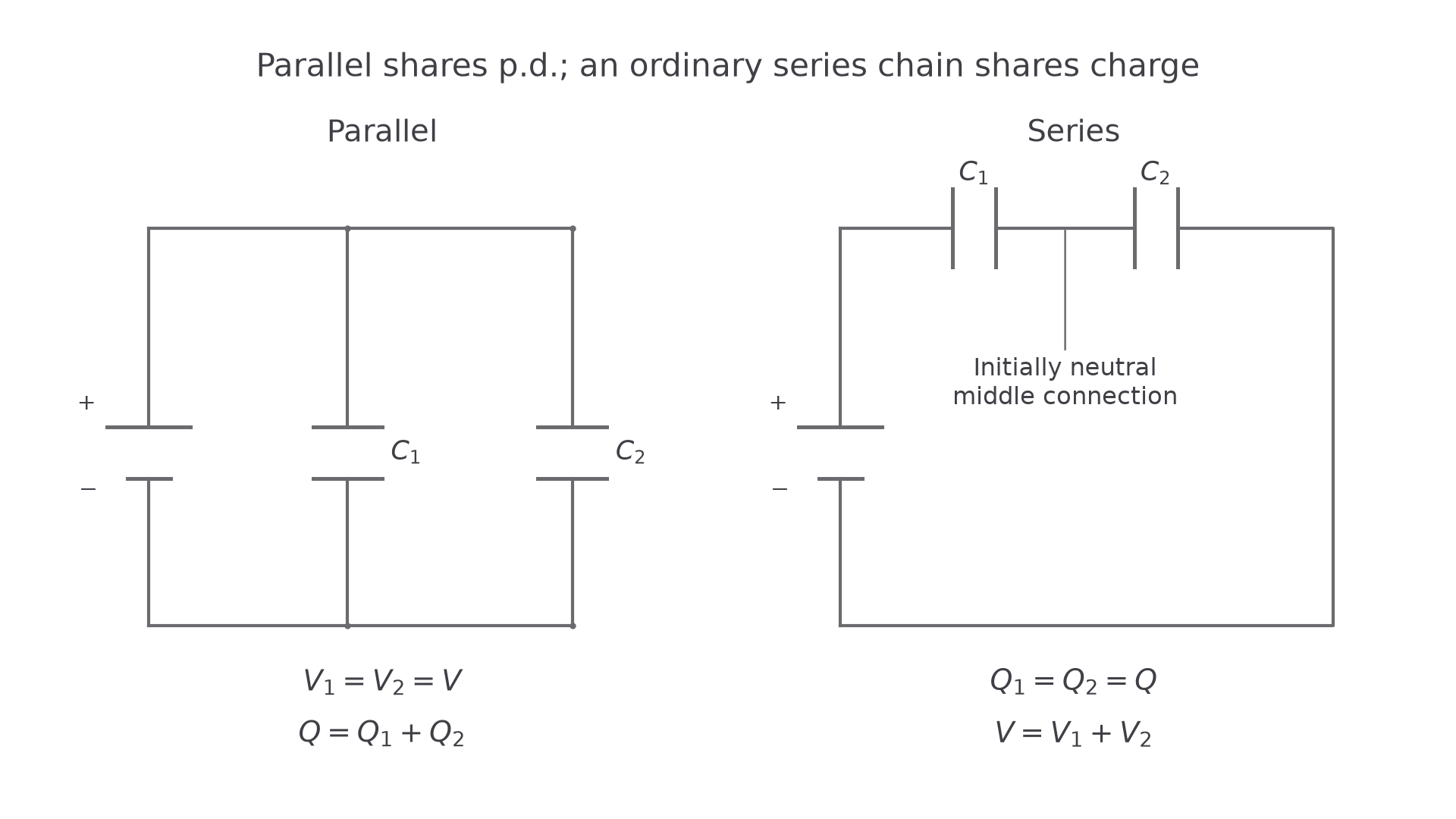
For two parallel capacitors, and total supplied charge is . Substitute the definition of capacitance:
The added capacity comes from being able to separate more charge at the same p.d. It is not a new rule disconnected from the definition.
Capacitors in parallel
All capacitances must use a consistent unit, normally . Each capacitor is across the same two nodes and therefore has the same p.d.; charge magnitudes add.
On the data sheet, Paper 4 only.
Continue this lesson.
You’re previewing NovaLearn without an account. Create a free account to read the rest.
Create free account