6.1 - Stress, strain and Young modulus
Separate a material's behaviour from a wire's dimensions using stress and strain, calculate Young modulus, and analyse a workable experiment to determine it from a metal wire.
Stress and strain
Would a thin steel wire and a thick steel wire of the same original length extend by the same amount under the same load? They are made from the same material, yet the thinner one normally extends more. A fair comparison must account for both cross-sectional area and original length.
The same tensile force spread over a larger cross-sectional area produces a smaller stress. Think of the cross-section as sharing the load: doubling the area halves the force per unit area. Use the area perpendicular to the wire's length, not the wire's curved surface area.
Stress and strain
Tensile stress is tensile force per unit cross-sectional area. Tensile strain is extension divided by original length.
Stress compares the load with the amount of material across the wire. Strain compares the extension with the length available to stretch. An extension of one millimetre is a much larger fractional change for a short wire than for a long one.
Tensile stress and tensile strain
is tensile stress in pascals (), is tensile force in N, is original cross-sectional area in , is extension in m and is original length in m. Strain is dimensionless because it is a ratio of lengths. These expressions describe the one-dimensional tensile loading used here.
Not on the data sheet: learn it.
For a circular wire, find the cross-sectional area from its diameter: . Convert millimetres to metres before squaring. The factor of 4 is essential because the radius is half the diameter.
Worked example 1: the same load on different areas
Question. A wire of diameter carries a tensile force of . Its original length is and its extension is . Calculate stress and strain.
Plan. Find the circular cross-sectional area, then form the two ratios.
Answer. Stress ; strain (2 s.f.).
Check. A large stress can accompany a small strain because the wire's cross-section is tiny. Strain has no unit; is a fractional extension of 0.040%.
Watch out
Strain uses the original length, not the final length. Stress uses cross-sectional area, not diameter. Confusing either pair changes the physical comparison, even if the arithmetic looks tidy.
Test the dependence without repeating the calculation.
Young modulus as a material property
In the proportional region, greater stress produces proportionally greater strain. Their ratio describes how strongly the material resists tensile deformation, without depending on the particular wire's length or area.
Young modulus
Young modulus is the ratio of tensile stress to tensile strain within the limit of proportionality.
A larger Young modulus means that a larger stress is needed to produce the same strain. It does not directly tell you the stress at which the material breaks, nor whether it can tolerate a large permanent strain.
Young modulus of a wire
is Young modulus in Pa; , , and retain the meanings and SI units above. Use this constant-ratio expression within the proportional region of a uniform wire at fixed temperature. Since strain is dimensionless, Young modulus has the same unit as stress.
Not on the data sheet: learn it.
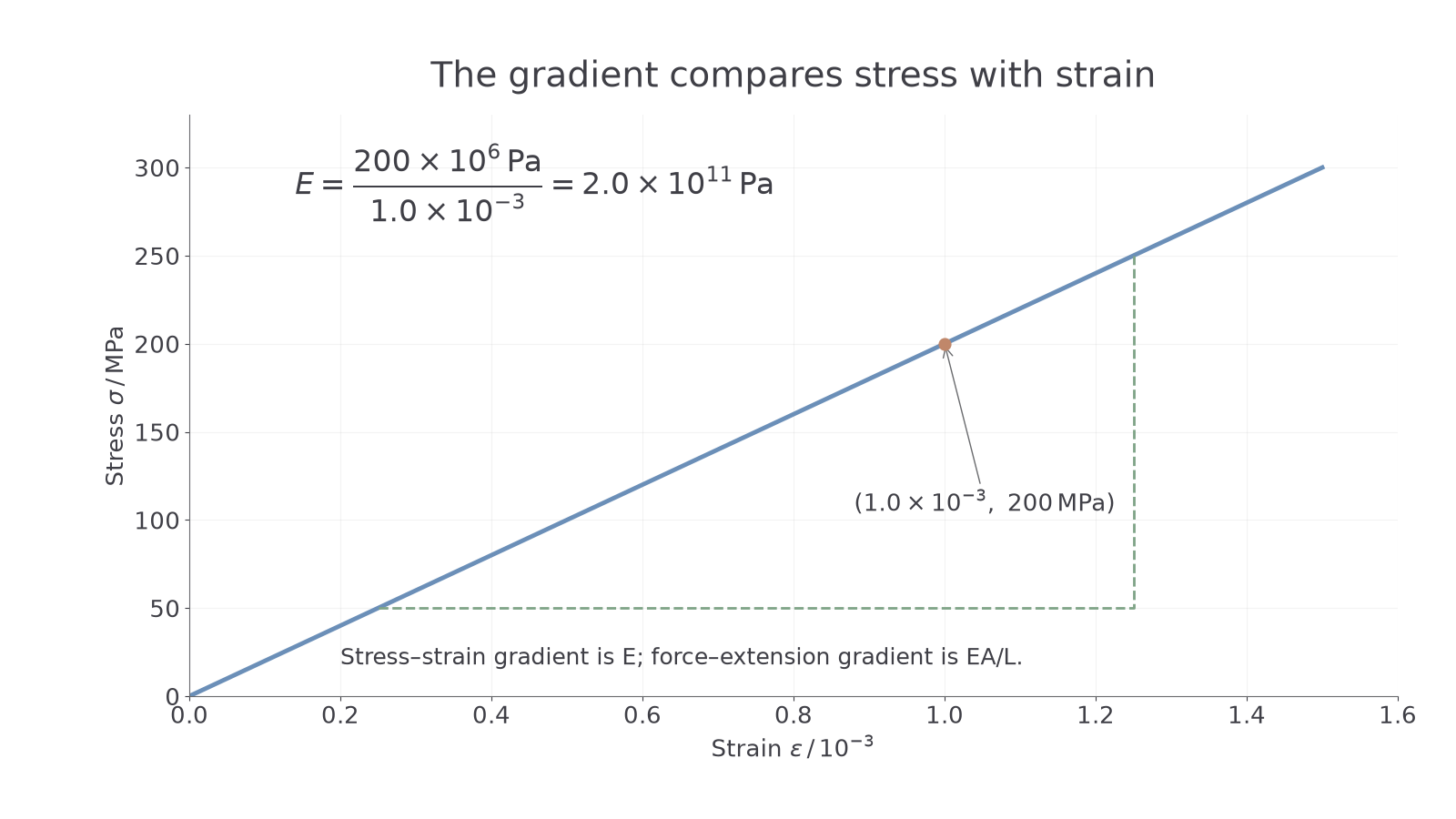
On a stress–strain graph with stress vertically, the gradient of the straight region is . A force–extension graph instead has gradient . The material property and the object's spring constant are different: a thicker wire has a larger , even though its material has the same .
[DIAGRAM: asset_name: Stress–strain gradient and material stiffness; asset_slug: materials-young-gradient; caption: Young modulus is the gradient of stress against strain in the proportional region; description: A straight stress–strain line through the origin has a large gradient triangle. The vertical axis is stress in megapascals and the horizontal axis is strain in units of ten to the minus three. A point at strain 1.0 times ten to the minus three and stress 200 megapascals gives Young modulus 2.0 times ten to the eleven pascals. A note distinguishes this material gradient from a force–extension gradient.]
Worked example 2: calculating a wire's extension
Question. A wire has Young modulus , length and cross-sectional area . Calculate its extension under a tensile load, within its proportional region.
Plan. Rearrange before substituting: .
Answer. .
Check. The fractional change is much less than 1, consistent with the small-deformation model. Doubling the length would double the extension; doubling the area would halve it.
That last prediction explains the opening puzzle. A thin wire has a smaller area, so a given force creates a larger stress, larger strain and larger extension. The material itself has not become less stiff simply because the wire is thinner.
Continue this lesson.
You’re previewing NovaLearn without an account. Create a free account to read the rest.
Create free account