8.3 - Two-source interference
Learn why two sources can make alternating regions of reinforcement and cancellation, what keeps their pattern stable, and how water, sound, light and microwave experiments demonstrate it. You will use double-slit fringes to determine a wavelength from measurable lengths.
Coherence and path difference
How can switching on a second loudspeaker make the sound quieter at one place? If its wave arrives with the opposite displacement to the first, the two contributions cancel there. Move to a different place and the same two sources can reinforce instead.
Interference is the superposition of waves producing resultant amplitudes that depend on their phase difference. Coherent sources have a constant phase difference and the same frequency. They need not always be in phase: a constant non-zero phase difference is also coherent. Having the same nominal frequency alone does not ensure a stable relative phase.
For sources emitting in phase, the distance each wave travels determines its arrival phase. A path difference of one wavelength is a full cycle, so the waves arrive in phase and reinforce. A path difference of half a wavelength makes them arrive in antiphase. Equal amplitudes then cancel completely; unequal amplitudes give a minimum with some disturbance left.
Interference conditions for in-phase sources
Here is the magnitude of the path difference in metres, is wavelength in metres, is the path contribution to phase difference in radians and . These forms assume coherent sources emitting in phase and waves whose displacements can combine. Equal amplitudes are needed for complete cancellation, rather than just a minimum.
Not on the data sheet: learn it.
[DIAGRAM: asset_name: Fixed interference lines from two sources; asset_slug: superposition-two-source-lines; caption: Different path differences create alternating lines of maxima and minima; description: A plan view has two coherent in-phase point sources separated by two wavelengths. Solid curves mark path differences of zero or one wavelength and dashed curves mark half-integer wavelength differences. The central maximum is labelled zero path difference, with a legend distinguishing maxima and minima.]
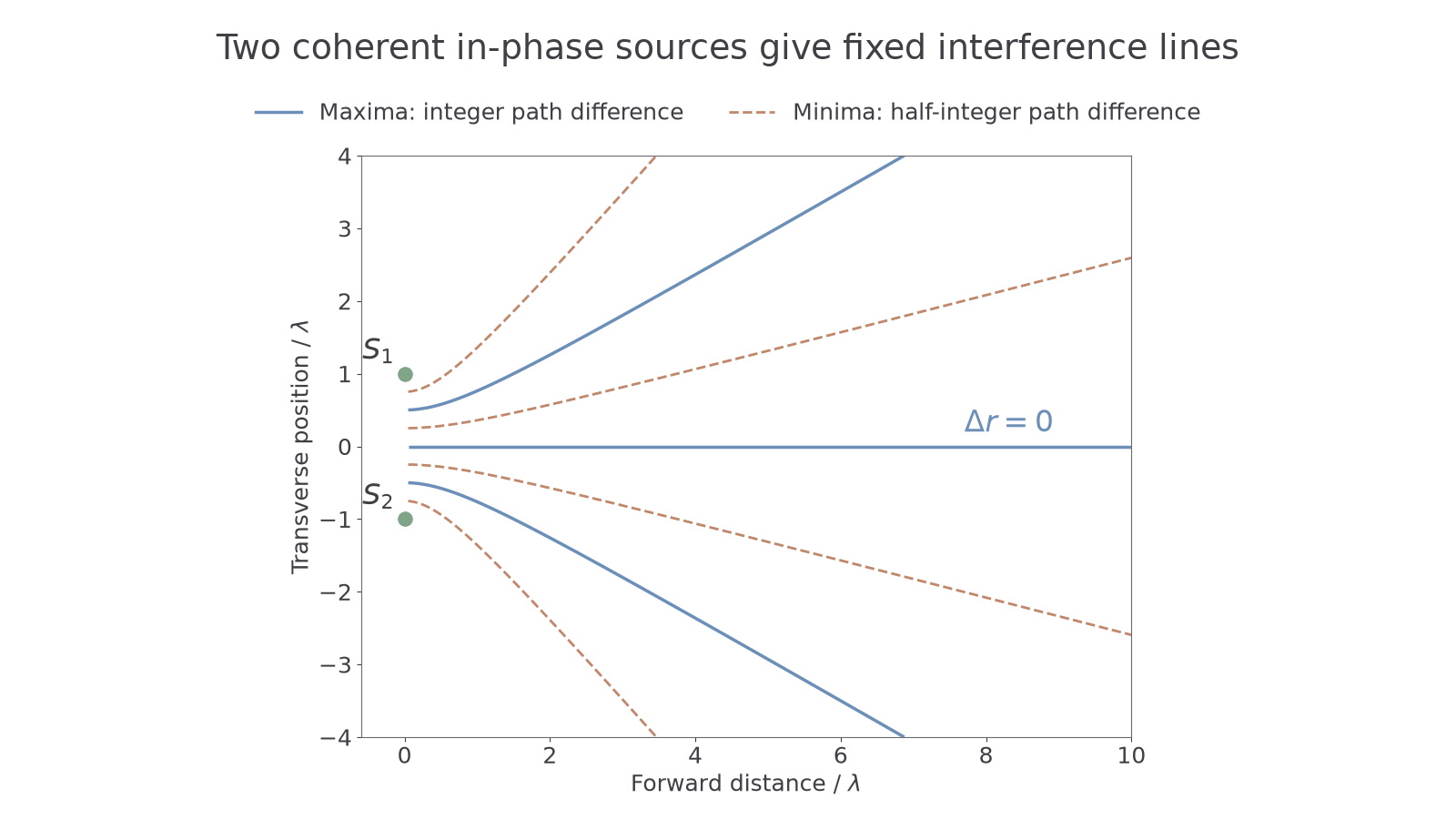
To observe a clear, stable pattern, the waves must overlap and their phase difference must remain stable. Comparable amplitudes give good contrast. For light, use the same polarisation direction for the components that interfere; perpendicular polarisations do not give the ordinary bright-dark fringe pattern. Monochromatic light avoids superposing differently spaced patterns from a range of wavelengths.
Watch out
“In phase” and “coherent” are different claims. Coherence means the phase difference stays constant. A fixed source phase offset shifts the pattern; it does not necessarily remove it.
Check the path condition with a whole-number and a half-number comparison.
Making and detecting two-source patterns
A stable pattern needs sources whose oscillations stay related. A reliable laboratory strategy is to drive both from one source, or split one wave into two paths. The detector then explores positions with different path differences.
Water waves. Attach two small dippers to the same vibrating bar in a ripple tank. They oscillate at the same frequency with a fixed phase relationship, generating overlapping circular waves. Observe alternating regions of large and small disturbance. Along a nodal line, equal opposite contributions cancel throughout the cycle. Keep depth uniform and reduce reflections from the tank edges so returning waves do not obscure the pattern.
Sound. Connect two loudspeakers to the same signal generator, with consistent connections, and send a single-frequency tone to both. Move a microphone across the overlap region and record its signal. Alternating maxima and minima show changing path difference. Use moderate sound levels and reduce unwanted reflected sound where possible. A minimum becomes less deep if one speaker's amplitude is much larger at the detector.
Microwaves. Illuminate two gaps in a metal screen with one microwave transmitter, positioning it so the two gaps are excited coherently. Each gap diffracts the incident wave, so the emerging waves overlap. Move a receiving probe across the far side, keeping its orientation suitable for the wave's polarisation, and record maxima and minima. Keep the transmitter, screen and receiver geometry fixed while scanning position.
Light. Illuminate two narrow, closely spaced slits with monochromatic laser light and observe the overlapping diffracted beams on a distant screen. The two slits act as coherent sources because they are driven by the same incident wave. Look at the screen, never into the beam. The central region contains alternating bright and dark fringes. Two ordinary independent lamps do not provide the stable optical phase relationship needed for this pattern.
The sources' identity is not enough: their outputs must actually overlap at the detector. Wide beams from two sources that never meet cannot make interference fringes there. Ordinary room light and uncontrolled reflections can also make weak fringes difficult to see, without changing the underlying superposition principle.
Key idea
Dark or quiet regions do not mean energy has disappeared from the complete pattern. Interference redistributes the detected intensity: reinforcement occurs at other positions.
Use the source and detector roles to describe a complete experiment.
Continue this lesson.
You’re previewing NovaLearn without an account. Create a free account to read the rest.
Create free account