7.1 - Wave motion and the wave equation
Explain how a progressive wave transfers energy, distinguish a particle's oscillation from the wave's motion, and read wave quantities from time and position graphs. Derive and use the relationship between wave speed, frequency and wavelength.
A travelling disturbance transfers energy
How can a cork rise and fall while a ripple crosses a tank? The cork follows the local water motion, while the wave pattern travels across the surface. The motion of the disturbance and the motion of the material are different things.
Shake one end of a stretched rope. That section moves its neighbour, which moves the next section, so the disturbance travels along the rope. A marked point oscillates about its original position rather than travelling all the way to the other end. The disturbance carries energy: it can make the far end move and do work on something attached there.
Progressive wave
A progressive wave is a travelling disturbance that transfers energy from one place to another. In a mechanical wave, particles of the medium oscillate about equilibrium positions rather than undergoing a net bulk transfer with the wave.
A long spring makes the same distinction visible in another way. Push and pull its end along the spring and regions of closely spaced coils travel along it. Each coil moves backwards and forwards locally. The moving region of compression is not one group of coils being carried down the whole spring.
In a ripple tank, a vibrating dipper repeatedly disturbs the water surface. The ripples move away from it. A small floating marker helps you separate the local oscillation from the travelling pattern. Surface-water motion is more complicated than a perfectly vertical oscillation, but the simple small-amplitude model correctly separates propagation from bulk transport.
Model limit
“Energy moves, matter does not” describes the ideal wave model's lack of net bulk transport. It does not mean each particle is stationary, or that real water can never have currents. State what is oscillating and what is propagating.
For a rope, the restoring interaction comes from tension. For sound in air, compressions and expansions pass energy between neighbouring regions of air. Mechanical waves need material to transmit the disturbance. Later you will meet electromagnetic waves, which can propagate through a vacuum.
Describing an oscillation and a wave
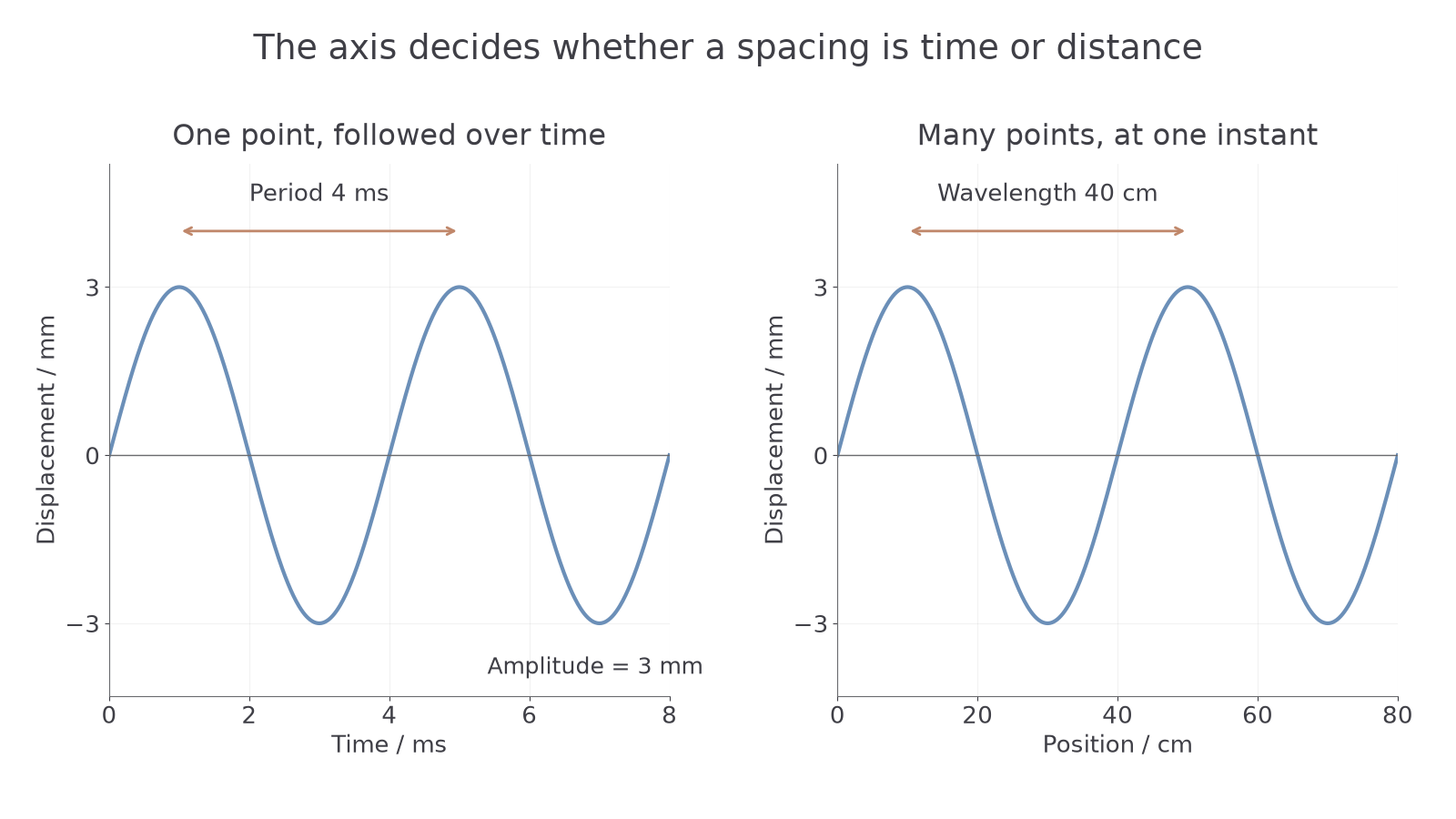
A wave involves a repeating motion in time and a repeating pattern in space. The horizontal axis tells you which of these you are looking at.
| Quantity | Meaning | Usual unit |
|---|---|---|
| Displacement | signed distance of a particle from its equilibrium position, in its oscillation direction | |
| Amplitude | maximum magnitude of displacement from equilibrium | |
| Period | time for one complete oscillation | |
| Frequency | number of complete oscillations per unit time | , equivalent to |
| Wavelength | shortest distance between points oscillating in phase along the direction of propagation | |
| Wave speed | distance travelled by a point on the wave pattern per unit time |
Phase identifies a stage of an oscillation. Two points are in phase when their displacements and directions of motion are at the same stage of the cycle. They might both be at a crest, or both pass through equilibrium in the same direction. Equal displacement alone is insufficient: a point going up and one going down can have the same displacement but different phases.
A whole cycle corresponds to a phase change of . A quarter cycle is , and half a cycle is , called antiphase. For a progressive sinusoidal wave, a separation corresponds to phase difference ; for repeating motions separated by a time , the magnitude of the phase difference is . Phase repeats after each whole cycle. These relations are not on the data sheet: learn the fraction-of-a-cycle reasoning.
[DIAGRAM: asset_name: Time and position are different axes; asset_slug: wave-time-position; caption: A time graph gives period; a snapshot against position gives wavelength; description: Two sinusoidal graphs have displacement amplitude 3 millimetres. The left is displacement of one point against time, with period 4 milliseconds marked. The right is a simultaneous displacement snapshot against position, with wavelength 40 centimetres marked. Both show two full cycles and distinguish equilibrium, positive crest and negative trough.]
Continue this lesson.
You’re previewing NovaLearn without an account. Create a free account to read the rest.
Create free account