15.3 - Molecular motion and gas pressure
Use the kinetic model of an ideal gas to explain pressure, derive it from molecular momentum changes, and connect a three-dimensional gas to measurable pressure and density.
The kinetic model of an ideal gas
If every molecular collision with a container wall is elastic, how can the gas exert pressure without continually losing energy? Elastic does not mean that nothing changes: a rebound changes momentum even when speed and kinetic energy stay the same.
A gas is modelled as a very large number of molecules moving continually and randomly. A molecule travels between collisions; its next collision can change its direction and speed. The orderly pressure reading on a gauge comes from averaging enormous numbers of these microscopic events.
The simple kinetic model makes specific assumptions:
- The molecules' total volume is negligible compared with the gas volume.
- Intermolecular forces are negligible except during collisions.
- Collisions between molecules and with the walls are perfectly elastic.
- Collision durations are negligible compared with the times between collisions.
- Molecular motion obeys Newton's laws, with random motion having no preferred direction in a gas at equilibrium.
Treating molecular size as negligible does not mean removing collisions from the model. It means ignoring the volume occupied by the molecules when calculating the space available to the gas. Similarly, neglecting forces between collisions allows straight-line motion between them; it does not remove the brief forces during an impact.
Model limit
Real gases depart from this model when molecular volume or intermolecular attractions matter. High density and low temperature make those effects harder to neglect; the model works better for a dilute gas far from condensation.
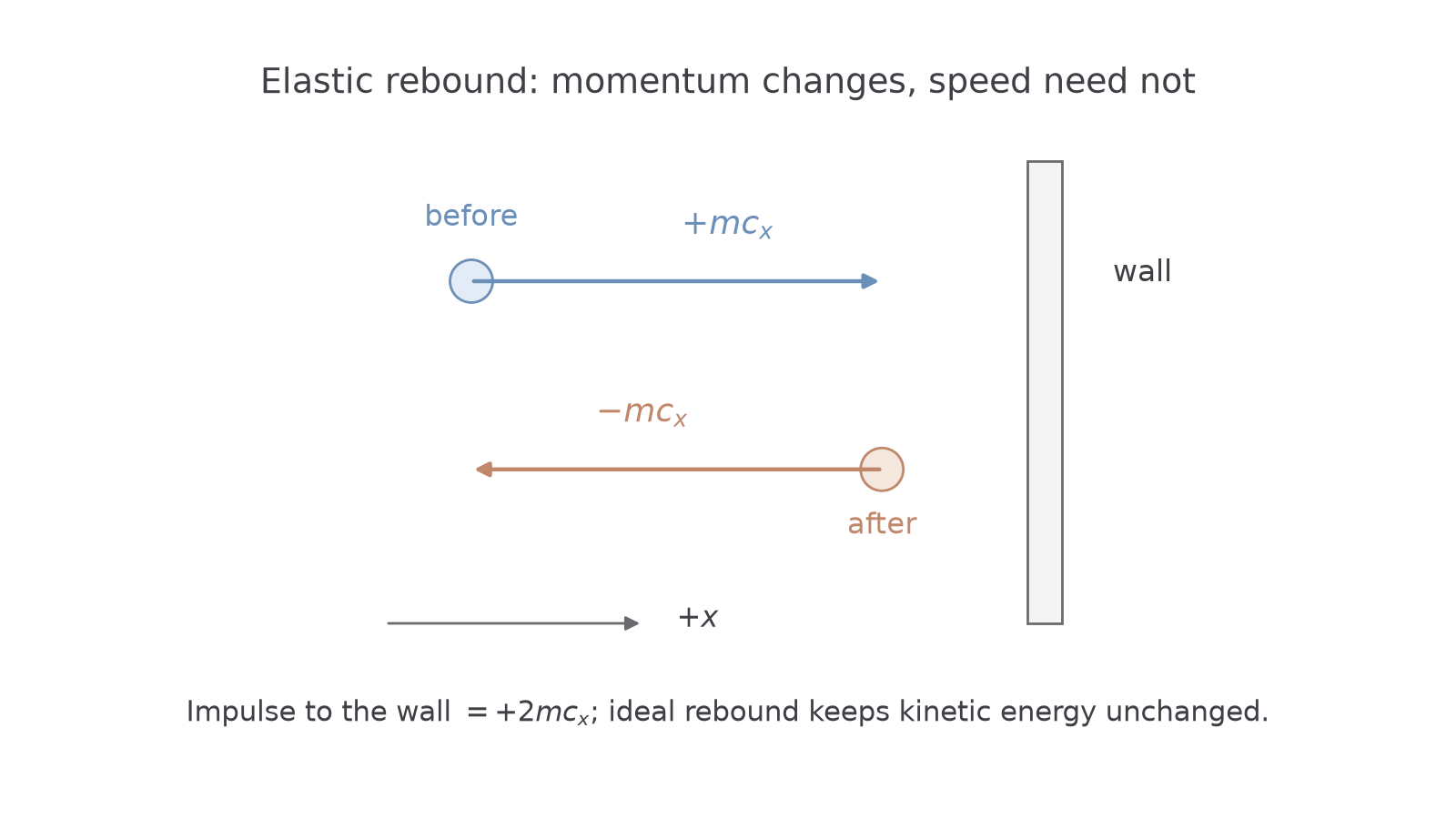
A perfectly elastic collision conserves the total kinetic energy of the colliding particles. It need not preserve each particle's velocity. At an ideal rigid, stationary wall, a molecule reverses its velocity component perpendicular to the wall while retaining its speed. The wall feels a force during the collision because momentum changes.
At equilibrium, the random motion has no bulk flow. Individual molecules still move quickly, although their average velocity can be zero. Pressure does not require every molecule to have the same speed, nor does it require one group of molecules to travel permanently along each coordinate axis.
These assumptions explain why the ideal-gas equation can be successful while remaining a model rather than a literal description of all molecular details.
Pressure from molecular momentum changes
A wall changes a molecule's momentum during each impact. By Newton's third law, the molecule gives an equal and opposite impulse to the wall. The many impulses per second create the average force that we measure as gas pressure.
Consider a cubic container of side . Let one molecule of mass have a velocity component towards a wall normal to the x-direction. For this step take as positive. Before and after the elastic impact, its x-momenta are and , so
The impulse given to the wall is . The factor of two comes from reversal, not from two molecules colliding at once. Components parallel to the wall do not reverse in this ideal smooth-wall model.
[DIAGRAM: asset_name: An elastic wall collision transfers momentum; asset_slug: thermal-wall-momentum; caption: Reversing the normal velocity component changes momentum even though speed is unchanged; description: A vertical wall is shown with a positive x-direction pointing towards it. Before collision, a molecule has normal momentum plus m c_x towards the wall. After collision, the same molecule has normal momentum minus m c_x away from it. The two stages are separately labelled. A note gives impulse to wall plus 2 m c_x and unchanged kinetic energy for an ideal elastic rebound.]
Ignoring intermolecular collisions for this single-molecule calculation, the molecule must travel to the opposite wall and back before its next impact with the same wall. The x-distance is , so the time between those impacts is . Average force is momentum transfer per unit time:
Real molecular collisions redistribute velocities, but the statistical average over all molecules leads to the same equilibrium result. The calculation's purpose is to identify how force depends on mass and the square of the normal component.
Worked example 1: one molecule's small contribution
Question. A molecule of mass has normal speed component between two walls apart. In the ideal single-molecule model, calculate its average force on one wall.
Plan. Find the momentum impulse per collision and the time to return to that same wall.
Check. This is a tiny force from one molecule. A macroscopic gas has enormous numbers of molecules contributing impulses, so its total force need not be tiny.
Continue this lesson.
You’re previewing NovaLearn without an account. Create a free account to read the rest.
Create free account