9.3 - Resistivity and wire measurements
Predict how wire length and area affect resistance, distinguish resistance from resistivity, and determine resistivity from careful electrical and dimensional measurements.
Wire geometry and resistance
Two wires of the same material have equal lengths, but one has twice the diameter: does its resistance halve? The area, rather than the diameter, is the relevant measure. Doubling diameter quadruples area, so the resistance becomes one quarter if temperature stays the same.
For a uniform wire of fixed material and temperature, increasing its length increases its resistance in direct proportion. A longer path needs more p.d. to drive the same current. Increasing its cross-sectional area decreases resistance: more charge carriers can contribute to the current alongside one another. Equal material and equal temperature are necessary conditions for comparing geometry alone.
The relationships are
Here is resistance, is length and is cross-sectional area. For a circular wire, , so at fixed length, material and temperature,
These statements make three familiar graph shapes physical. Area against diameter is a square-law curve, bending upwards. Resistance against area is a reciprocal curve, bending downwards towards zero as area becomes large. Resistance against diameter is an inverse-square curve: it falls more rapidly than a reciprocal dependence. Neither resistance curve has a finite value at zero area or diameter in this model.
[DIAGRAM: asset_name: Square, reciprocal and inverse-square wire relationships; asset_slug: electricity-wire-geometry; caption: Area follows diameter squared, while resistance is reciprocal in area and inverse-square in diameter; description: Three graphs show cross-sectional area in square millimetres against diameter in millimetres as an upward parabola; resistance in ohms against area in square millimetres as a decreasing reciprocal curve; and resistance in ohms against diameter in millimetres as a decreasing inverse-square curve. The latter two use the same fixed material and length, with a constant rho L of 0.20 ohm square millimetres. The zero-area and zero-diameter values are excluded.]
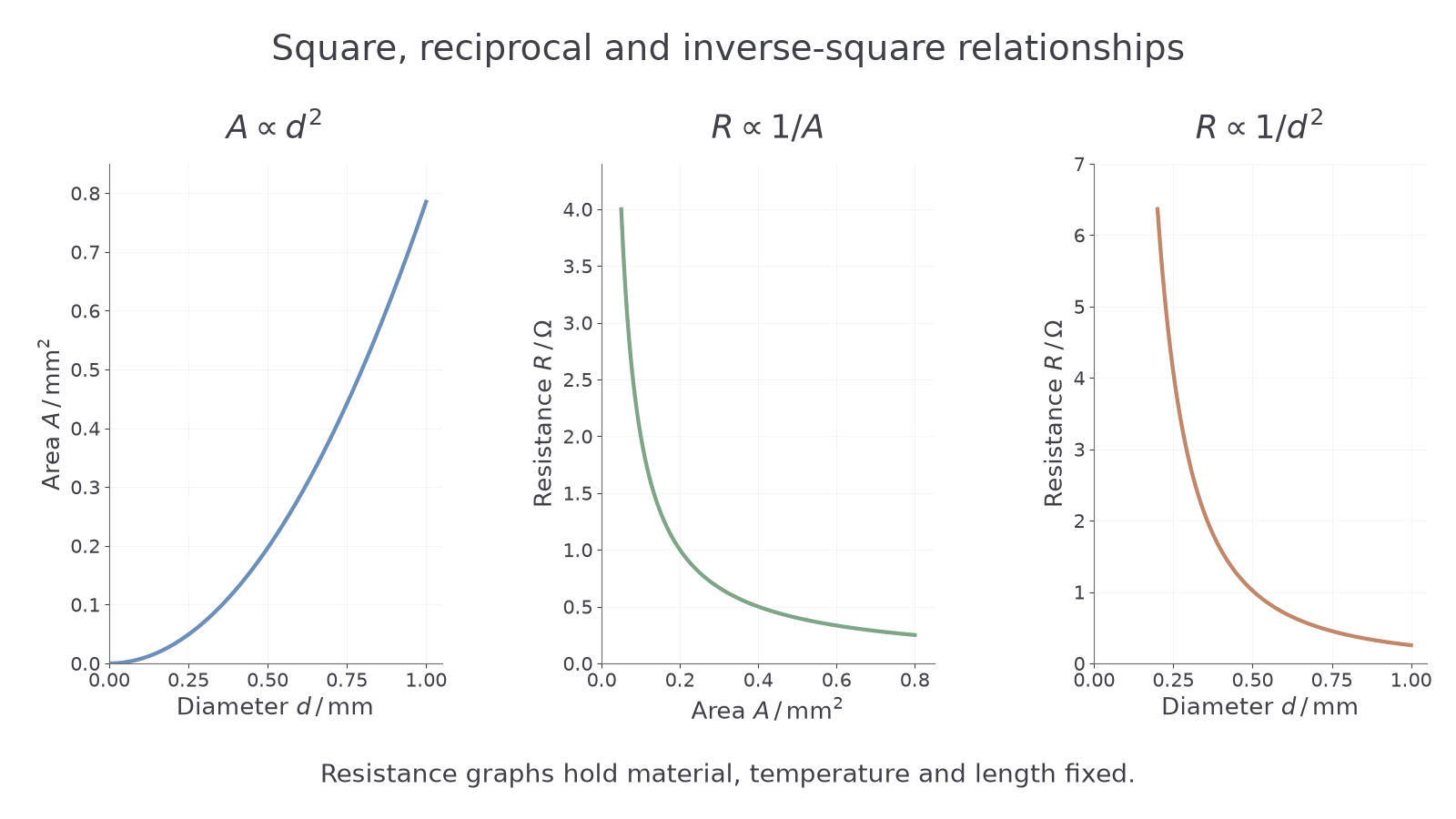
For a fair graph comparison, change only the horizontal variable and hold the other relevant quantities fixed. A graph of against , rather than against , is straight through the origin in the uniform-wire model.
Worked example 1: combining two geometry changes
Question. A wire has resistance . A second wire of the same material and temperature has twice its length and twice its diameter. Calculate the second wire's resistance.
Plan. The length doubles, but the area becomes four times larger.
Check. The area increase more than compensates for the length increase. Treating diameter as area would incorrectly predict no resistance change.
Watch out
State what stays fixed. “A longer wire has greater resistance” assumes the same material, temperature and cross-sectional area. A long thick copper wire can have less resistance than a short thin wire of another material.
Check the square hidden in a diameter change.
Resistivity as a material property
A wire's resistance depends on its dimensions as well as its material. Resistivity separates the material's contribution from the length and area of the particular sample.
Resistance and resistivity
is resistance in , is resistivity in , is wire length in m and is cross-sectional area in . This form assumes a uniform wire with constant cross-section and a stated, approximately uniform temperature. Resistivity can change with temperature; it is not one universal constant for every condition.
Not on the data sheet: learn it.
Resistivity is resistance multiplied by area and divided by length. The unit check gives , rather than . For two samples of the same material at the same temperature, this value should agree even when their resistances do not.
Resistivity
Resistivity is the material property for a uniform sample at a stated temperature.
It is common to describe it as the resistance of a sample of unit length and unit cross-sectional area. The equation is safer for calculations because it makes the geometry and the unit explicit.
The cross-section need not be circular. For a rectangular strip, is width multiplied by thickness; for a square section, it is side length squared. Use the cross-section perpendicular to current flow, rather than the strip's large top surface.
Worked example 2: a thin wire
Question. A wire of length , diameter and resistance is at a uniform temperature. Calculate its resistivity.
Plan. Convert diameter to metres, find area, and use .
Answer. (2 s.f.).
Check. Inserting the unrounded area and resistivity back into returns . Using the diameter as the radius would overestimate area and resistivity by a factor of four.
A flat strip provides a useful comparison. If it is long, wide and thick, its cross-sectional area is . A measured resistance of would give . The method is unchanged; only the area calculation differs.
A further geometry change tests the model. If a wire is stretched to twice its original length while its volume remains constant, its area halves. If temperature and resistivity remain unchanged, the resistance becomes four times the original value. This is a stated model: a real stretching process can also alter the material, so the unchanged-resistivity assumption must not be hidden.
Model limit
Resistance is a property of the sample and its dimensions. Resistivity is a property of the material at specified conditions. A change in resistance does not, by itself, show that resistivity changed.
Calculate a material property from a different specimen.
Continue this lesson.
You’re previewing NovaLearn without an account. Create a free account to read the rest.
Create free account