20.3 - The Hall effect and magnetic measurements
Explain how sideways magnetic deflection of charge carriers establishes a Hall voltage. Derive its relation to current, carrier density and sample thickness, then use a calibrated Hall probe to measure magnetic flux density with a clear orientation and zero correction.
Why a voltage appears across a current
Why can a magnetic field establish a voltage across the width of a strip, even though the supply drives current along its length? The moving carriers are initially deflected sideways. Their separation establishes an electric field that eventually prevents further sideways drift.
Consider a thin conducting strip in the plane of the page. Conventional current is to the right and magnetic field is into the page. In an electron conductor, the electrons' drift velocity is to the left. Apply the positive-charge force rule to that leftward velocity, then reverse it because the carriers are negative: their magnetic force is upwards.
Electrons accumulate at the upper edge, leaving an excess of positive charge at the lower edge. The upper edge is therefore at lower electric potential. The transverse potential difference is the Hall voltage. It is across the width, not the longitudinal voltage that drives the current.
[DIAGRAM: asset_name: Hall charge separation and equilibrium; asset_slug: hall-electron-charge-separation; caption: Electron deflection establishes an opposing electric force; description: A horizontal strip in the page carries conventional current rightwards while electrons drift leftwards in a field into the page. Negative charge accumulates on the upper edge and positive charge on the lower edge. On a central electron an upward magnetic force and equal downward electric force are shown; the electric field points upwards from the positive lower edge to the negative upper edge.]
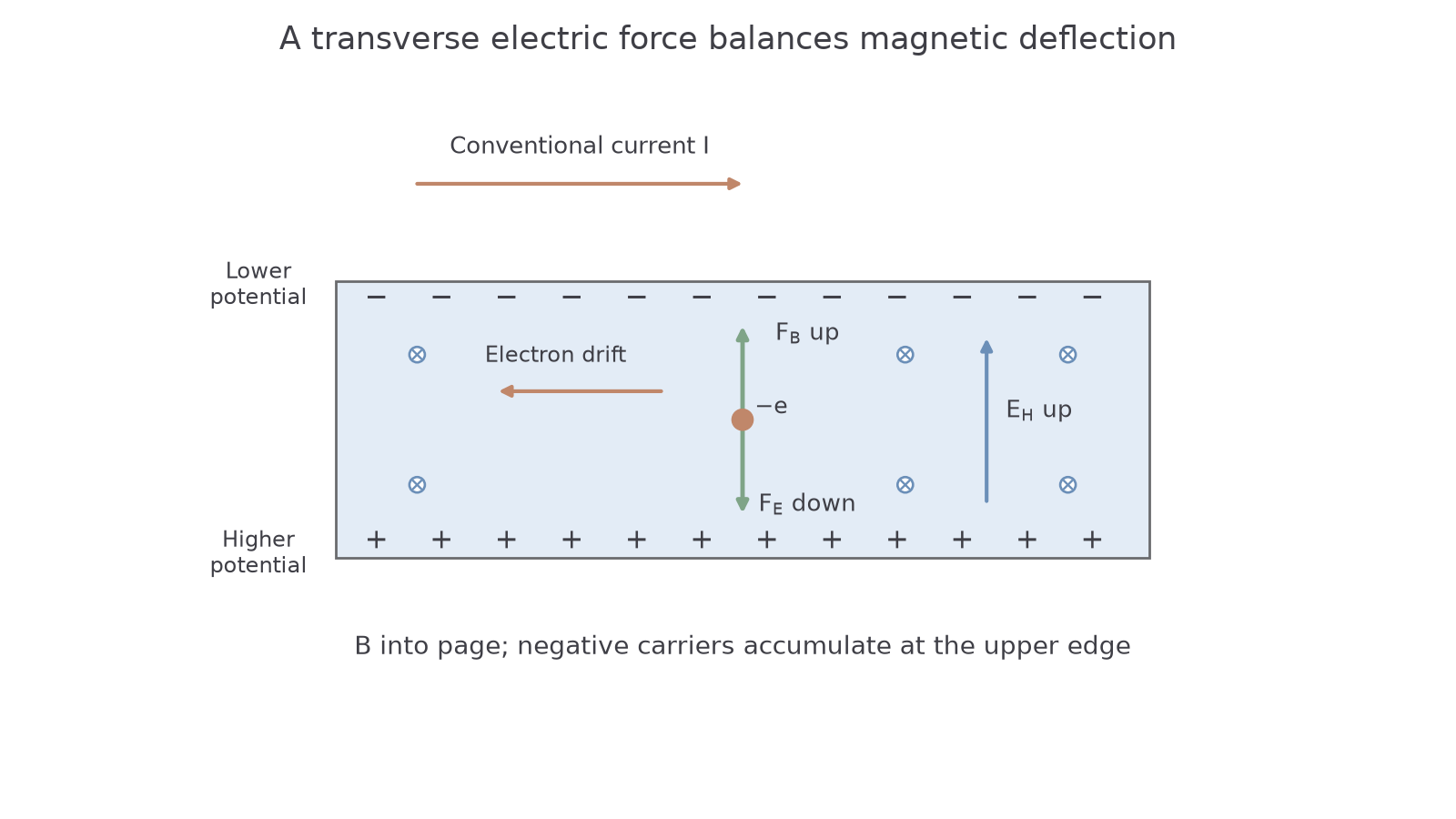
The separated charges establish an electric field from the positive lower edge to the negative upper edge: upwards. The electric force on an electron is downwards, opposing its upward magnetic force. Separation grows until those forces are equal and opposite. The carriers continue drifting along the strip, but there is then no resultant transverse force and no continuing net transverse accumulation.
Key idea
The Hall voltage is a steady-state consequence of charge separation. The magnetic force does not vanish; the electric force balances it. The current along the strip continues.
The polarity also reveals carrier sign when current and field directions are known. Keep the same conventional current to the right but imagine positive mobile carriers instead. Their drift is now rightwards, and their magnetic force is again upwards. They accumulate at the upper edge, making it positive, opposite to the electron conductor's polarity.
This comparison needs care: opposite signs moving with the same velocity have opposite magnetic forces; opposite carrier signs giving the same conventional current move in opposite directions as well. You cannot reverse the charge sign while silently retaining both velocity and current direction.
For a fixed sample and carrier type, reversing only current or only magnetic field reverses the Hall polarity. Reversing both leaves it unchanged. A high-input-resistance voltmeter measures the transverse voltage without drawing a substantial current across the width.
Deriving the Hall-voltage equation
The Hall voltage is not determined by magnetic field alone. A greater drift speed gives a greater sideways magnetic force, so a greater opposing electric field is needed. Relate drift speed to the current before using a sample's dimensions.
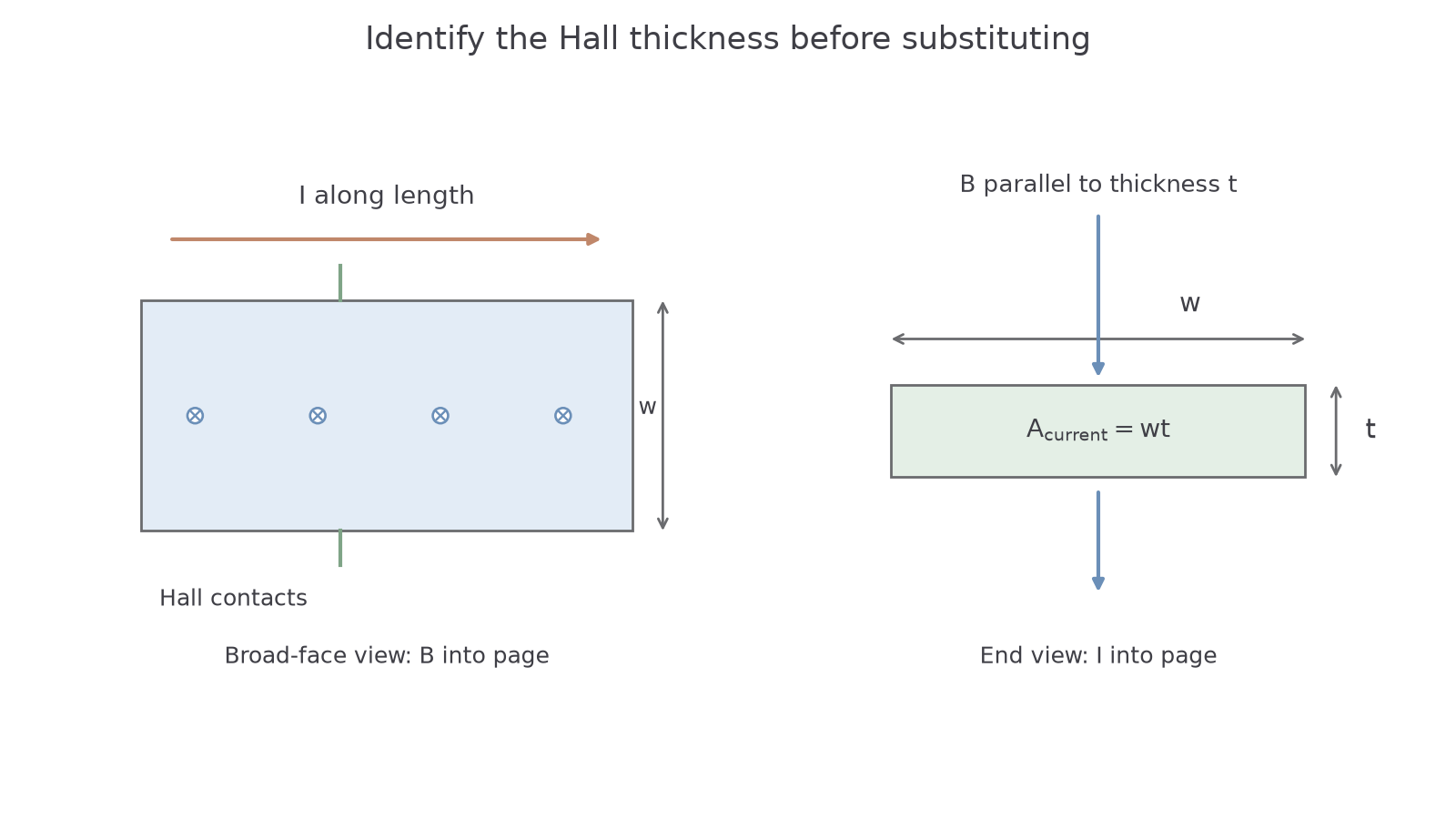
Let the strip width between Hall contacts be , and its thickness parallel to the magnetic field be . Current flows along the remaining length. The cross-sectional area carrying current is therefore , rather than the broad face area visible from above.
[DIAGRAM: asset_name: Hall sample dimensions; asset_slug: hall-strip-dimensions; caption: Thickness is parallel to the magnetic field and width spans the Hall contacts; description: Two matching views of a rectangular strip identify its dimensions. The broad-face view shows current along its length, width w between transverse Hall contacts and field into the page. An end view shows current into the page, cross-sectional area w times t, and magnetic-field arrows parallel to thickness t.]
At transverse equilibrium, use force magnitudes:
Here is the magnitude of one carrier's charge, its drift speed and the transverse electric-field magnitude. The approximately uniform transverse field lets us use .
The drift-current relation is , where is the number of mobile charge carriers per unit volume. This relation is on the data sheet; comes from our sample geometry. Substitution gives
The width cancels: a wider strip needs a smaller drift speed for a fixed current, but the resulting transverse field acts over a larger separation. These effects compensate in this simple model.
Hall-voltage magnitude
is Hall-voltage magnitude in volts, the perpendicular magnetic flux density in teslas, current in amperes, carrier number density in , thickness parallel to the field in metres and charge magnitude per carrier in coulombs. This model assumes one dominant carrier type, uniform current and transverse steady state. Find polarity from the actual carrier motion, not from this magnitude equation.
On the data sheet, Paper 4 only.
Continue this lesson.
You’re previewing NovaLearn without an account. Create a free account to read the rest.
Create free account