11.1 - The nuclear atom and nuclides
Use alpha-particle scattering evidence to explain the nuclear atom, identify protons, neutrons and electrons, and read nuclide notation without confusing the numbers. Convert microscopic masses using the unified atomic mass unit.
Scattering reveals a small concentrated nucleus
How can a fast particle pass through a sheet of metal, yet occasionally turn almost straight back? The contrast between those two observations, rather than either one alone, reveals the atom's internal structure.
In the alpha-particle scattering experiment, a narrow beam of positively charged alpha particles is directed at a very thin metal foil. A detector at different angles records particles emerging from the foil. The apparatus is evacuated to reduce scattering and energy loss in air, so more alpha particles reach the foil and detector. The thin foil helps limit multiple encounters, so a large deflection can be linked to a close encounter with one atom. It also reduces the chance of alpha particles losing all their kinetic energy and stopping inside the foil before they can be detected.
The main observations and their implications are different steps in the argument:
| Observation | What it tells you |
|---|---|
| Most alpha particles pass through with little or no deflection. | The atom's strongly scattering central region occupies only a small fraction of its volume; most of an atom is relatively empty space. |
| Some particles are deflected through small angles. | A charged region can exert a force and change the particles' momentum without physical contact. |
| A very small proportion suffer large-angle deflections, including backward scattering. | A strong force can act during a close encounter with a small region containing a large concentration of positive charge and mass. |
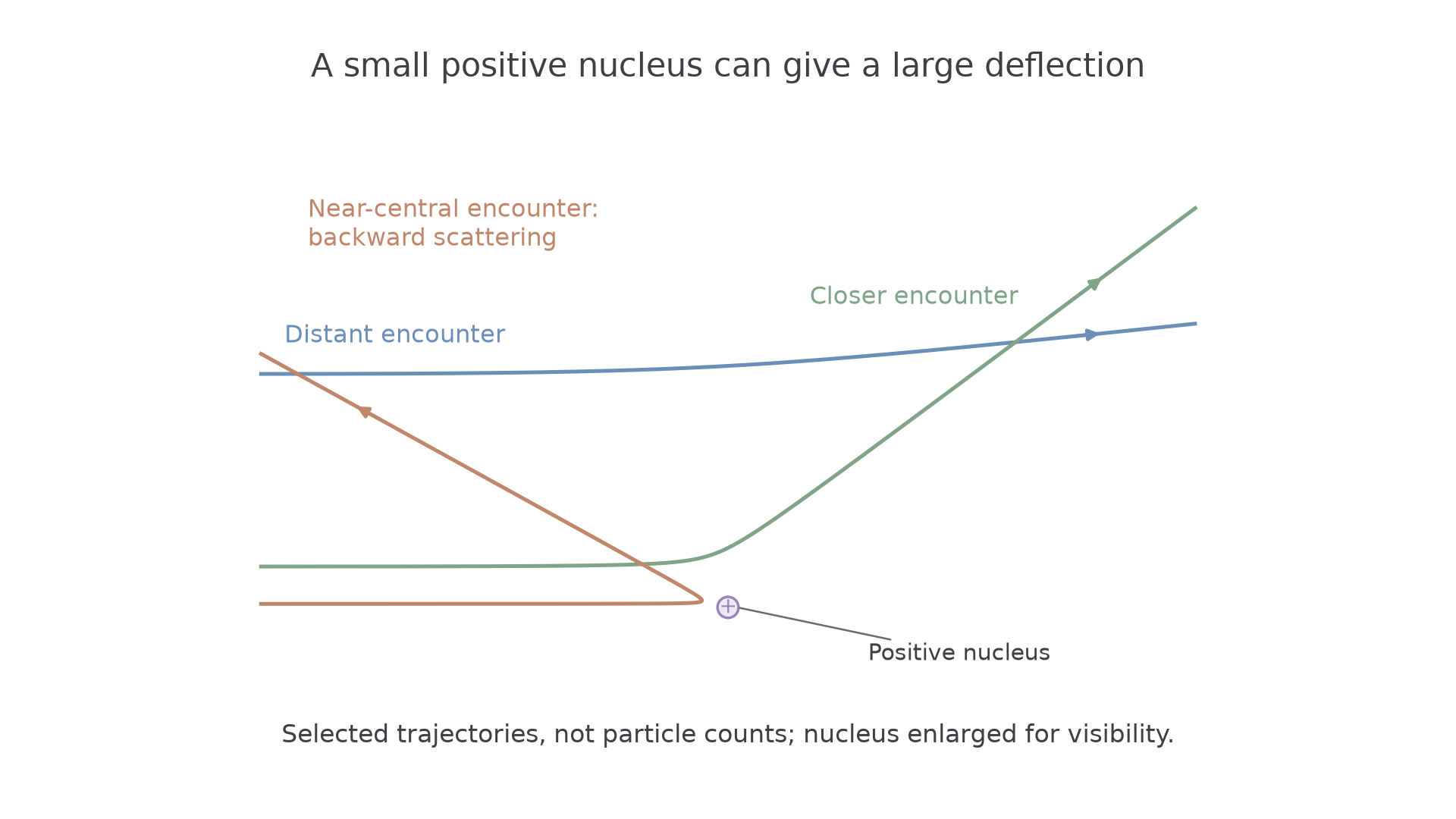
The alpha particle and positive nucleus repel electrically. A near miss can give a large deflection. The nucleus must be massive enough compared with the alpha particle for such a large change of the particle's direction: the much lighter electrons cannot account for the large-angle results.
[DIAGRAM: asset_name: Selected alpha-particle trajectories; asset_slug: alpha-scattering-paths; caption: Close encounters with a concentrated positive nucleus can give large deflections; description: Three initially parallel alpha-particle trajectories approach a small positive nucleus from the left. A distant trajectory is almost straight, a closer trajectory bends away, and a near-central trajectory turns back. These are selected trajectories rather than counts, and the nucleus is enlarged for visibility.]
Key idea
Link each inference to its evidence: mostly straight-through paths imply a very small nucleus; rare large deflections imply concentrated charge and mass. “Some particles bounced” by itself does not explain the whole atomic model.
The paths are not like billiard balls hitting a solid wall. The repulsive interaction can change a particle's motion before it touches nuclear matter. Scattering is therefore a way of investigating regions too small to see directly.
Protons, neutrons and bound electrons
The nuclear model places protons and neutrons in a small central nucleus, with electrons outside it. Protons and neutrons together are called nucleons. Almost all the atom's mass is associated with the nucleus, although electrons also have mass.
| Particle | Electric charge | Approximate mass compared with a proton | Location in the nuclear-atom model |
|---|---|---|---|
| Proton | 1 | Nucleus | |
| Neutron | 0 | 1 | Nucleus |
| Electron | about | Outside the nucleus |
Here is the positive elementary charge. The examination data sheet gives , proton mass , and electron mass . The approximate relative-mass statement does not mean that proton and neutron masses are exactly equal.
For an electrically neutral atom, the number of electrons equals the number of protons. Their total charges then cancel. Adding neutrons changes the mass and nuclear composition without directly changing the charge. Removing an electron makes a positive ion; it does not remove a proton from the nucleus or change which element the atom belongs to.
[DIAGRAM: asset_name: The nuclear-atom model; asset_slug: nuclear-atom-model; caption: A small nucleus contains protons and neutrons, while electrons occupy the surrounding atomic region; description: A shaded atomic region surrounds a small central nucleus. Labels identify a nucleus with protons and neutrons and electrons outside it; there are no drawn planetary tracks. An enlarged inset shows eight proton count markers and eight neutron count markers for an oxygen-16 nucleus, with eight electrons stated for the neutral atom. The figure is a model and not to scale.]
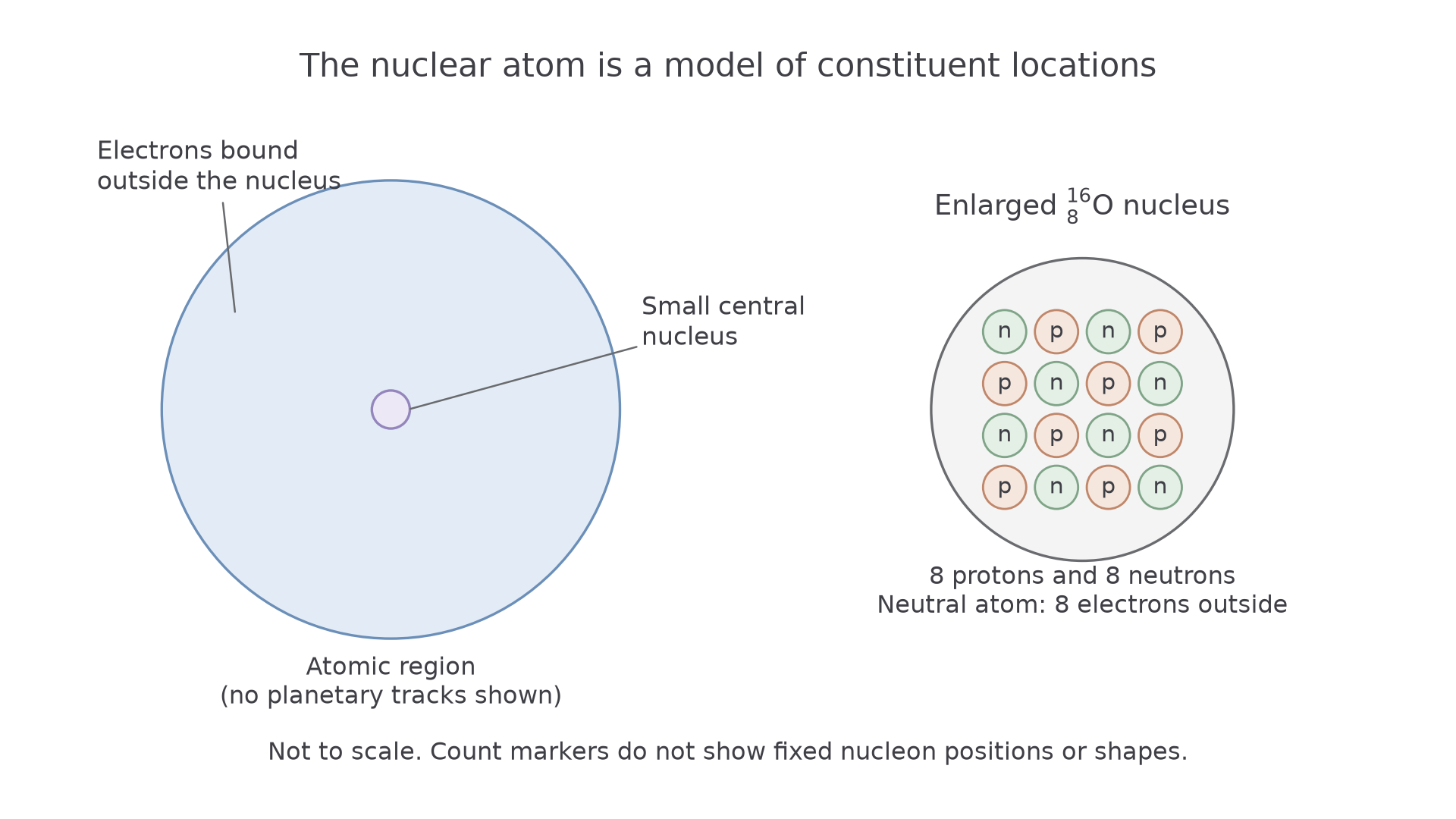
The syllabus's “orbital electrons” are electrons bound outside the nucleus. Do not take an orbit sketch as a literal photograph of little planets following circular paths. The simple nuclear model locates the charges and explains scattering, but it does not by itself give a complete account of electron behaviour. Discrete electron energy levels will become important in the A Level course.
Model limit
An atom diagram is enormously enlarged and usually distorts the nucleus-to-atom size ratio. Drawn dots and shaded regions help you keep track of constituents; they do not show measured particle shapes, fixed nuclear positions or classical electron tracks.
Continue this lesson.
You’re previewing NovaLearn without an account. Create a free account to read the rest.
Create free account