17.1 - Simple harmonic displacement and acceleration
Learn to describe an oscillation, identify simple harmonic motion from its restoring acceleration, and interpret the displacement and acceleration graphs. Use radians consistently, including the small-angle approximations that make a pendulum approximately harmonic.
Describing an oscillation
A swing stops for an instant at the end of its travel. Is its acceleration zero there too? Being momentarily at rest does not tell you whether velocity is changing. To answer, distinguish where the oscillator is from the way its motion changes.
An oscillation is repeated motion about an equilibrium position. Define displacement from that equilibrium, with one direction positive. Displacement is signed; the amplitude is the maximum magnitude of displacement, so it is a positive length. The two extreme positions are and ; their separation is .
The period is the time for one complete oscillation, returning to the same phase of motion. The frequency is the number of complete oscillations per unit time. Passing the equilibrium position twice does not necessarily count as two complete oscillations: the direction of motion matters.
Period, frequency and angular frequency
Period is in seconds, frequency in hertz and angular frequency in . One complete cycle corresponds to a phase change of radians. These relations describe periodic oscillations with a definite period; they do not assert that every periodic motion is simple harmonic.
Not on the data sheet: learn it.
Phase identifies the stage of a cycle, including the direction of motion. Two oscillations at the same frequency may be in phase, in antiphase or separated by another phase difference. For a time separation , the magnitude of the phase difference is in radians; this relation is not printed on the data sheet. State which motion leads or lags if that is required. Compare like points, such as two positive-going equilibrium crossings.
Worked example 1: timing several cycles
Question. An oscillator completes 30 full oscillations in . Determine its period, frequency and angular frequency.
A second oscillator of the same period whose corresponding crossing occurs later lags by radians, one quarter of a cycle.
Check. Thirty cycles in eighteen seconds is a little under two cycles per second, consistent with the calculated frequency.
Watch out
An object can have the same displacement twice in one cycle but be moving in opposite directions. Equal displacement alone does not establish equal phase.
Apply both timing and phase to a new set of readings.
Restoring acceleration and small angles
A displaced oscillator needs a resultant force towards equilibrium if it is to turn back. Simple harmonic motion makes a more precise requirement: acceleration is proportional to displacement and oppositely directed.
Simple harmonic motion
Simple harmonic motion is motion in which acceleration is directly proportional to displacement from a fixed equilibrium point and always directed towards that point.
Acceleration in simple harmonic motion
Acceleration is in , displacement in metres and angular frequency in . The minus sign expresses the opposing directions of acceleration and displacement. The coefficient is constant for the SHM being modelled.
On the data sheet, Paper 4 only.
“Restoring force” names the resultant responsible for this acceleration; it is not another force to add to a force diagram. For a horizontal ideal spring, with vertical weight and support balanced, the horizontal spring force is the restoring resultant. Hooke's law gives , so and . Here spring constant is in and mass in kilograms. This spring result is derived from the laws, rather than printed separately on the data sheet.
[DIAGRAM: asset_name: Acceleration points back towards equilibrium; asset_slug: oscillations-restoring-spring; caption: Positive displacement has negative acceleration and negative displacement has positive acceleration; description: Two views of the same horizontal spring-mass system show the mass displaced equally to the right and left of the equilibrium marker. Each acceleration arrow begins at the mass and points towards equilibrium with equal length. Weight and support are stated to balance vertically.]
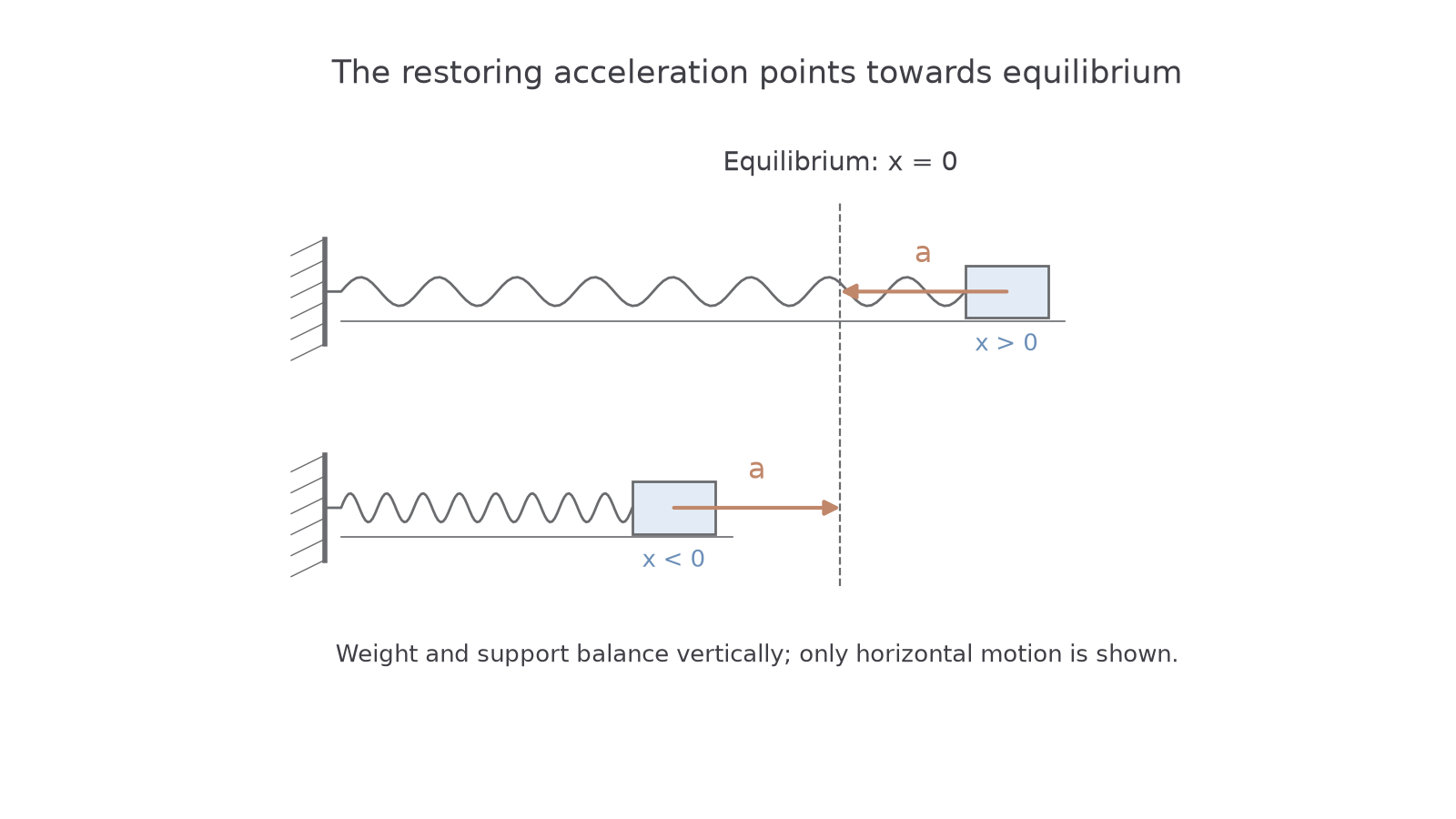
For a mass on a spring, . At , . At the opposite displacement, acceleration has the opposite sign. At equilibrium, acceleration is zero even though speed can be large.
Why a small pendulum swing is approximately harmonic
A pendulum's tangential restoring acceleration is , where is its angular displacement from the downward vertical. Its arc displacement is for length and in radians. The acceleration is not exactly proportional to , because sine is not exactly proportional to its angle.
For a small angle measured in radians,
Continue this lesson.
You’re previewing NovaLearn without an account. Create a free account to read the rest.
Create free account