20.2 - Forces on current-carrying conductors
Determine the direction and magnitude of the magnetic force on a current-carrying conductor. Define magnetic flux density through a measurable force, and use force balances and conductor angles without confusing current direction with electron motion.
The direction of the magnetic force
A horizontal wire carries current through a magnetic field and lifts upwards. How can a force at right angles to the current lift the whole wire? The mobile charges experience magnetic forces and transfer that force to the conductor; the current is not a stream of material pushing the wire along its own length.
A current-carrying conductor may experience a magnetic force. Its direction depends on the field and current directions. For a straight conductor perpendicular to a uniform field, the force is perpendicular to both. This makes a three-dimensional direction problem even when the drawing is flat.
Use Fleming's left-hand rule with three mutually perpendicular digits:
- First finger: magnetic field, from north to south outside a magnet.
- Second finger: conventional current, the direction positive charges would move.
- Thumb: force on the conductor.
A right-hand grip rule maps the field around a current; this left-hand rule gives the force on a current in a field. They answer different questions.
[DIAGRAM: asset_name: Current field and conductor force; asset_slug: conductor-force-directions; caption: Reversing either current or field reverses the force; description: Three panels show a horizontal wire. Current right with field into the page gives force up; current left with the same field gives force down; current right with field out of the page gives force down. Each force arrow starts on its wire. A dot and a cross are explicitly identified as out of and into the page.]
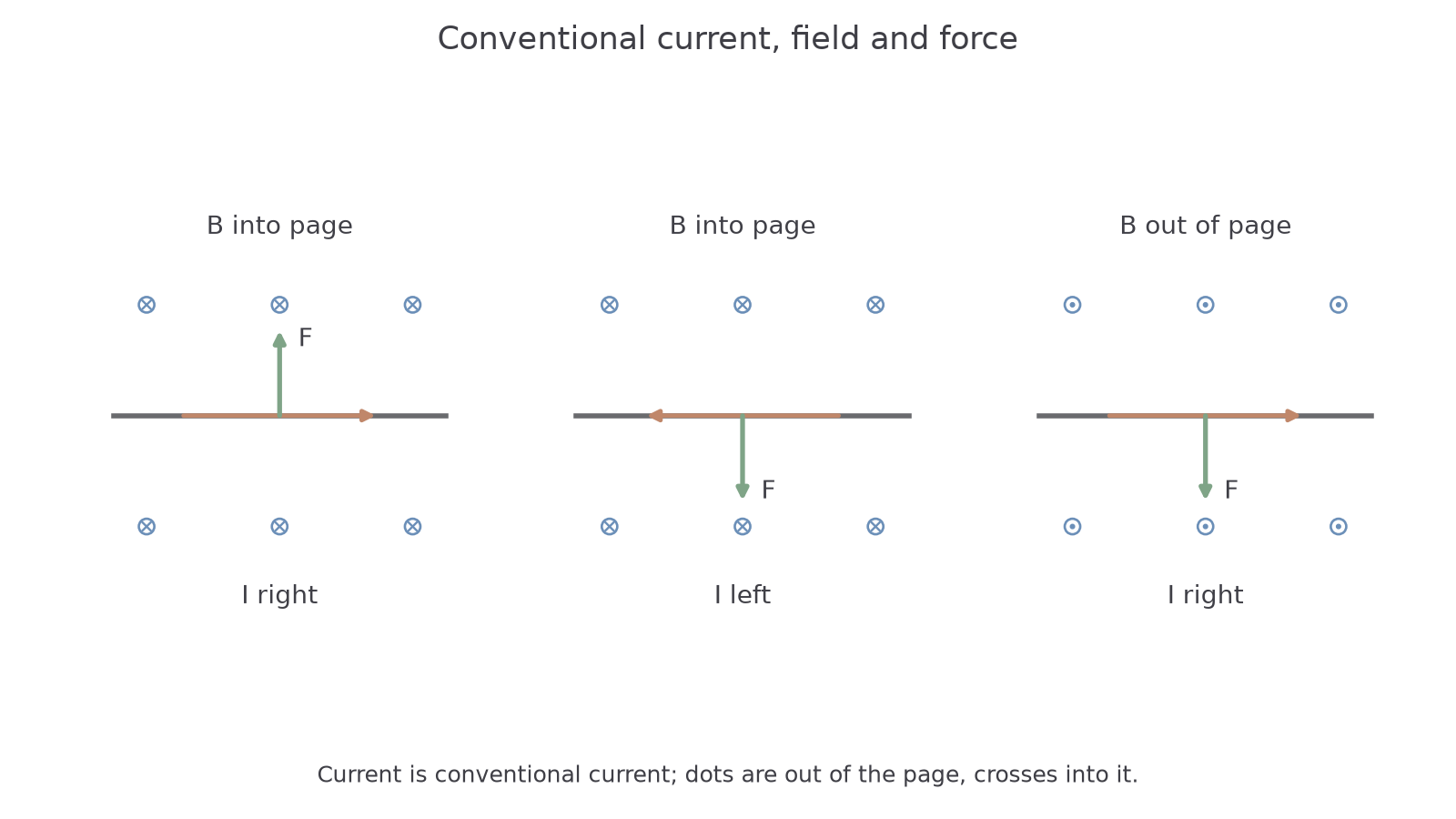
For example, point the first finger into the page and the second finger to the right. The thumb points upwards. Reverse only the current or only the field and the force reverses. Reverse both and the force retains its original direction.
In a metal, the electrons drift opposite to conventional current. Do not put electron velocity directly into the current finger. You can use the electron's actual velocity with a separate moving-charge force rule in the next lesson; mixing the two conventions reverses a correct answer.
Watch out
The field does not always exert a force on a current. For a straight wire exactly parallel or antiparallel to the field, the magnetic force is zero. “There is a current and a field” is not enough to establish a force.
A magnetic force on a conducting section does not automatically make it accelerate. Weight, supports or tension may balance it. First determine the magnetic force, then include the other actual forces in the resultant.
Measuring magnetic flux density by force
A field map shows where the field points, but line spacing alone does not provide a calibrated strength. Measure the force on a known current over a known perpendicular length instead. This defines magnetic flux density, symbol .
Magnetic flux density
Magnetic flux density is the force per unit current per unit length on a straight wire placed at right angles to the magnetic field.
The right-angle condition is essential. A wire parallel to a strong field has zero force, so an unrestricted force-per-current-per-length ratio would give a false field measurement.
Perpendicular conductor force
is magnetic force in newtons, magnetic flux density in teslas, current in amperes and the straight wire length within the field in metres. The field is uniform over that length and the wire is perpendicular to it.
Not on the data sheet: learn it.
One tesla is the magnetic flux density that gives a force of one newton on a one-metre wire carrying one ampere perpendicular to the field. Therefore
The length is the portion actually in the field, not the total length of connecting wire back to the power supply. For a uniform field, doubling that active length or the current doubles the force. Changing the wire's resistance while keeping the current unchanged does not itself change this force.
Worked example 1: calibrating a field
Question. A straight section of wire lies perpendicular to a uniform magnetic field. With current , its magnetic force is . Determine the magnetic flux density.
Plan. Convert the active length into metres and divide force by current times length.
Answer. .
Check. is a tesla. Using 80 without converting millimetres would make the inferred field a thousand times too small.
If you measure several forces at different currents while holding the active length and orientation fixed, a graph of against should be a straight line through the origin. Its gradient is , so dividing the gradient by the known active length determines . A nonzero intercept suggests an offset force or a zero error rather than an extra part of the magnetic force.
Continue this lesson.
You’re previewing NovaLearn without an account. Create a free account to read the rest.
Create free account