24.2 - X-ray production and attenuation
Explain electron-bombardment X-ray production and its spectrum. Calculate the shortest wavelength from the tube p.d., and use exponential attenuation and logarithmic data to describe transmission through matter.
Fast electrons transfer energy at a metal target
Why does an X-ray tube produce a whole range of wavelengths, but none shorter than one sharp limit? Its electrons can transfer different amounts of energy to individual photons, but a photon cannot take more energy than an incoming electron has available.
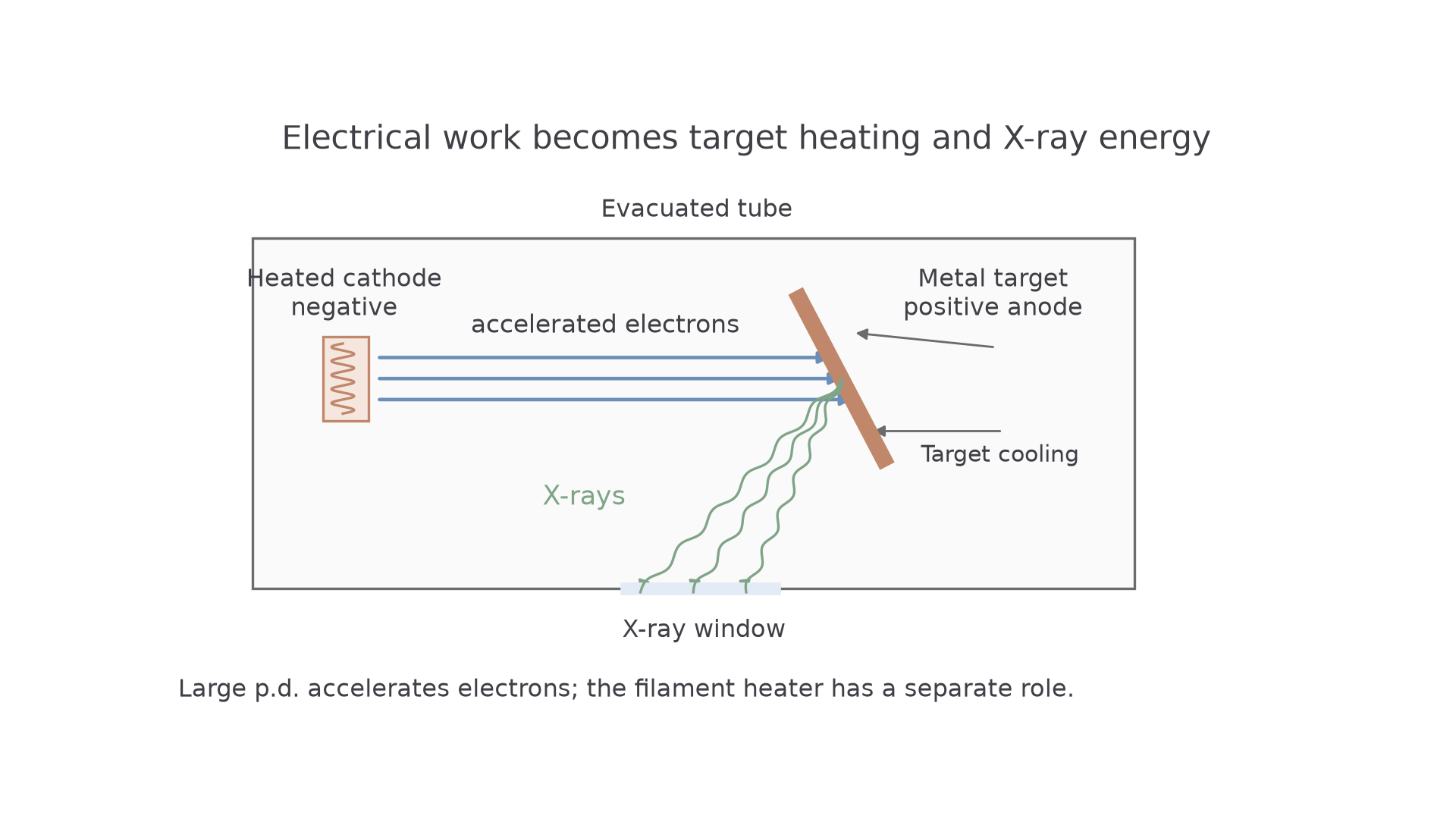
A heated cathode releases electrons by thermionic emission. A large accelerating p.d. between the negative cathode and positive anode transfers electrical energy to these electrons. The evacuated tube lets them reach the metal target without repeated collisions with gas particles.
When fast electrons are decelerated in the target, some of their kinetic energy becomes energy of X-ray photons. Different encounters transfer different fractions to a photon, so the emitted radiation includes a continuous spectrum. Much of the electron energy instead becomes internal energy of the target, which needs cooling. It is not the target's temperature that fixes the maximum photon energy.
[DIAGRAM: asset_name: The working parts of an X-ray tube; asset_slug: x-ray-tube; caption: Electrons accelerate towards the positive metal target and X-rays leave through a window; description: An evacuated enclosure contains a heated negative cathode on the left and a positive sloping metal target on the right. Electron arrows run from cathode to target. Wavy arrows show X-rays leaving from the impact region through a lower window. Heating, accelerating p.d. and target cooling are labelled separately.]
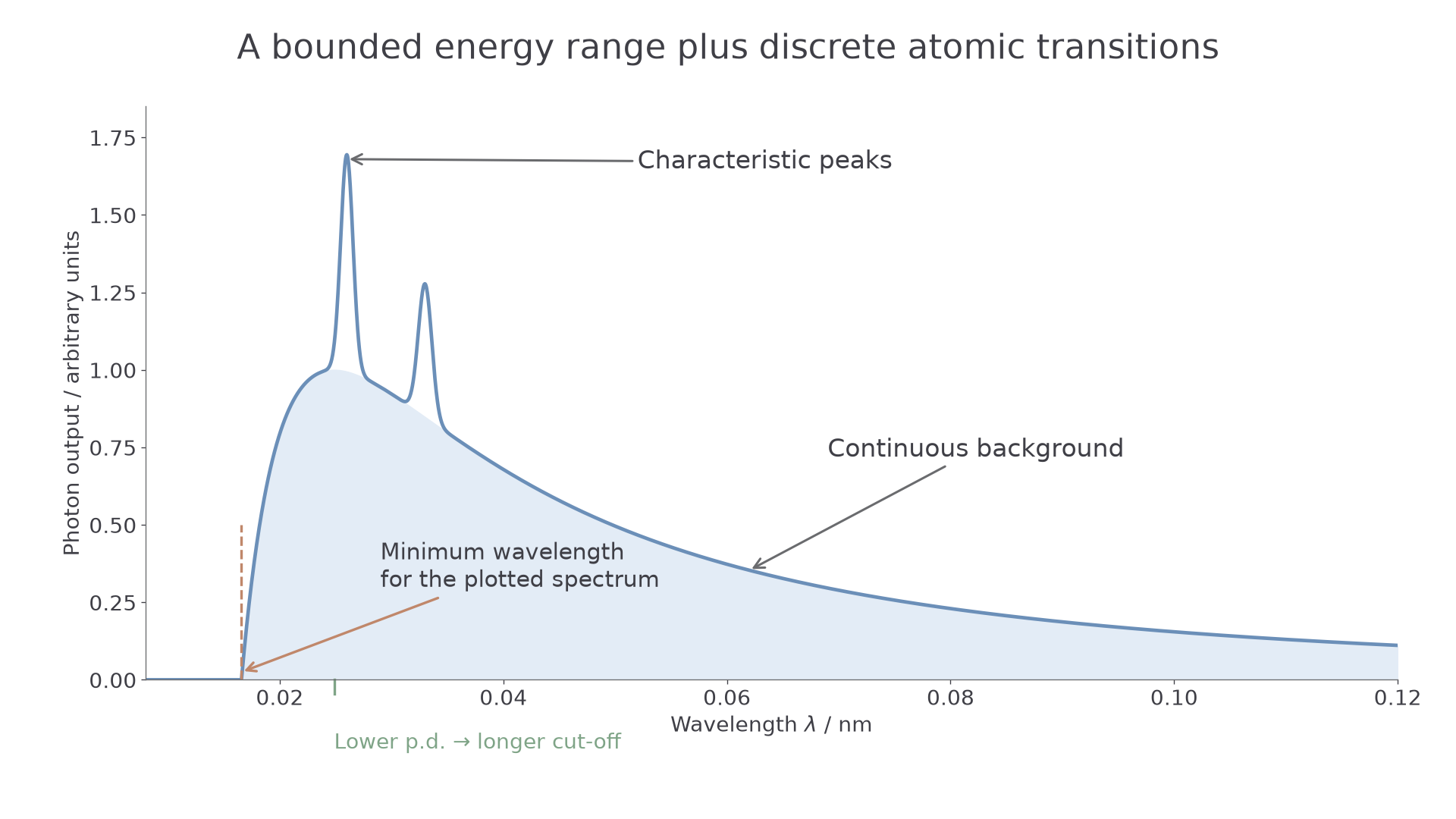
Sharp characteristic lines may be superposed on the continuous spectrum. An incoming electron can remove an inner-shell electron from a target atom. An electron from a higher energy level fills the vacancy, emitting a photon with energy equal to the level difference. Discrete energy differences give discrete photon energies, characteristic of the target material. These are electronic transitions, not gamma rays from a nuclear transition.
Watch out
The continuous background does not require incoming electrons with a wide range of initial kinetic energies. Even electrons accelerated through the same p.d. can transfer different fractions of their energy to X-ray photons.
Increasing filament heating can increase electron current and hence the rate of X-ray production. At unchanged accelerating p.d., it does not increase the maximum energy available from each electron. Changing the target changes its characteristic lines; changing the accelerating p.d. changes the continuous-spectrum cut-off.
The tube p.d. sets the shortest wavelength
The largest possible energy transfer occurs if all of one electron's acquired kinetic energy becomes the energy of one photon. A shorter wavelength would need more energy than that electron has.
An electron accelerated from negligible initial kinetic energy through p.d. gains energy . A photon has energy . Equating these at the maximum photon energy gives the short-wavelength limit.
X-ray cut-off wavelength
Here is elementary-charge magnitude in , is accelerating p.d. in , is the Planck constant in , is light speed in , and is in . This is the ideal maximum-energy transfer from one electron, with negligible initial kinetic energy and negligible target recoil energy. Most emitted photons have less energy and longer wavelength.
Not on the data sheet: learn it.
The constants are on the data sheet, but this relationship is not. The energy gain remains valid even when a classical calculation would no longer accurately describe the electron's speed.
[DIAGRAM: asset_name: Continuous X-ray background and characteristic lines; asset_slug: x-ray-spectrum; caption: The continuous spectrum has a minimum wavelength and may carry target-specific peaks; description: A qualitative photon-output-versus-wavelength graph is zero below the marked minimum wavelength, rises into a broad continuous background and then falls. Two narrow characteristic peaks sit at longer wavelengths. A second lower-p.d. cut-off is marked to the right to show that reducing p.d. lengthens the minimum wavelength. The vertical axis has arbitrary units and is not a calibrated spectral formula.]
Worked example 1: a tube-energy limit
Question. A tube accelerates electrons through . Find the maximum photon energy and minimum wavelength. Use , , and .
Answer. The maximum energy is , or , and the minimum wavelength is about .
Check. This wavelength is , not . Doubling the tube p.d. would halve the cut-off wavelength.
Continue this lesson.
You’re previewing NovaLearn without an account. Create a free account to read the rest.
Create free account