12.2 - Centripetal acceleration and force
Explain acceleration at constant speed, calculate the inward acceleration of circular motion, and identify the real forces whose resultant provides it. Build radial force equations without adding a separate, invented centripetal force.
A changing direction means acceleration
Can a ball on a string accelerate while its speed stays exactly the same? Yes. As it goes around a circle, its velocity points along a continually changing tangent. Acceleration responds to that change of velocity, not just to speeding up or slowing down.
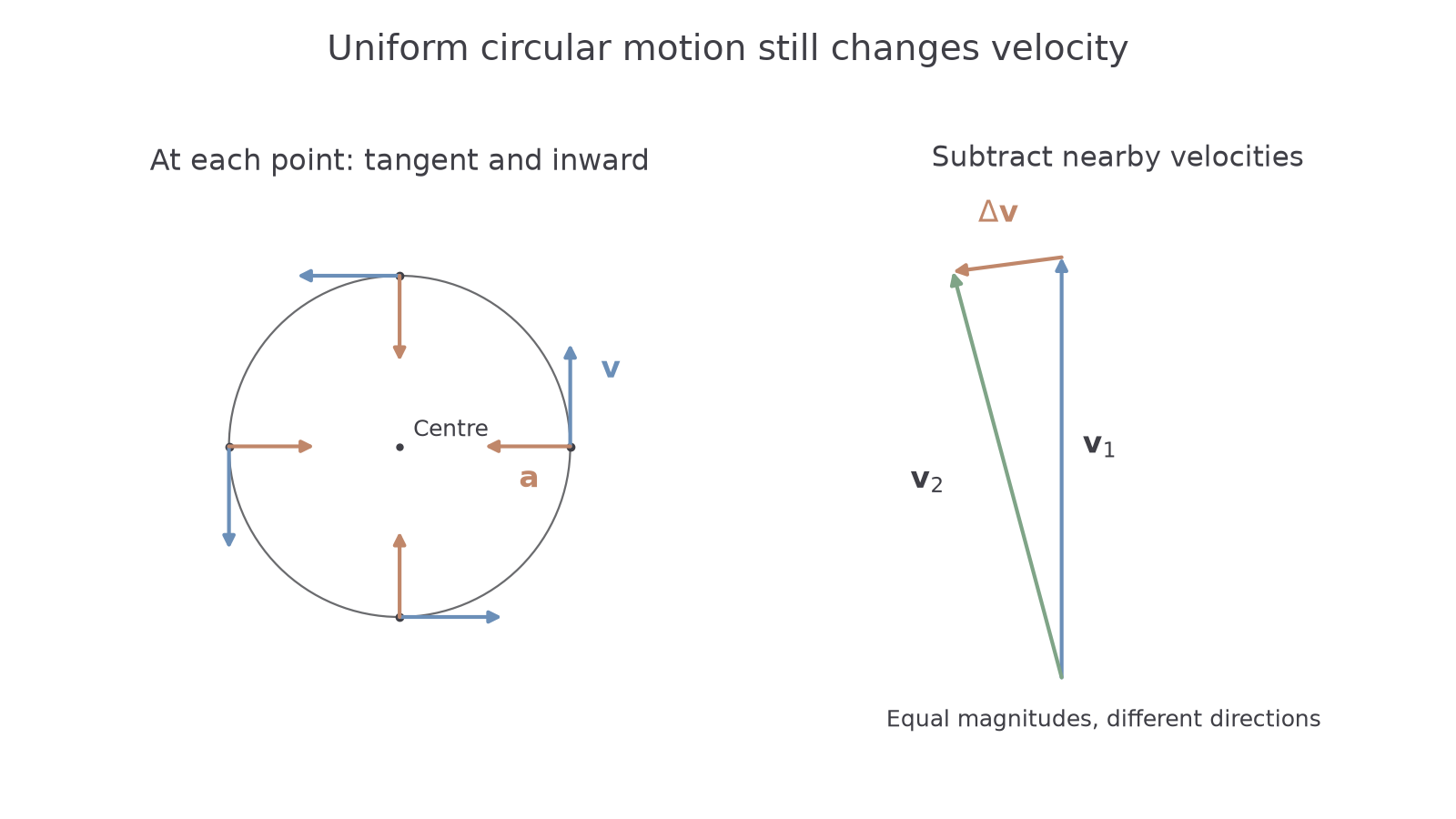
At two nearby points on a circular path, the velocity arrows have the same length but different directions. Subtract the initial velocity from the final velocity. The small change points towards the inside of the turn. In the limit of a very short time interval, acceleration points directly towards the centre.
[DIAGRAM: asset_name: Velocity turns while acceleration points inward; asset_slug: circular-velocity-acceleration; caption: Tangential velocity and inward acceleration are perpendicular at each point; description: A circular path has four marked positions. Equal-length blue velocity arrows are tangents in the anticlockwise direction and equal-length clay acceleration arrows start at each position and point towards the centre. A separate small vector triangle compares two nearby equal-magnitude velocities and their inward change.]
Centripetal acceleration
Centripetal acceleration is acceleration directed towards the centre of a circular path. In uniform circular motion its magnitude is constant, while its direction changes continuously.
A force always perpendicular to velocity changes its direction rather than its magnitude. The force does no work in the instantaneous direction of motion, so it does not change kinetic energy. A constant-magnitude inward resultant therefore gives circular motion at constant speed and constant angular speed when the radius is fixed.
This is a real acceleration. A person in a turning car may feel as though they are being thrown outwards, but their body would continue along a straight tangent without an inward interaction from the seat or restraints. In an inertial frame, an extra outward force is not needed to explain that tendency.
You already know
Newton's first law describes straight-line motion at constant velocity when resultant force is zero. Constant speed along a curved path is different: the velocity direction changes, so a resultant force is required.
If the string breaks, the ball initially continues along the tangent at the breaking point. It does not immediately move along the outward radius. Other forces, such as gravity, can then change its subsequent path.
Calculating the inward acceleration
A faster object must change its velocity more rapidly to follow the same circle. A larger circle is a gentler turn at the same speed. Those two physical comparisons are captured by the centripetal-acceleration equation.
For a very small angular turn , the velocity vectors turn through the same angle as the radius. Their vector difference has magnitude approximately , with in radians. Divide by the short time interval: . Since , this becomes either or .
Centripetal acceleration
Here is inward acceleration magnitude in , is tangential speed in , is radius in , and is angular speed in . The acceleration vector points towards the centre. For uniform circular motion these magnitudes are constant.
Not on the data sheet: learn it.
Worked example 1: a gentle circular turn
Question. A point moves at around a circle of radius . Calculate its acceleration.
Plan. Use the given linear speed and radius.
Answer. , towards the centre.
Check. The unit is , not a force unit.
At fixed radius, doubling speed quadruples acceleration. At fixed speed, doubling radius halves acceleration. However, at fixed angular speed, increases with radius. These statements are consistent because fixing makes increase with .
Continue this lesson.
You’re previewing NovaLearn without an account. Create a free account to read the rest.
Create free account