1.4 - Resolving vectors
Represent a vector by signed perpendicular components, reconstruct a resultant from components, and use Pythagoras in two and three dimensions. Choose trigonometric functions from the geometry and state directions without losing a minus sign.
Perpendicular components and signs
Can a force of magnitude have components of and , even though six plus eight is fourteen? Yes: the components act in perpendicular directions, so their magnitudes do not add as ordinary numbers. Together they represent the original vector.
To resolve a vector, replace it by components along chosen directions. Usually you choose two perpendicular axes, such as east and north, or horizontal and vertical. A component is a projection of the vector along one axis. The components are an alternative description of the same vector, rather than additional forces acting alongside it.
[DIAGRAM: asset_name: One vector and its components; asset_slug: perpendicular-vector-components; caption: The components form a right-angled triangle whose hypotenuse is the original vector; description: A clay vector from the origin to the point 6,8 has magnitude 10 newtons. Blue horizontal and sage vertical projection arrows have magnitudes 6 and 8 newtons. Dashed projection lines and a right-angle marker show the triangle; theta is the angle from the positive horizontal axis to the vector. A note says the components replace the vector.]
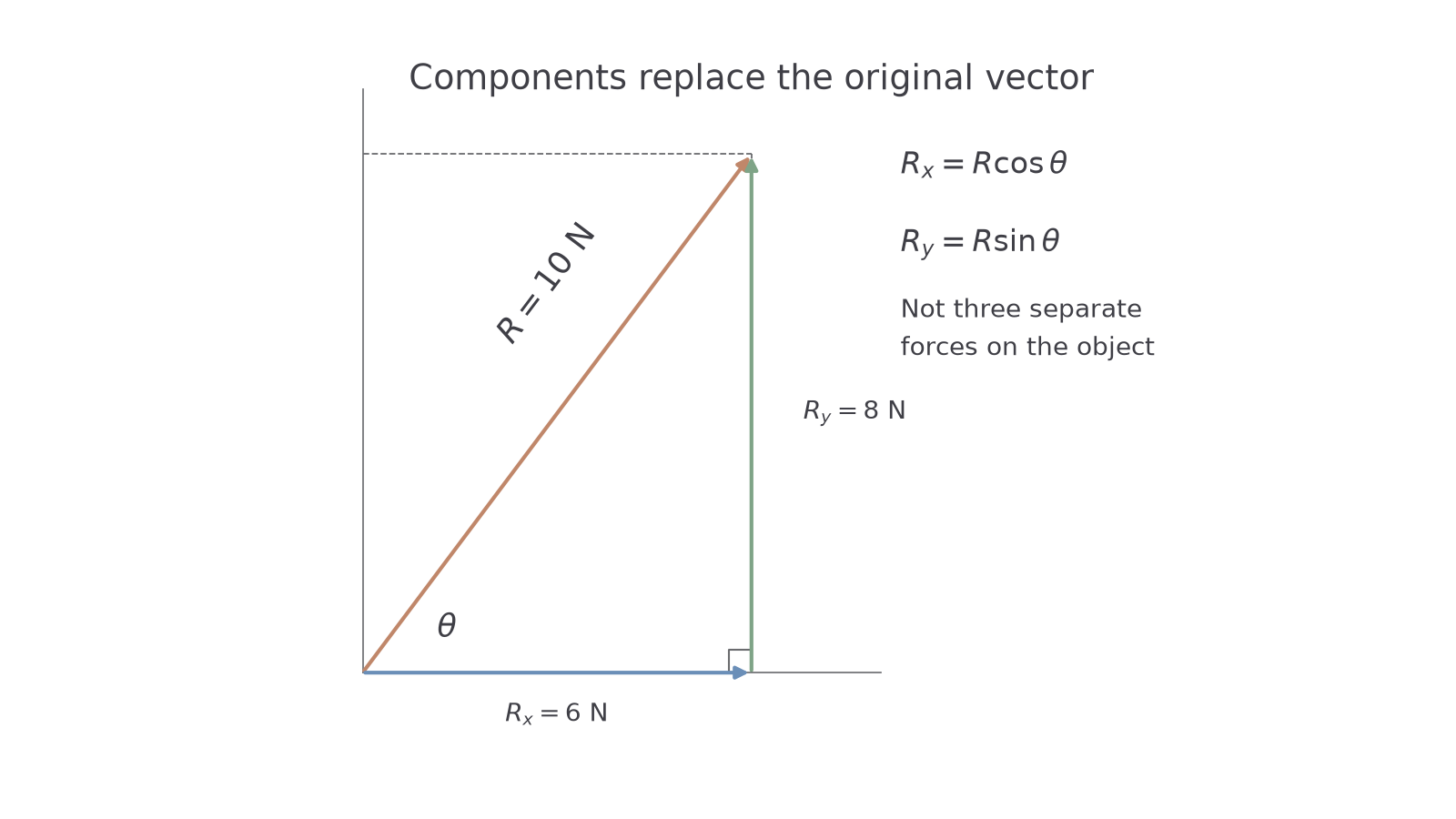
The original vector is the hypotenuse of the component triangle. For a right-angled triangle,
Dividing the sine ratio by the cosine ratio cancels the hypotenuse and gives . Use sine, cosine and tangent to find sides; use their inverse functions to find an angle. Check that your calculator is in degrees when angles are given in degrees.
Resolving along perpendicular axes
For a vector of magnitude making angle anticlockwise from the positive x-direction,
The vector and its components all have the same unit, such as for force or for velocity. Components are signed: positive or negative identifies the chosen axis direction. The two axes must be perpendicular.
Not on the data sheet: learn it.
Do not memorise “horizontal is always cosine”. Cosine belongs to the side adjacent to the angle you have been given. If that angle is measured from the vertical, the vertical component is adjacent instead.
Worked example 1: an angle from the horizontal
Question. A force of acts at above the positive horizontal direction. Determine its horizontal and vertical components.
Plan. The horizontal side is adjacent to the given angle; the vertical side is opposite.
Answer. About horizontally to the right and upwards.
Check. Both components are smaller than the original magnitude. The direction is closer to horizontal, so its horizontal component is larger.
Changing the reference direction changes which side is adjacent.
Worked example 2: an angle from the vertical
Question. A displacement of is directed east of north. Determine its eastward and northward components.
Plan. North is adjacent to the angle; east is opposite.
Answer. east and north.
Check. As the angle tends to zero, the eastward component should tend to zero while the northward component tends to . These expressions do exactly that.
Choose signs before calculating. With east and north positive, a north-west vector has a negative east component and positive north component. You can use a full angle measured from positive east, or calculate positive triangle lengths and assign their directions afterwards. Either method is valid when the signs remain consistent.
Resultants from signed components
Several vectors can be awkward to join into one triangle. Resolving them gives you a simpler problem: add all components along one axis, then all components along the other axis. Each axis behaves like its own signed number line.
For forces on the same object in this translational calculation,
All terms here are force components in newtons. The same vector addition works for compatible displacements or velocities. Do not add the magnitudes first and then try to attach a direction.
Reconstructing a vector
Here is the non-negative magnitude and are signed perpendicular components in the same unit. The acute angle is measured from the horizontal axis in the relevant quadrant. Use the signs of both components to state the actual direction. If one component is zero, determine the direction directly from the other.
Not on the data sheet: learn it.
Pythagoras applies to the perpendicular resultant components even when the original vectors were not perpendicular. That is the advantage of resolving first.
Worked example 3: three perpendicular-direction forces
Question. Three forces on an object are east, north and west. Determine the resultant.
Plan. Combine east-west forces with signs, then combine the remaining perpendicular components.
Answer. About at north of east.
Check. The north component is larger than the east component, so the direction must be more than north of east.
An oblique force needs resolving before the component sums.
Exam-style example: a resultant in the north-west quadrant
Question. In a horizontal plane, one force is at north of east. A second force of acts west. Determine the resultant.
Plan. Resolve the oblique force, add the westward force with a negative east component, then reconstruct.
Answer. About at north of west, or west of north. Intermediate values have been retained at full precision for the final rounding.
Check. A negative east component means west, not a negative resultant magnitude. The large northward component places the vector close to north.
Watch out
An inverse tangent alone does not identify the quadrant. A calculator may return a negative angle for a negative ratio even when your vector points north-west. Sketch the signs first, then state a direction that matches the sketch.
A component may be larger than another component, but neither magnitude exceeds the original vector's magnitude. Two perpendicular components of and reconstruct to , answering the opening puzzle.
Distances in three dimensions
Pythagoras is not confined to a flat page. A direct path across a room can involve perpendicular changes east-west, north-south and vertically. Find a floor diagonal first, then treat that diagonal and the height change as another right-angled triangle.
Suppose perpendicular coordinate changes are , all in metres. The horizontal diagonal is . The full straight-line displacement has magnitude
This relation is not on the data sheet: learn it. It applies to three mutually perpendicular directions in ordinary Euclidean geometry. It finds separation between endpoints, rather than the length of an arbitrary route travelled between them.
[DIAGRAM: asset_name: Pythagoras twice; asset_slug: three-dimensional-pythagoras; caption: The floor diagonal and height form a second right-angled triangle; description: A transparent rectangular room has perpendicular dimensions 4.0 metres, 3.0 metres and 2.4 metres. A blue floor diagonal is labelled 5.0 metres and a clay diagonal joins opposite lower and upper corners, labelled 5.55 metres. A small adjacent right triangle shows sides 5.0 and 2.4 and hypotenuse 5.55, with clear right-angle markers.]
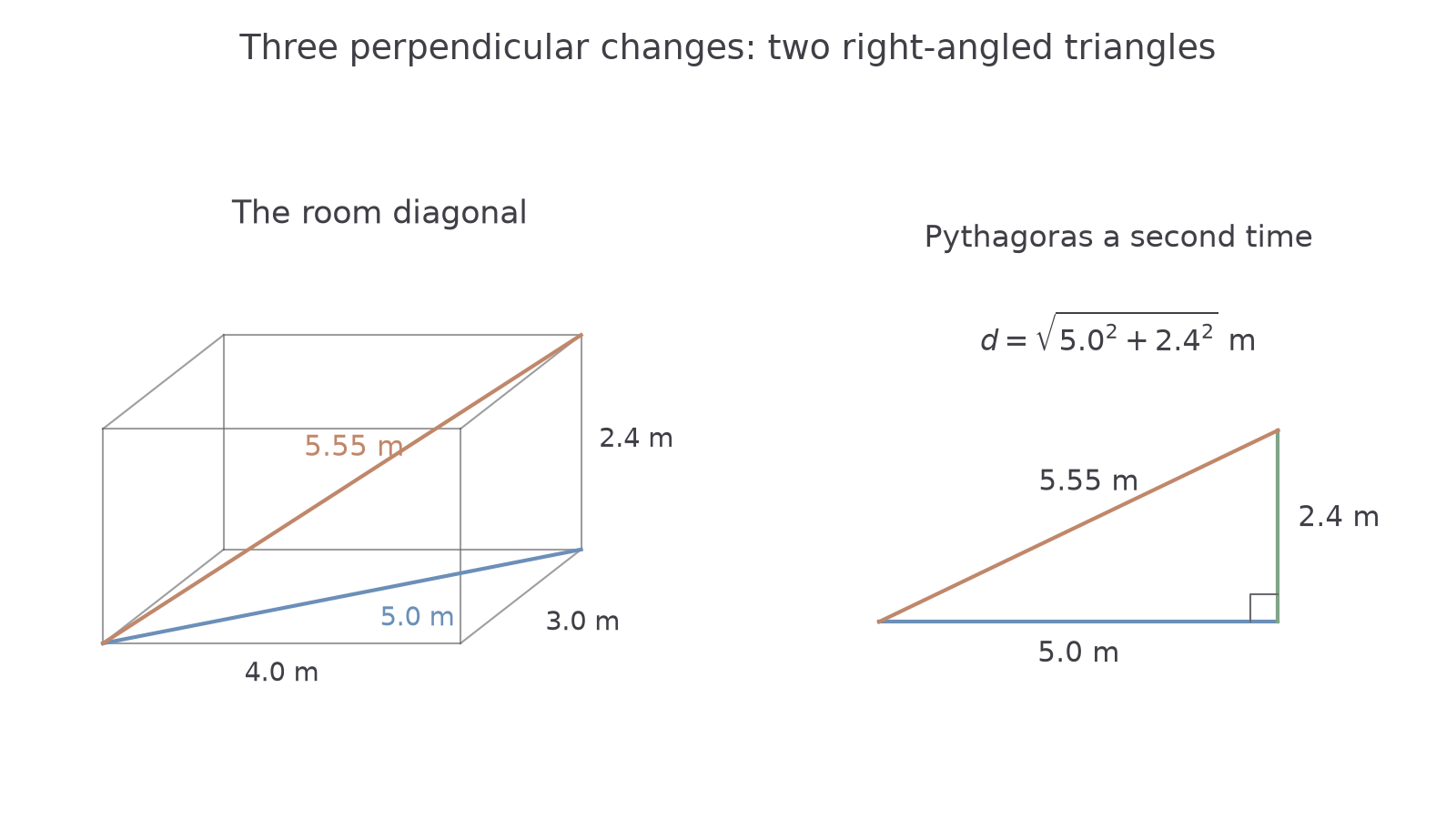
Worked example 4: the diagonal across a room
Question. A rectangular room is long, wide and high. Find the straight-line distance from one floor corner to the opposite ceiling corner.
Plan. Apply Pythagoras to the floor, then to the vertical triangle.
Answer. to two significant figures.
Check. The diagonal is longer than the floor diagonal, but shorter than walking that floor diagonal and then climbing .
When positions are given by coordinates, calculate the changes first. A point at coordinates and a point at differ by . Their separation is , about . Squaring the original coordinates would find distances from the origin, rather than the distance between the two points.
Similar triangles give a useful check on all these calculations. If every perpendicular component is multiplied by the same factor, all corresponding lengths, including the resultant, multiply by that factor and the direction stays the same. Scaling to therefore scales the resultant from 5 to 10 without changing its angle.
Key idea
Resolve along perpendicular axes, keep the component signs, and reconstruct using a right-angled triangle. In three dimensions, use Pythagoras twice; do not add component magnitudes to obtain a diagonal.
Try a separation with three non-zero components.
Quick Recap
- Resolve a vector into signed components along perpendicular directions.
- Use cosine for the side adjacent to the stated angle and sine for the opposite side.
- Add components along each axis, then reconstruct the resultant and check its quadrant.
- A three-dimensional diagonal has magnitude for perpendicular coordinate changes.
A force can have and perpendicular components because they combine by Pythagoras, not by adding their magnitudes.