25.1 - Luminosity, flux and standard candles
Distinguish a star's total radiated power from the radiation received per unit area, use inverse-square spreading, and explain how a known luminosity allows a galaxy's distance to be estimated.
Radiated power and received intensity
Two stars give us the same radiant flux intensity, yet one radiates 100 times more power. Can the more luminous star be farther away? Your detector measures what reaches its small collecting area, rather than everything that leaves the star.
A star's luminosity, , is the total power of radiation it emits. It is measured in W and includes radiation across the whole electromagnetic spectrum. Luminosity is a property of the source; moving your detector farther away does not reduce that emitted power.
The radiant flux intensity, , at the detector is the radiation power received per unit area normal to the radiation's direction. Its unit is . A faint received signal could mean a low-luminosity star, a large distance, or absorption along the path. Flux alone does not distinguish these possibilities.
You already know
Intensity is power per unit area. For an isotropic source, radiation spreads equally in all directions, so the same total power crosses larger spherical surfaces farther from the source.
Imagine a sphere of radius centred on the star. If radiation is not absorbed on its way out, all the luminosity crosses the sphere, whose area is . Dividing the power by that area gives the inverse-square law.
Luminosity and radiant flux intensity
is radiant flux intensity in , is luminosity in W and is distance from the source centre in m. This model assumes isotropic emission, negligible absorption and a distance large compared with the source radius. Doubling distance spreads the same luminosity over four times the area, reducing flux to one quarter.
Not on the data sheet: learn it.
[DIAGRAM: asset_name: Radiation spreads over a growing spherical area; asset_slug: cosmology-inverse-square; caption: Doubling distance gives four times the spherical area and one quarter of the radiant flux intensity; description: A source is surrounded by two schematic spherical surfaces at distances d and 2d, labelled areas 4 pi d squared and 16 pi d squared. An adjacent graph has dimensionless distance d divided by a reference distance on the horizontal axis and flux F divided by its reference value on the vertical axis. It passes through 1 and 1, 2 and one quarter, and 3 and one ninth. Radiation spreading is isotropic, with no absorption.]
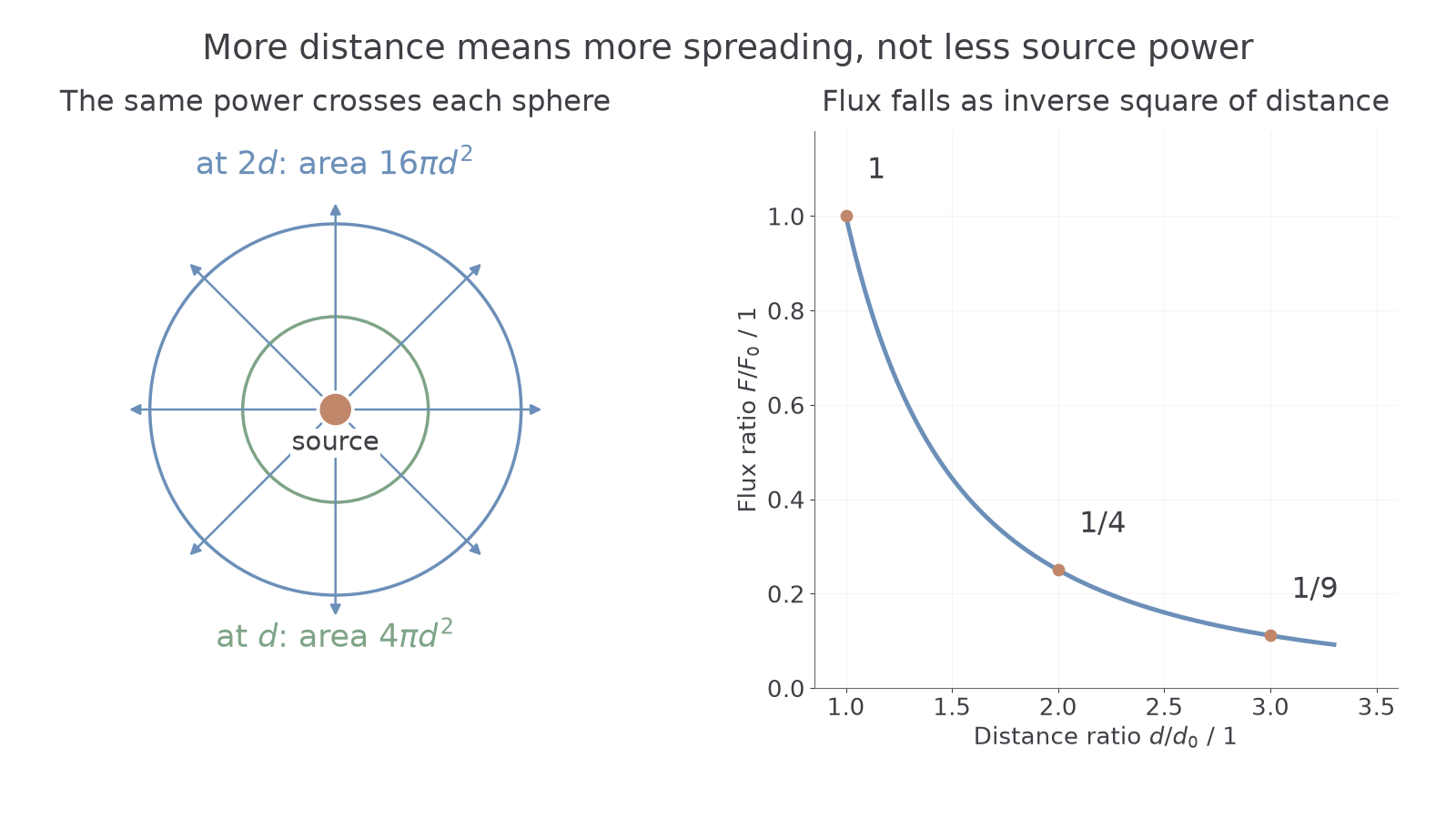
A graph of against is a falling curve, not a straight line. Plotting against instead gives a straight line through the origin for this model, with gradient . The changed horizontal variable is what makes the graph straight.
Worked example 1: flux from a known luminosity
Question. A star radiates isotropically. Calculate the radiant flux intensity at distance , neglecting absorption.
Plan. Divide the luminosity by the area of the sphere at the detector's distance.
Answer. (2 s.f.).
Check. Multiplying this flux by the spherical area restores the total radiated power. A detector of small area receives only a small fraction of that power.
Keep source power and received power per area separate in a fresh comparison.
A source with a known luminosity
A received flux does not normally tell you distance because luminosity is also unknown. A standard candle removes that ambiguity: it is an astronomical object whose luminosity is known.
Standard candle
A standard candle is an astronomical object of known luminosity.
“Standard” does not mean that all stars have the same luminosity. It means that an appropriate calibration gives the luminosity of the chosen object. The particular way that calibration is obtained is not needed for the distance calculations here.
Measure the candle's radiant flux intensity at Earth and use its known luminosity to rearrange the spreading relation:
These expressions are rearrangements of the inverse-square law, rather than additional data-sheet formulae. The ratio has units of area; the square root turns it into a distance. At a fixed measured flux, a larger known luminosity means a greater inferred distance.
Worked example 2: finding distance
Question. A standard candle has luminosity . Its radiant flux intensity at Earth is . Estimate its distance, assuming isotropic emission and negligible absorption.
Plan. The luminosity is known, so solve the inverse-square relation for distance.
Answer. (2 s.f.).
Check. The square-root argument has units . Forgetting the square root would leave both the unit and the physical distance wrong.
Continue this lesson.
You’re previewing NovaLearn without an account. Create a free account to read the rest.
Create free account