16.1 - Internal energy and changes of state
Describe internal energy in terms of random molecular kinetic and potential energies, connect temperature changes with that energy, and explain why a phase change can increase internal energy without increasing temperature.
Microscopic energy and the state of a system
Can a sample gain internal energy without becoming hotter? Melting and boiling show that it can. Temperature tells only part of the microscopic story, because molecules have potential energies as well as kinetic energies.
A system is the matter you choose to study. Its internal energy is associated with the microscopic motion and interactions of its particles. The particles have a distribution of energies; they do not all share one speed or one kinetic energy.
Internal energy
Internal energy is the sum of the random kinetic and potential energies associated with the molecules of a system.
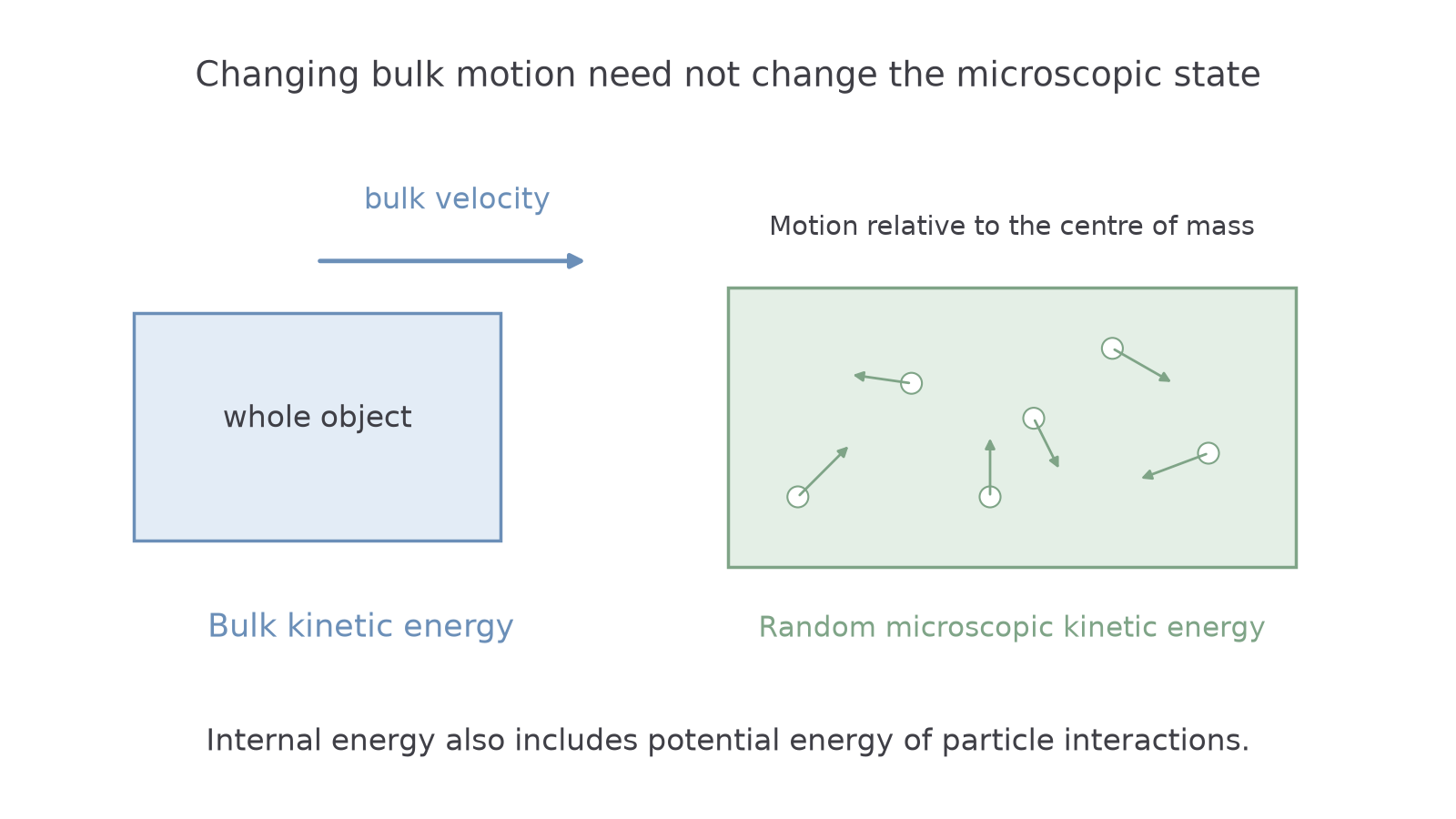
Random kinetic energy includes motion such as molecular translation and, where the molecule's structure allows it, rotation and vibration. Molecular potential energy is associated with interactions and arrangements of particles. Intermolecular attractions matter in liquids and solids even when they can be neglected in the ideal-gas model.
The coherent motion of the whole object is different. Carrying a book faster increases its bulk kinetic energy; lifting it increases the gravitational potential energy of the Earth–book system. Neither necessarily increases the book's internal energy if its microscopic state is unchanged. Friction during those actions could increase internal energy, but that would be an additional physical process.
[DIAGRAM: asset_name: Bulk motion and random microscopic motion; asset_slug: thermal-internal-bulk; caption: The motion of an entire object is distinct from the random molecular motion counted in internal energy; description: One panel shows a whole object moving to the right with a single large velocity arrow. A magnified view shows particle velocity arrows pointing in different directions relative to the object's centre of mass. Separate labels identify bulk kinetic energy and random microscopic kinetic energy, while a note adds potential energy of particle interactions to internal energy.]
Internal energy is determined by the system's state. If a fixed system reaches the same equilibrium state by two different routes, its final internal energy is the same. The routes may involve different heating and work transfers; those describe how energy crosses the boundary, rather than a memory stored in the final state.
Watch out
A body has internal energy; “heat” describes energy transferred because of a temperature difference. Do not describe internal energy as a quantity of heat trapped inside the body.
Try explaining both the microscopic and the whole-object accounts.
Temperature changes and internal energy
Within a single phase, raising the temperature of a fixed sample increases its internal energy. The microscopic motion becomes more energetic. For an ideal gas, you have a precise measure of the mean translational kinetic energy per molecule: , with in kelvin.
Temperature is not total internal energy. A large sample can have more internal energy than a small sample at the same temperature because it contains more particles. Materials can also have different microscopic contributions, so temperature alone does not identify the internal energy of any arbitrary object.
For a monatomic ideal gas, the model is particularly simple. Ignore intermolecular potential energy and internal molecular structure, and choose the potential-energy reference as zero. Only the atoms' translational kinetic energies contribute to this thermal model, so summing over atoms gives
Here is internal energy in J, is atom count, is amount in mol, is Boltzmann constant and is the molar gas constant. The last equality uses and . This is a deduced result for the stated model, not a universal definition of internal energy or an additional general formula printed on the data sheet.
Worked example 1: a specified monatomic model
Question. A fixed sample of a monatomic ideal gas is heated from to . Calculate the increase in internal energy using . Use .
Plan. Use the temperature change, because the amount and model remain unchanged.
Answer. (2 s.f.).
Check. The initial model internal energy is . Raising temperature by 20% increases that energy by 20%. The question asks for , not for the final total .
A diatomic or more complex gas can also have rotational and vibrational energy. A real liquid or solid has important interaction energies as well. Do not multiply every gas's temperature by and call the result its full internal energy.
For a solid or liquid warmed without a phase change, a heat-capacity measurement can estimate the change. If , and the temperature rise is , the energy needed is . If energy losses and mechanical work are negligible, that is the internal-energy increase. Without those conditions, energy supplied and internal-energy increase need not be equal.
Continue this lesson.
You’re previewing NovaLearn without an account. Create a free account to read the rest.
Create free account