1.1, 1.2 - Quantities, units and estimates
Learn to communicate a measurement, recognise the SI base quantities used at AS Level, convert prefixes without losing powers of ten, and make estimates that catch impossible answers before they reach your calculator.
A measurement needs a unit
How can the speed of light define the length of a ruler? It sounds backwards: speed seems to need a length already. The trick is to agree a fixed value for light's speed, then use a very accurately measured time to define the metre.
Since 1983, the metre has been defined using the distance light travels in a vacuum. In today's SI definition, the speed of light is exactly . One metre is the distance light travels in of a second. You do not need to memorise that definition for this course. It shows why units are shared standards rather than labels attached after the physics is finished.
A physical quantity is a measurable property. To report a measurement, give a numerical magnitude and a unit. “The wire is 12 long” leaves you guessing. “The wire has length ” communicates something another person can reproduce.
Physical quantity
A physical quantity is expressed as a numerical magnitude and a unit. For example, in a length of , the numerical magnitude is 0.12 and the unit is the metre.
The same quantity can have different numerical magnitudes when its unit changes:
The wire has not shrunk. A metre is a larger unit than a centimetre, so fewer metres describe the same wire. This simple check will rescue you from many conversion errors.
A symbol for a quantity and a symbol for a unit do different jobs. In , represents the length and means metre. Units are upright; quantity symbols are usually italic. A number such as a count or a ratio may have the dimensionless unit 1, which is normally omitted. That does not make its physical meaning optional.
Watch out
A larger number does not necessarily mean a larger quantity. is shorter than , because . Compare quantities only after putting them in compatible units.
Try separating the measurement from the way it is written.
SI base quantities
A shared system of units lets measurements from different people fit together. The International System of Units, abbreviated SI, starts with base quantities treated as independent, then builds other units from them.
At AS Level, you must recall these five base quantities and their units:
| Base quantity | SI base unit | Unit symbol |
|---|---|---|
| Mass | kilogram | |
| Length | metre | |
| Time | second | |
| Electric current | ampere | |
| Thermodynamic temperature | kelvin |
These five are the required AS recall list, rather than the whole SI. You will meet amount of substance, measured in moles, in the A Level gas lessons. The full SI also includes luminous intensity.
A base unit is the unit of a base quantity. A derived unit combines base units. For example, speed compares a length with a time, so its SI unit is metres per second, . The negative power means “per second”; it does not mean a negative time. In the next lesson you will build more demanding derived units and use them to check equations.
Key idea
Mass is measured in kilograms; weight is a force measured in newtons. A balance reporting kilograms is reporting mass. The distinction becomes essential when you study gravitational forces.
Unit symbols are case-sensitive. is second; is ampere; is kelvin. Write kelvin without a degree sign. Leave a space between a numerical value and its unit, as in . A symbol is not pluralised: use , rather than “8 kgs”.
The kilogram has a historical quirk: its name already contains a prefix, yet it is the base unit of mass. Consequently, . When a later calculation uses SI units, a mass given in grams normally needs converting to kilograms.
Prefixes and powers of ten
Prefixes make very large and very small measurements readable. They change the size of the unit, so changing the prefix must change the numerical magnitude in the opposite direction.
Learn the prefixes in this table. They are not listed on the examination data sheet.
| Prefix | Symbol | Factor | Prefix | Symbol | Factor |
|---|---|---|---|---|---|
| pico | p | deci | d | ||
| nano | n | kilo | k | ||
| micro | mega | M | |||
| milli | m | giga | G | ||
| centi | c | tera | T |
The factor multiplies the unprefixed unit: one microsecond is . In standard form, write one non-zero digit before the decimal point, for example , rather than , when standard form is requested.
Worked example 1: a short time interval
Question. Express in seconds.
Plan. Replace the prefix by its power of ten, then put the result in standard form.
Answer. .
Check. A microsecond is much shorter than a second, so 470 microseconds should be much less than one second.
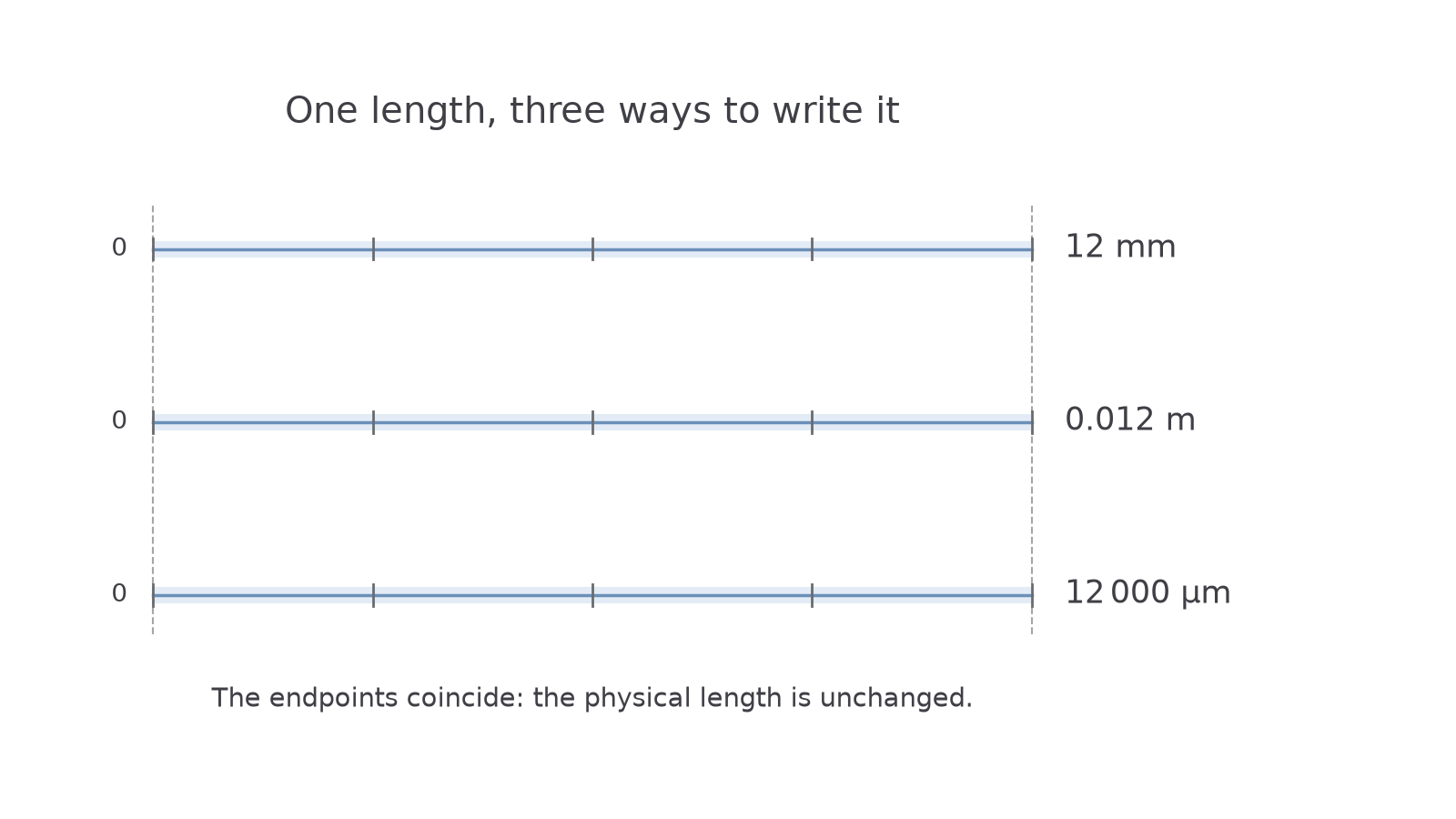
Here is the same length written three ways. The bar stays the same length in every panel; only the unit and numerical magnitude change.
[DIAGRAM: asset_name: One length in three units; asset_slug: same-length-three-units; caption: A larger unit needs a smaller numerical magnitude for the same length; description: Three identical horizontal bars run from zero to the same endpoint. The top bar is labelled 12 millimetres, the middle 0.012 metres and the bottom 12000 micrometres. Matching guide lines show that the endpoints coincide. The caption states that only the representation changes.]
A prefix attached to a squared or cubed unit is raised to that power too. A square millimetre is the area of a square whose side is one millimetre:
Likewise, . Do not just replace “milli” by and leave the power unaffected.
Exam-style example: a small cross-sectional area
Question. Express an area of in square metres.
Plan. Convert the unit square millimetre, then multiply by the numerical magnitude 5.6.
Answer. .
Check. The factor is a millionth. We square the unit conversion, not the number 5.6, because that number already gives an area.
The reverse conversion uses the same equality. To write in millimetres, divide by the size of one millimetre in metres: . The numerical magnitude grows because a millimetre is smaller than a metre.
Watch out
means milliampere, while means megaampere. Their unit sizes differ by a factor of . A capital letter can be a billion-fold change.
Now convert quantities with two different powers.
Reasonable estimates
An estimate is a reasoned approximate value. It uses a familiar scale, a simple model or a short calculation. It is much more useful than a random guess, even when its last digit is uncertain.
Build a few reference scales. A pen is of order long; a classroom door is of order high; an adult's mass is of order , meaning tens to hundreds of kilograms rather than grams or tonnes. These are rough scales, not universal measurements of every pen, door or person. An ordinary hand-held object's length is unlikely to be or .
Start with what you know, state your assumption, and check whether the result fits. If you need a thickness too small for a ruler to measure directly, measure a stack and divide. This also becomes a useful practical method later.
Worked example 2: the thickness of one sheet
Question. A stack of 250 sheets is approximately thick. Estimate one sheet's thickness, assuming the sheets have equal thickness and gaps are negligible.
Plan. Divide the stack thickness by its number of sheets.
Answer. About .
Check. Ten sheets would be about one millimetre thick, consistent with a visibly thin individual sheet. Compressible gaps would make this an overestimate of the paper thickness.
You can also estimate before calculating. If a cyclist travels about in , the speed is about . A calculator result of should trigger a unit check. An estimate catches powers-of-ten mistakes; it does not prove that your physical model or exact answer is correct.
Return to light and the ruler. Dividing one metre by the defined speed gives a travel time of about , or . That is why a tiny, well-defined time interval can set a familiar length. In ordinary exam calculations use the supplied rounded value ; the exact defining value is a different purpose, rather than a demand for nine significant figures in your answers.
Exam tip
For an estimate, choose a sensible scale and include the unit. Extra decimal places do not make a guess more convincing. If you calculate from an assumption, show what that assumption was.
Try an estimate with a different measured total.
Quick Recap
- A physical quantity needs a numerical magnitude and a unit; changing the unit changes the number, rather than the object.
- Recall mass/kg, length/m, time/s, current/A and thermodynamic temperature/K as the required AS base quantities and units.
- Replace prefixes by powers of ten; square or cube the conversion factor when converting an area or volume.
- Use familiar scales and explicit assumptions to make estimates and catch implausible answers.
Light defines the ruler's length because one metre is the distance light travels in a fixed fraction of a second: about .