17.3 - Damping, forced oscillations and resonance
Learn how resistance reduces oscillation energy, distinguish light, critical and heavy damping under comparable conditions, and explain how a periodic driving force can produce resonance. Read the graphs as physical changes in energy, amplitude and response rather than memorising curve names.
Resistance and decreasing amplitude
Why can small, well-timed pushes make a swing move much further than an occasional poorly timed shove? Energy transfer depends on the timing of the driving force, and energy is also being dissipated. First understand what happens when the pushes stop.
A real oscillator experiences resistive forces. A paddle attached to a spring-mounted mass, for example, pushes through air or a liquid as it moves. Resistance opposes its velocity, transferring mechanical energy from the oscillation to internal energy of the apparatus and surroundings. The total energy of everything is conserved, but the oscillator's mechanical energy decreases.
Damping
Damping is the effect of a resistive force that dissipates an oscillator's mechanical energy, causing the amplitude of free oscillations to decrease.
Do not confuse a resistive force with a restoring force. The restoring resultant acts towards equilibrium and exchanges kinetic and potential energy. A resistive force opposes motion and removes mechanical energy. At the same displacement on the outward and return journeys, the restoring force has the same direction but the resistive force reverses.
For light damping, the oscillator continues to cross equilibrium while successive amplitudes decrease. Its frequency is close to the undamped natural frequency, though not exactly equal in the usual linear-resistance model. Constant-amplitude SHM is therefore an approximation when the energy loss per cycle is small, not an exact description of a freely decaying oscillation.
Worked example 1: amplitude decay and energy
Question. A horizontal linear spring oscillator has successive positive turning-point amplitudes and . Determine the fraction of its mechanical energy remaining at the second turning point.
Plan. At each turning point the velocity is zero. For the same spring constant, mechanical energy relative to equilibrium is , so the ratio is the squared amplitude ratio.
Answer. remains; has been dissipated from the mechanical oscillation.
Check. Amplitude fell by , but energy fell by . Energy is proportional to amplitude squared, rather than amplitude.
A smooth exponential-looking envelope is common for weak resistance proportional to velocity. Not every kind of resistance gives exactly that envelope, so do not assume an exponential decay law from the word “damping” alone. The relevant syllabus skill is to connect resistance, energy loss and the decreasing oscillation amplitude.
Watch out
An undriven damped oscillator does not lose “force” a little each cycle. It loses mechanical energy. A driving force can replace that energy and maintain a steady amplitude despite damping.
Light, critical and heavy damping
Compare damping strengths only after fixing the other conditions. Use the same mass and restoring stiffness, release the mass from the same positive displacement with zero initial velocity, and apply no periodic driving force. Changing the release as well as the damping would make the curves harder to interpret.
[DIAGRAM: asset_name: Three damping regimes with the same release; asset_slug: oscillations-damping-regimes; caption: The same initial displacement and zero initial velocity allow a fair comparison; description: Three displacement-time curves for the same mass and restoring stiffness start at the same positive displacement with zero initial velocity. Light damping crosses equilibrium repeatedly with decreasing amplitude. Critical damping returns without oscillating and is faster than the heavy-damping curve for this release. Heavy damping approaches equilibrium more slowly without repeated crossings.]
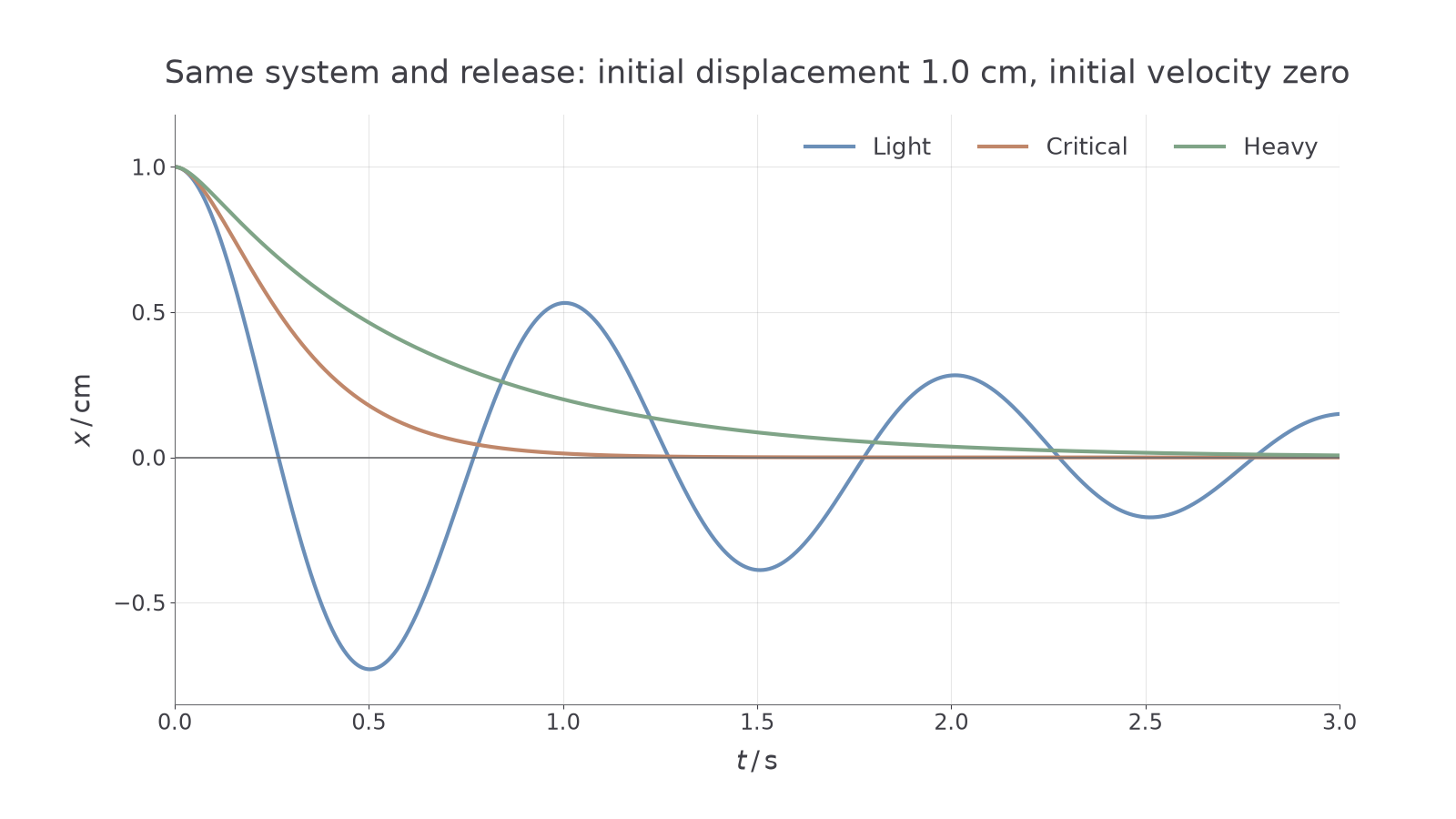
- Light damping: the mass oscillates about equilibrium with a decreasing amplitude.
- Critical damping: the resistance is just sufficient to prevent repeated oscillations. For the stated release, it gives the fastest return to equilibrium without oscillating.
- Heavy damping: the resistance is greater than the critical value. For the same release, the mass returns more slowly without oscillating.
These standard curves describe a linear restoring force with resistance proportional to velocity. At the instant of release, all have zero velocity, so this resistive force is initially zero. Their initial acceleration is determined by the same restoring force. As motion develops, the differing resistances produce the different responses. “Heavy damping” does not mean a very rapid wiggle that is difficult to see.
A measuring instrument's pointer should settle promptly without repeated swings around its reading. A response close to critical damping is useful for that purpose. Increasing damping without limit does not keep making it settle faster: beyond the critical value the return becomes slow. For a vehicle suspension, the useful damping depends on comfort and road contact as well as settling time; it is not a universal instruction to choose the same damping for every device.
Exam tip
State the common initial conditions when comparing sketches. In a qualitative curve, show whether equilibrium is crossed and how the amplitude or return changes with time; do not add a new driving force unless the question specifies one.
Continue this lesson.
You’re previewing NovaLearn without an account. Create a free account to read the rest.
Create free account